Every adventure has a story, and sometimes it’s better told than read.
READ the blog below, WATCH the adventure, or LISTEN to the podcast below!
Choose your adventure right here on NorthAmericanDarrell.com.
Episode 54: 91% went Quiet. IM STILL HERE! | Why I Refuse to Quit
Bus Ride! 🇬🇹 | Barbershop Adventures & Latin America fun! 🐔🚍
READ • WATCH • LISTEN!
HOW MUCH LONGER? HOW MUCH LONGER?
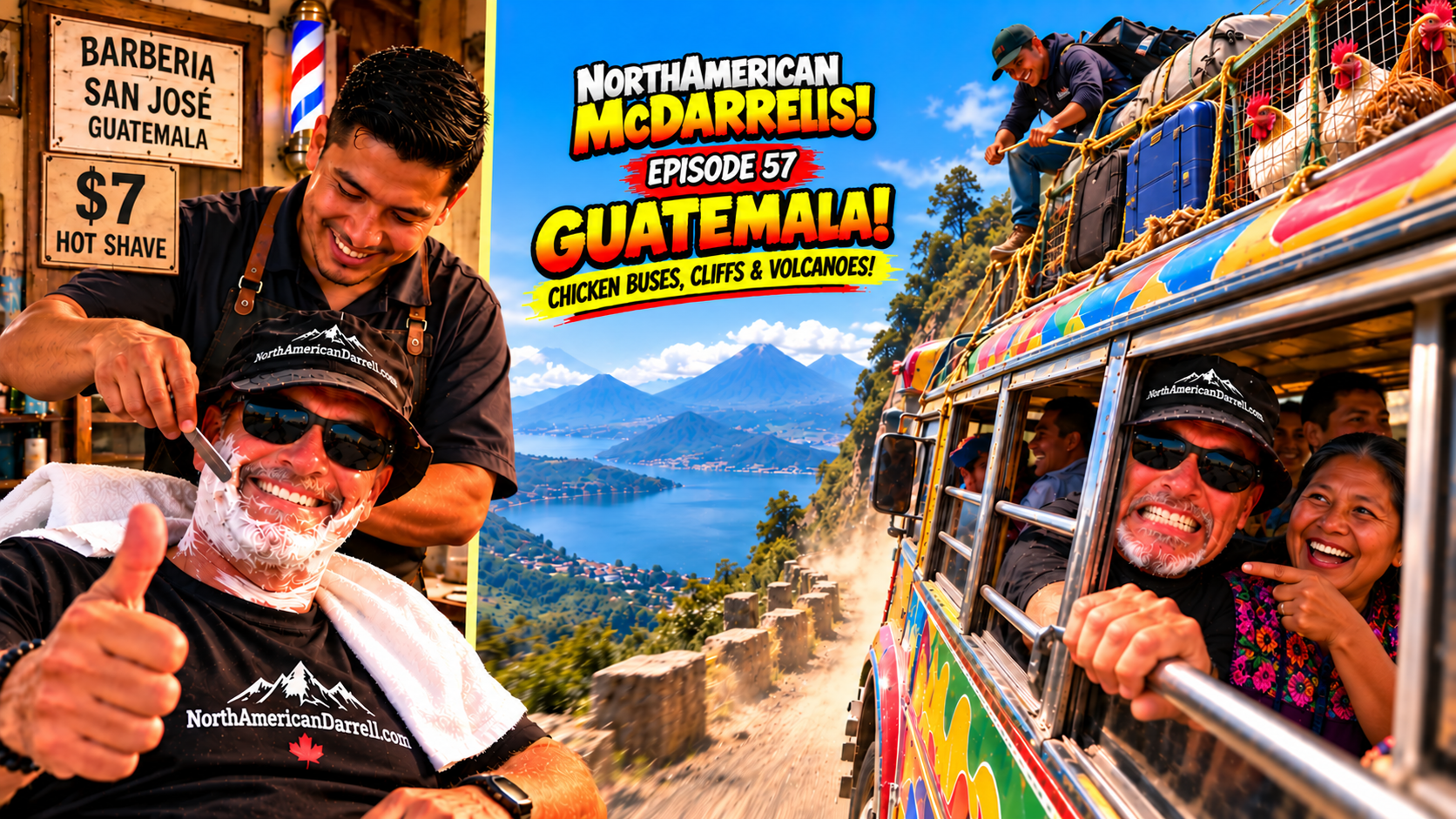
That’s what I kept asking the perfectly calm lady sitting next to me on a Guatemalan chicken bus.
The driver was drifting around mountain corners. There were cliffs outside the window. His helper was climbing over the front of the bus and onto the roof to deal with luggage as people boarded, then making his way toward the back.
And me? I was white-knuckling the handle like my life depended on it.
The locals weren’t frightened. They were entertained.
Apparently, I’d become the most interesting thing on the bus!
Welcome back to the NorthAmericanDarrell Podcast!
Today, Guatemala takes us from an unforgettable seven-dollar shave and an enormous McDonald’s courtyard to three chicken buses, volcanoes, and the longest few miles of my life.
But how did I get there?
With my favorite kind of travel planning: cheap flights and enough flexibility to let the adventure happen.
Apparently, I collect all-you-can-fly passes like other people collect refrigerator magnets.
I have the Frontier GoWild pass for eligible last-minute flights, and I have my VOLARIS all-you-can-fly pass.
VOLARIS, not Wizz Air. Wizz was the pass I used for adventures in Europe.
I picked up my Volaris pass for about half price, and my renewal has been around two hundred dollars a year. That’s my renewal price, not a promise of what you’d pay today.
You still pay airport taxes and fees, flights depend on available pass seats, and the booking windows reward flexibility.
International bookings generally open within three days of departure and domestic Mexican bookings within twenty-four hours.
I go deeper into the airline-pass strategy in Episode 17, so I won’t turn this into a sales presentation.
Here’s the part I love: I used Frontier to get from Phoenix to Los Angeles for around fifteen dollars, then Volaris to Guatemala for about sixty dollars in taxes and fees.
Of course, that doesn’t include what I’d already paid for the passes.
Now THAT is how you start an adventure!
I’d actually visited Guatemala twice.
On my first trip, I stayed in San José before continuing toward Costa Rica.
And one of my favorite memories from that visit wasn’t a landmark or a volcano.
It was a barber.
SEVEN DOLLARS for one of the best hot shaves of my entire life!
For the first time, I experienced actual steam during the shave.
The barber worked his magic, and when I got up, my face was as smooth as a baby’s butt.
Looking in the mirror, there might have been a family resemblance, too.
Seven dollars!
I’ve spent more than that on a Big Mac in North America!
Which is funny, because in Episode 55 I told you about my magnificent McDonald’s career: one shift, fourteen years old, and a kid who could sing the Big Mac jingle but couldn’t remember how to make the burger under pressure.
Fast-forward to Antigua, Guatemala, and I walked into one of the biggest, most beautiful McDonald’s restaurants I’ve ever personally visited.
From the street, you’d never guess what was inside: this enormous colonial-style courtyard, greenery, fountains, tables indoors and outdoors, and what looked to me like hundreds of places to sit.
A volcano in the distance.
I thought, THIS is a McDonald’s?
I’ve heard about the giant McDonald’s in Orlando that’s reported at around nineteen thousand square feet.
I couldn’t verify the area or official seat count in Antigua, and I’m not saying it beats the world’s biggest.
I’m saying the one I walked into was HUGE.
I usually stop at McDonald’s for coffee, but there I tried breakfast for under five dollars and a Big Mac meal for around six.
After my one-shift career, I can confidently say the employees in Antigua knew what they were doing better than I did!
Antigua itself was beautiful: cobblestone streets, colorful buildings, parks, churches, and volcanoes on the horizon.
I met a local who showed me around.
We visited a church more than two hundred years old, and I stood there thinking about all the people who’d passed through it before me.
And right alongside that history?
McDonald’s, Taco Bell, Burger King, and a Little Caesars that seemed to have a lineup every time I passed it.
I skipped those other chains.
The local Guatemalan food was too good, and the prices made it easy to eat well without spending a fortune.
Now, the sensible way to visit Lake Atitlán from Antigua might have been a comfortable shuttle.
Sensible wasn’t what I chose.
I chose the chicken bus.
If you’ve ever wondered what happened to those old North American school buses, some end up with a second career as brightly painted public buses in Central America.
In Guatemala they’re often called camionetas.
Visitors call them chicken buses, partly because people sometimes bring chickens and other goods along as cargo, and partly because passengers can be packed in tight.
I thought maybe I should order a McCHICKEN for the trip.
Then I looked at the roads and realized the chicken was ME.
I’d taken a chicken bus before, on a relatively straightforward road. No terrifying drop-offs. No reason to think anything would go wrong.
Lake Atitlán was a different story.
Getting from Antigua toward Panajachel involved THREE chicken buses for me.
The road distance is roughly fifty miles, give or take the route, but that tells you nothing about the experience.
You’re in the Guatemalan highlands, winding through mountains before descending toward a lake sitting about five thousand one hundred feet above sea level.
And suddenly the driver is coming into these corners FAST.
I’m talking curves that felt like he was DRIFTING the bus.
I could see the drop-offs.
In places, I couldn’t see much protecting us from the edge, either.
Meanwhile, the guy working alongside the driver was doing something that completely blew my mind.
As passengers got on with luggage, he was moving up over the front and climbing onto the roof, handling bags, then working his way toward the back of the bus.
ON THE ROOF!
I’m inside thinking, SHOULD SOMEBODY TELL HIM THIS THING IS MOVING?
The helper looked like he’d done it a thousand times.
The driver looked like he’d done those corners ten thousand times.
And I looked like I’d never left my house before.
I WAS CHICKEN-SHIT SCARED!
I was gripping the handle so hard my knuckles went white.
Beside me sat this calm lady, completely unfazed.
She looked like she was on a regular trip to the grocery store.
HOW MUCH LONGER?
Another corner.
HOW MUCH LONGER NOW?
I must have asked her over and over.
Nobody else seemed especially concerned.
In fact, I’m pretty sure my reaction was the entertainment for the locals for the entire ride.
Then I remember asking a guy whether anyone checked the brakes.
He didn’t speak English.
Which was not the answer I was hoping for.
The mountains really were spectacular, but every time I started to admire the scenery, the bus would take another bend and I’d remember how far down the valley was.
No seatbelt, no comforting answer about the brakes, and an entire bus full of people who were apparently watching the nervous Canadian put on a show.
THIS WASN’T JUST PUBLIC TRANSPORTATION. IT WAS MY UNPLANNED COMEDY TOUR!
And somehow, after all three buses, I arrived at Lake Atitlán.
What a reward.
Deep blue water in an ancient volcanic basin, with three magnificent volcanoes around the lake: San Pedro, Tolimán, and Atitlán.
It’s one of Central America’s deepest lakes, reaching roughly eleven hundred feet in places.
I stayed in Panajachel in an Airbnb that cost me around fifteen dollars a night.
After the bus ride, that room felt like a five-star resort—mainly because it wasn’t moving around a cliff!
And one of my favorite ways to explore was by water taxi.
Little boats called lanchas connect towns around the shore, including San Pedro La Laguna, San Marcos La Laguna, and Santa Cruz La Laguna.
Each place has its own atmosphere, and from the water the scenery just keeps getting better.
That’s the kind of slow travel I love: not rushing through attractions, but spending time in a place, using local transport, and finding out what everyday life looks like.
Although I’m happy to report the boats didn’t require me to ask whether anybody had checked the brakes.
That first Guatemala trip also led me onward toward Costa Rica.
And that’s where I’m taking you in our NEXT episode.
More Central America, another adventure, and the same question I always ask myself when I have an all-you-can-fly pass sitting there waiting:
WHERE SHOULD I GO NEXT?
As for Guatemala, I can still picture the lady next to me.
Calm as can be.
And me, with white knuckles, asking her how much longer until we got off that bus.
I’m NorthAmericanDarrell, a legend in my own mind!
Find more at NorthAmericanDarrell.com.
READ! WATCH! LISTEN!
And I’ll catch you on the next adventure in Costa Rica!