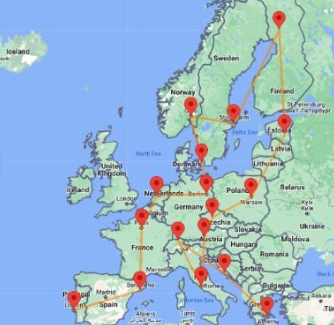
I rebooked for September 2025 with a 7-day train travel pass, which works out to roughly USD $50 per travel day, plus any required reservation fees. For the distance covered and flexibility you get, it’s an incredible deal.
Until I visited Europe in mid-2024, I honestly had no idea how amazing—and how popular—train travel is there. It’s fast, comfortable, scenic, and stress-free. No security theater, no baggage roulette, no sprinting through airports.
These train trips weren’t just transportation—they were part of the experience. Watching cities turn into countryside, countryside into mountains, and borders quietly disappear from your seat changes how you think about moving through a continent.
Once you do Europe by train, it’s hard to imagine doing it any other way.
Here are the routes I took in September 2025 on my seven-day pass
Day 1:
Faro, Portugal to Porto, Portugal via Lisbon
Day 2:
Warsaw, Poland to Prague, Czeck
Day 3:
Prague, Czeck to Munich, Germany
Day 4:
Munich, Germany to Chur, Switzerland
Day 5:
Chur, Switzerland to Lucia, Switzerland
Lucia. Switzerland to Zurich, Switzerland
(Famous Bernia Express)
Day 6:
Zurich, Switzerland to Strasbourg.
Strasbourg, France – Paris, France
Day 7:
Paris, France – London, England
These trips were taken over the month of September. I more than paid for the pass with these trips as Day 5 in Switzerland would have been $300+
Reservation fees were a bummer! It cost me over and above pass to secure seats on some of these routes. I spent about $100 on top of the $350 pass.

Here are some **pictures and videos from train travel in Vietnam and across Europe during the spring of 2025.
I rode so many trains, for so long, that I eventually made a smart call and postponed the European portion of my train-heavy travel until September 2025. At a certain point, even the best journeys deserve a pause.
That’s one of the underrated lessons of slow travel: knowing when to keep moving—and when to save something great for later.
I also got to experience a high-speed train from Barcelona to Madrid, cruising along at 300 km/h on the return.
Smooth, fast, quiet—and wildly efficient. One minute you’re in the city, the next you’re watching the Spanish countryside blur past like a screensaver. It’s another perfect example of how, in Europe, the train isn’t just a backup to flying—it’s often the best option.
The slow train from Naples to Rome, Italy, was also a great experience as I was able to see a lot more of the Italian wine Countryside.