Screenshot 2024-12-28 085419 (1)

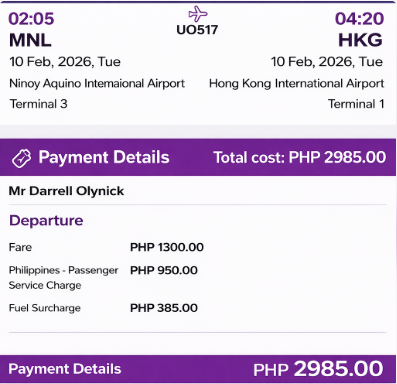
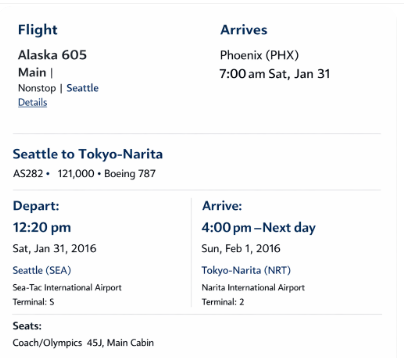
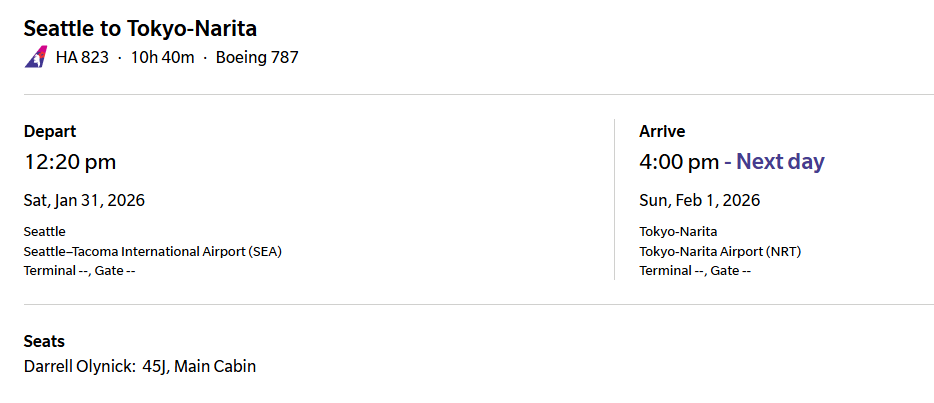
Tokyo, Japan – $12 on points Feb 1st, 2026!

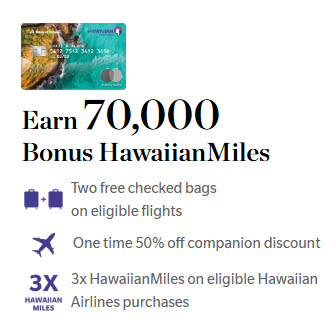
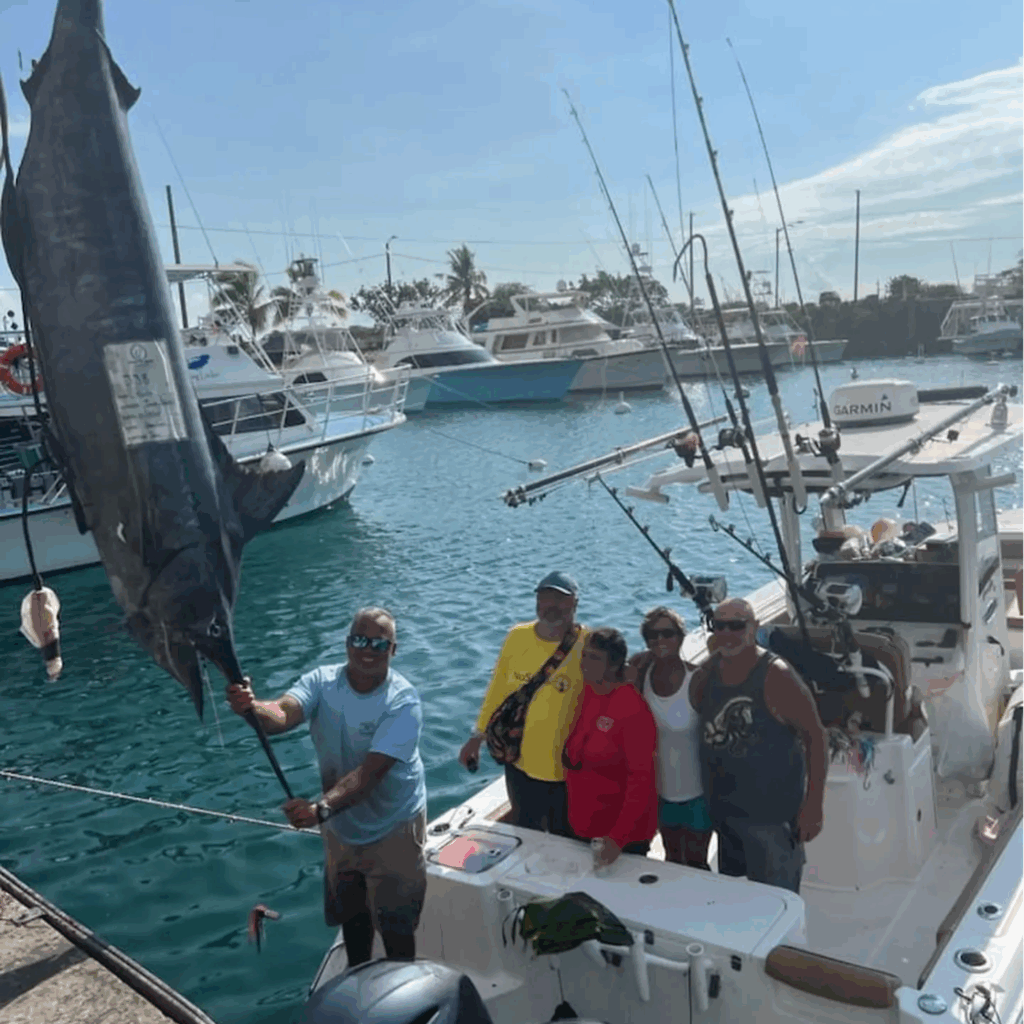
A few years ago, during a perfectly innocent fishing trip to Hawaii, I applied for a Hawaiian Airlines Mastercard.

Somehow, this resulted in 70,000 points.

Those points have been burning a hole in my pocket ever since—quietly judging me every time I checked my balance.

Until now.

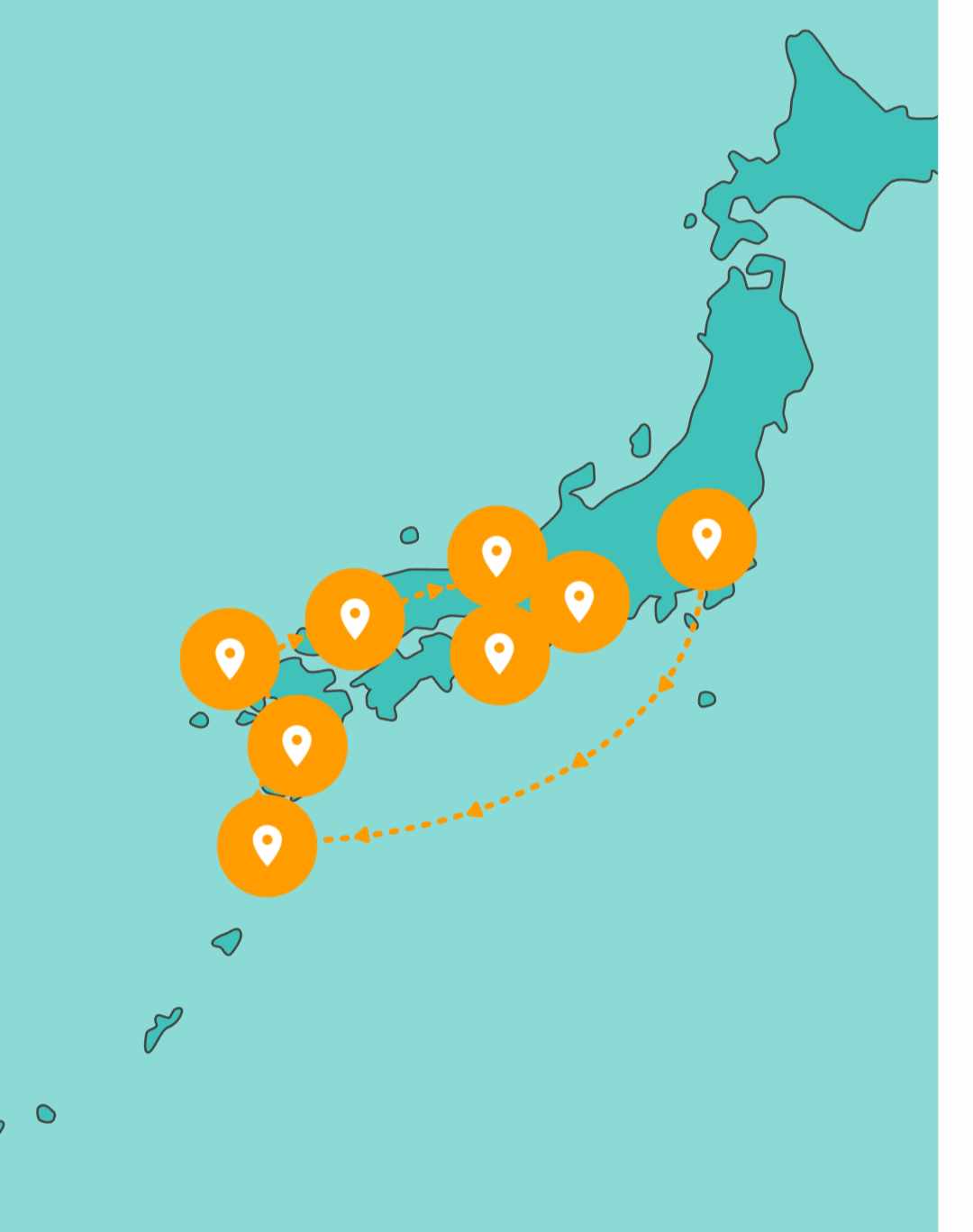
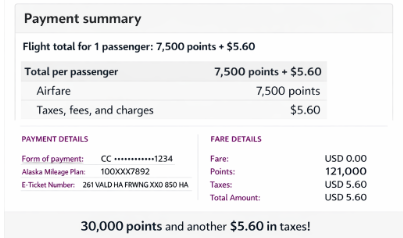
I officially booked a trip to Tokyo, Japan, departing February 1st, 2026—paid entirely with points. Turns out, the long game does pay off.

Especially when it ends in Tokyo.

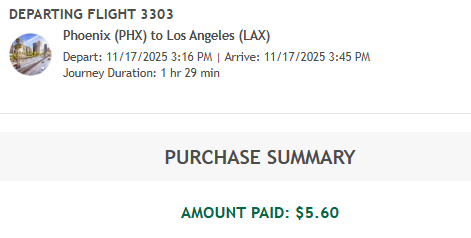
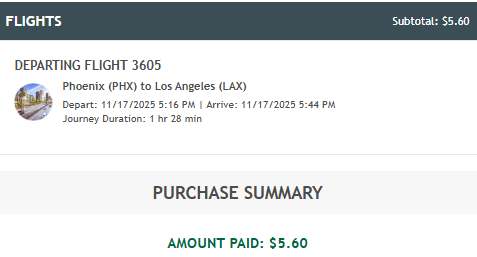
30,000 points and another $5.60 in taxes!

That’s right—$11.20 to get from Phoenix to Tokyo using points. đŸ€˜đŸ»

Eleven dollars.

And twenty cents.

I haven’t finalized my return flight yet—because commitment is overrated and flexibility feels very on-brand. Plus, Korea is just around the corner and on the bucket list.

The plan is to stay two and a half months, since my Airbnb is locked in until April 15th.

If you’re curious how a fishing trip turned into a trans-Pacific flight for the price of a vending machine snack, you can read more about the Hawaiian Airlines credit card on my blog by clicking:

âžĄïžâžĄïžHERE.âŹ…ïžâŹ…ïž

You can read my long-winded Kona fishing blog. 

No refunds. Never getting that time back by clicking

âžĄïžâžĄïžHERE âŹ…ïžâŹ…ïž

Why Japan Tops the Travel Charts

Japan is often ranked the number one travel destination because it’s a magical mix of tradition, technology, and sheer wow factor. You can go from serene ancient temples and cherry blossom gardens to bustling neon-lit cities and bullet trains in a matter of minutes.

Add to that world-class food, from Michelin-starred sushi to street-side takoyaki, ultra-clean streets, incredibly polite locals, and a culture that balances the ultra-modern with centuries-old customs—and it’s easy to see why travelers can’t get enough.

Plus, every season brings something spectacular: spring for cherry blossoms, autumn for fiery leaves, winter for skiing, and summer for festivals that make your Instagram explode. Japan isn’t just a trip—it’s a full-on sensory adventure.

train

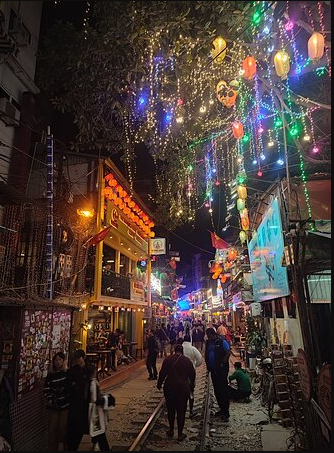
11/17/25 Hanoi ~24-hours of travel!

I started 2025 in Ho Chi Minh City, Vietnam, and I’ll be ending the year in Hanoi — and honestly, I could 100% get used to visiting Vietnam. The energy, the food, the landscapes, the coffee culture
 it’s way too easy to fall in love with.

But first
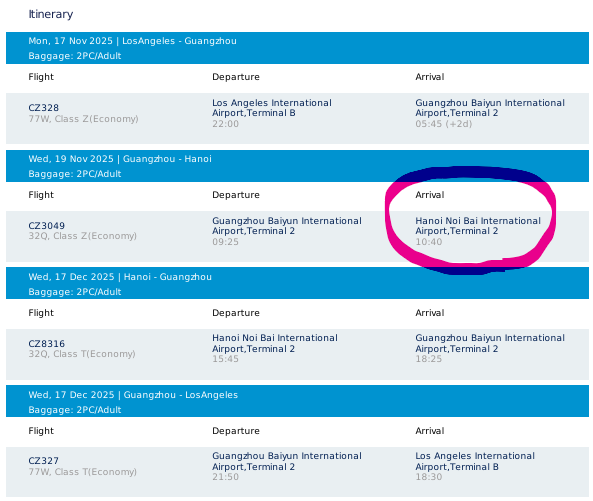
 I have to survive this 24-hour travel gauntlet:

9:30 AM

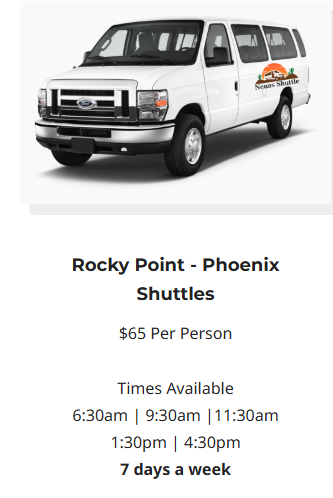
4-hour shuttle from Rocky Point, Mexico → Phoenix Airport

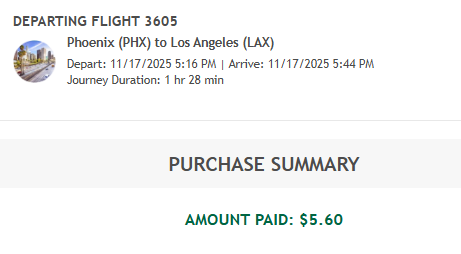
3:30 PM / 5:15 PM

1.5-hour Phoenix → Los Angeles flight
(Yes
 I booked two refundable options because I don’t trust the universe.Â đŸ«Ł) 

10:00 PM

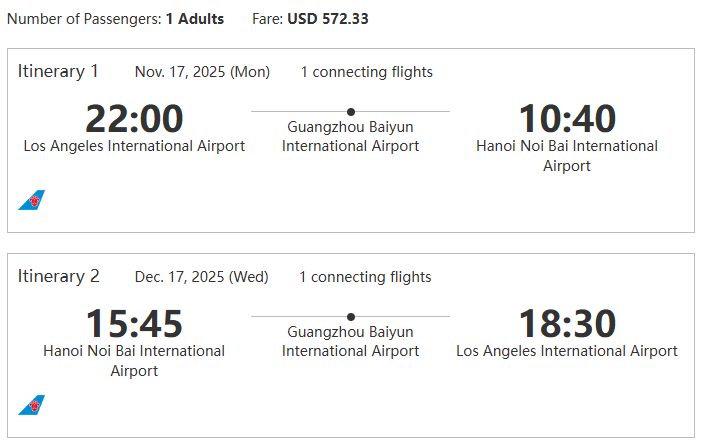
15-hour long-haul from Los Angeles → Guangzhou, China

3 hours from Guangzhou, China to Hanoi, Vietnam

Bonus insanity:

Approximately 8 more hours of layovers, airport wandering, questionable terminal coffee, and whatever chaos China Southern or the universe continues to throw at me.

Mission accomplished!

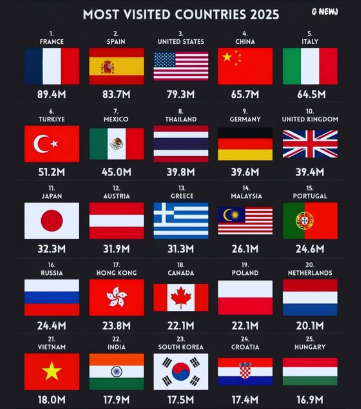
mostvisited

25 most visited Countries *21 completed!🌎

“I hope that giddy ‘new place’ feeling never goes away. At this point, I’ve only got 4 of the top 25 most visited countries left to catch
 but who’s counting?” đŸ™‹đŸ»â€â™‚ïžđŸ€˜đŸ»

Completed:

1-France, Paris twice, and leaving was the best part!

2 Spain, Madrid and Barcelona!

3-USA, So much fun, so many places lived and visited!

4-China, Guangzhou airport counts, right?

5-Italy, Venice, Rome, Naples, and Milan

6-Turkey, Istanbul, and the Princes’ Islands.

7-Mexico, so many Coronas and a bit of tequila everywhere!

9-Germany, Oktoberfest in Munich

10-UK, London pubs several times

12-Austria, Vienna

13-Greece, Athens

14-Malaysia, Kuala Lumpur

15-Portugal, Algarves, and coastal train adventure

16-Russia, Moscow airport counts, right?

18-Canada, born to leave the cold!

19-Poland, Warsaw

21-Vietnam, HCMC, Phu Quoc, and Hanoi, among other places.

And 25-Hungary. Budapest

Remaining:

11 – *Japan (February 2026, #1 tourist spot finally happening)

17 – Hong Kong (still there, still expensive- CHINA!)

20 – *Netherlands (flat but impressive, 2026 Europass đŸ€žđŸ»)

22 – India (interest level: zero, zilch – nada!)

23 – *South Korea (March 2026, scheduled obsession)

24 – *Croatia (Europass vibes plans for 2026 đŸ€žđŸ»)


“My retirement often seems that it is on life support but keeps whispering one more flight.”

opinion

It’s just my opinion! Travel man! đŸ™ŒđŸ»

When I talk about travel, I’m simply sharing my own experiences and opinions. Everyone travels differently, so what works for me may not work for you.

I tend to travel a lot and try to save money, so my perspective is probably skewed.

The reality is that most people don’t want to skimp on their vacations.

There are two very different types of travelers.

Many travelers return to work so they can earn more money to fund future trips. I take a different approach. I save money while traveling so I don’t have to go back to work.

Someday, you may find yourself in a similar situation—please consider reading this blog with that perspective in mind.  It’s just my opinion man, relax!

I also don’t have anyone else who has to suffer because of my budget travel choices—and that’s a pretty big advantage.

If I stay in a hostel, I’m the only one listening to a stranger’s world-class snoring performance. If I book a non-direct flight, I’m the only one pacing the terminal during a five-hour layover, questioning my life choices.

These decisions work for me—but I fully understand why they might be a hard no for someone else.

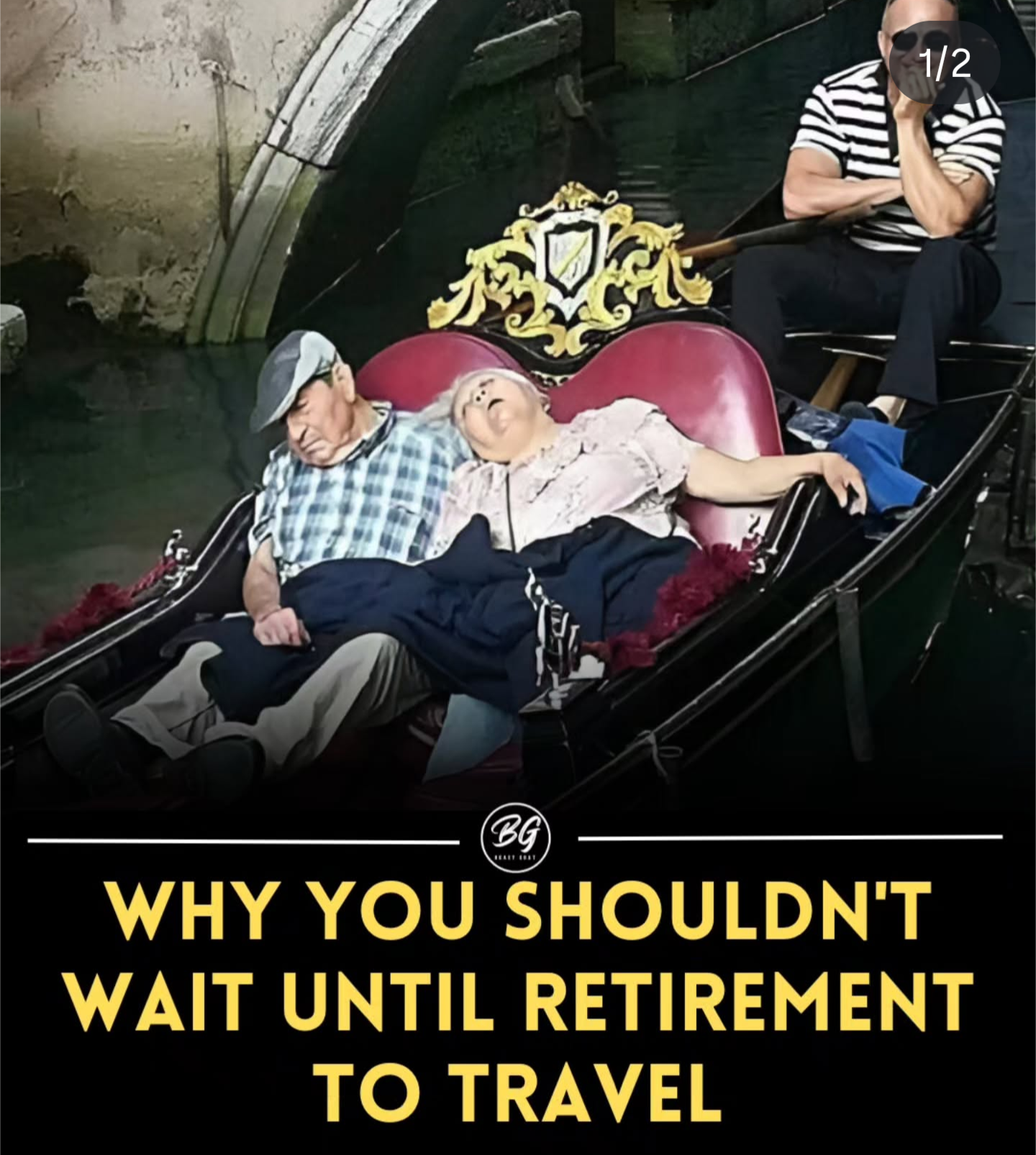
If nothing else, we can agree on this: travel as much as you can while you’ve still got enough piss and vinegar to haul yourself onto that next flight. Waiting on compression socks and flip-flops is not a good vibe.

    • “Never give up. Live life to the fullest—without regret.”
stickpack

Legend in my own mind – A Mocumentary!

Another reason I started this website was to help me navigate the absolute chaos that is early retirement. At least twice a week, I’m convinced market fluctuations are about to force me into a very tastefully decorated dumpster.

2025 was my first full year taking a serious swing at retirement—emphasis on swing.

Even with the site’s modest traffic (hi Sis! 👋), I’ve genuinely loved writing.

Which means it might be time for my next fun travel project?!

And speaking of big ideas
 here’s my first book proposal from a ghostwriting company:

“North American Darrell – A Legend in my own mind”

A traveler’s mocumentary …


Project Vision:

Darrell, your story is more than travel.
It’s about freedom, the kind that comes from defying convention, exploring the world solo, and
mastering the art of geoarbitrage. You’ve already built a digital footprint that thousands of
people dream of, through your website, vlogs, and life experiences.

What’s missing now is the next chapter:
Transforming North American Darrell into a published brand, a professional, inspiring book
and digital identity that cements your journey as a living example of how to live smarter, freer,
and bolder.
This isn’t just a book project. It’s a brand evolution, from traveler to author, from storyteller
to inspiration.

Our Understanding of Your Vision
You’re not looking to “just publish a book.”
You want something that:
‱ Reflects your authentic voice and humor, not ghostwritten into something artificial.
‱ Organizes your blog posts and memories into a cohesive travel autobiography.
‱ Establishes your legacy and builds on the momentum of NorthAmericanDarrell.com
and your YouTube channel.
‱ Generates passive income and brand credibility, creating new opportunities for
collaborations, sponsorships, and future travel projects.

What We’ll Do for You


1. Structural Blueprint (Book Framework Development)
We’ll organize your content into a professional book structure tailored to your style:
‱ Categorize posts into themes: Travel Adventures, Life Reflections, Humor, Turning
Points and Modern Freedom
‱ Group your stories into chapters for maximum reader engagement
‱ Suggest transitions and hooks that keep readers turning pages
‱ Deliver a fully editable outline and story placement plan you can keep for future use
projects
Result: A clear, publish-ready roadmap of your book that preserves your voice.

2. Editorial Collaboration & Story Enhancement
We’ll guide you chapter by chapter:
‱ Edit and enhance your existing drafts for clarity, humor, and pacing
‱ Strengthen dialogue and narrative flow without changing your tone
‱ Provide professional feedback and suggestions to make your stories resonate with a
wide audience
Result: Your words shine, professionally polished, but still 100% you

3. Professional Formatting & Book Design
‱ Format for eBook & Paperback (Amazon KDP, Ingram Spark)
‱ Design a bold, minimalist cover inspired by your travel photography
‱ Interior layout optimized for short-story pacing, section variety, and readability
Result: A premium, reader-friendly book that looks as great as it reads.

4. Publishing & Branding Setup
‱ Distribution across Amazon, Kindle, Barnes & Noble, and other platforms if
required
‱ Category selection, keywords, and optimization to maximize discoverability
Result: Your book reaches readers globally, with professional presentation and discoverability.

5. Optional Add-On: Pre-Marketing & Website Optimization
To amplify your book launch, we recommend a pre-marketing and brand optimization
package:

‱ Website Upgrade: Ensure NorthAmericanDarrell.com is polished, visually attractive,
mobile-friendly, and optimized for your book launch
‱ Pre-Launch Marketing: Build anticipation with a teaser campaign using your blog
posts, travel clips, and email list
‱ Social Media Strategy: Align your book promotion with your social channels for
organic reach and engagement

‱ Email Campaigns & Lead Capture: Collect leads from your audience for pre-orders
and newsletter sign-ups
‱ Launch Momentum: Create a strategy to drive early reviews, engagement, and initial
book sales

Benefits:
‱ Position your book as a professional, must-read travel memoir
‱ Turn existing followers into early readers and brand advocates
‱ Increase visibility and traction for a higher-impact launch
‱ Future-proof your online brand for subsequent books, courses, or media opportunities.

I’ve always wanted to write an autobiography once I had a website—clearly the natural next step.

Making it a mocumentary seems wiser. Less pressure, more jokes.

A mockumentary is a type of film, TV show, or video that mimics the style of a documentary and is often comedic. It looks like a serious documentary—with interviews, “real” footage, and narration—but the events, characters, or situations are made up, exaggerated, or absurd for humor or satire.

Key features:

Basically, it’s a fake documentary that makes you laugh, sometimes by tricking you into thinking it’s not real.

You can’t finish a dream

unless you start dreaming it first.

Stay tuned
 or don’t. I’ll be here either way.

acc3

Green card, Citizenship & travel visas🛂

I’ve been dealing with travel visas for over 25 years—long enough to know this topic is wildly misunderstood by anyone who’s never actually lived it.

You can’t just let people casually wander into a country

unless, apparently, you’re shopping for votes.

Like it or not, visas are 100% necessary.
Not glamorous.
Not fun.
Necessary.

My travel saga started in the late 1990s, flying for work between Calgary, Canada and Dallas, Texas.

I regularly traveled from our manufacturing plant in Calgary to our U.S. headquarters in Dallas. And every trip began exactly the same way:
Me, arriving at the Calgary airport—already sweating—fully aware that my real journey was about to begin
 with U.S. Immigration.

The script never changed.

Agent: Purpose of travel?
Me: Meetings.
Agent: How long?
Me: One week.
Agent: That’s a long meeting.
Me: We have meetings all week.
Agent: Go sit in our office.

Me (internally): Yes sir. Thank you sir. I respect the process and my fragile freedom.

Then came the waiting.

The agents would let me slowly marinate in anxiety—right up until five minutes before boarding.

Agent: You’re free to go.
Me: Immediately sprinting to the gate like I’d just been released from a minimum-security prison.

Every.
Single.
Time.

đŸƒđŸ»â€âžĄïžâœˆïž

Eventually, I graduated to actual work visas.
Real ones.
Laminated.
Official.
Very fancy.

I would calmly present my current visa to the immigration officer, exactly as instructed.

[“DO NOT ANSWER QUESTIONS.”]

The office rules were very clear:
Show the visa.
Say nothing.

Apparently, immigration officers are highly trained professionals whose primary job is to trick you into saying one wrong word, realize you have the wrong visa, and deny you entry—
purely by accident.
On your part.

This never happened to me.
I suspect it’s because they eventually recognized me.

“Oh. It’s this guy again.”

Somewhere along the way, I stopped being “potential international threat” and became “frequent flyer with anxiety.”

Eventually, I moved to the United States full-time, which—shockingly—required an entirely different visa.

I will forever clutch my citizenship like it’s a winning lottery ticket.

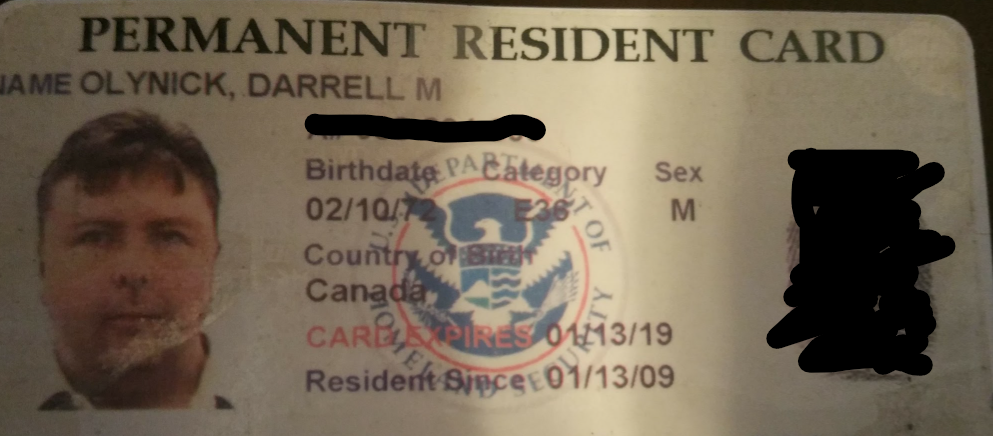
Ten years and dozens of visas later, I finally received my United States Permanent Resident card—
the government’s way of saying, “Fine. You can stay.”

“TEN YEARS LATER”

Another ten years passed, and—six months after my green card expired on January 13, 2019—I officially became a U.S. citizen on July 3, 2019.

Yes, there was a brief but thrilling period where I existed in pure bureaucratic limbo:
No longer green-card valid, not yet American enough.

USA Immigration has always loved a good cliffhanger.

Then, just in time for Independence Day sales, fireworks, and historically poor life choices


I became a U.S. citizen.

Sworn in by DJT himself.

Roll credits. đŸ‡ș🇾🎆

My entire immigration journey took roughly 20 years.

Two decades of forms, fees, interviews, fingerprints, photos—and the low-grade terror of checking the mailbox.

So yes, I tend to notice immigration policy.

Between 2020 and 2024, under a Democratic administration, millions of migrants were allowed into the U.S. with what appeared to be minimal vetting. Many arrived with criminal records, some unvaccinated, and many had their expenses covered.

At the exact same time, Americans were required to get vaccinated while enduring shutdowns that hit them financially.

That contrast did not go unnoticed.

The current Republican administration, by contrast, treats border security as non-negotiable. Their 2025 immigration policies can best be summarized as FAFO—and they are the strongest I’ve seen.

And just for context—so this doesn’t sound like vibes-only commentary—I’ve also held travel visas for:

Thailand (three of them), Cambodia, and Vietnam (two).

Turns out, when you’ve played immigration on hard mode across multiple countries, you develop opinions.

Earned ones.

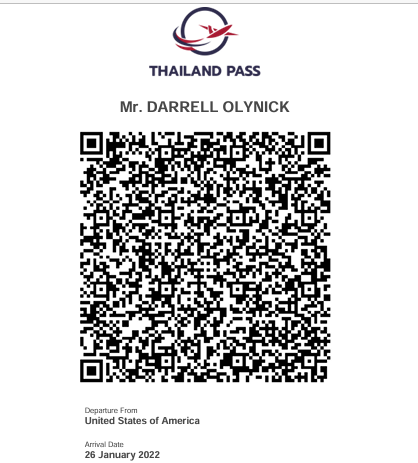
This pass was just after COVID and there were many hoops to jump through!

Cambodia Immigration — departing Vietnam

No computers.
No scanners.
No backup system.

Just pens, paper, and deeply suspicious vibes.

Everything was done by hand.
Every passport.
Every stamp.
Every long, silent glance that felt like a background check conducted telepathically.

The process took hours—not because anything was wrong, but because time itself had chosen to opt out.
The heat was oppressive.
The fans were decorative.
The concept of “boarding time” was aspirational.

This was immigration in its purest form:

slow, deliberate, and completely immune to deadlines.

And watching it all unfold, I realized something oddly comforting—

no matter the country,
no matter the technology,
no matter the system


immigration always finds a way to remind you who’s really in charge.

These Asian visas are extremely strict.

As in: follow the rules
 or enjoy a complimentary tour of the prison system.

There’s no confusion about the process.

No gray area.
No “I didn’t know.”

You follow the entry requirements, or there are consequences.

And somehow—miraculously—when you follow the immigration process wherever you go, you avoid those consequences entirely.

Seems 100% fair to me.

Legal immigration history:

It didn’t start with some fancy red carpet—it started when governments realized people moving freely could get
 complicated. Back in the 19th century, countries like the U.S., Canada, and Australia were basically like, “Sure, come on in
 as long as you check a box or two.”

Then came the U.S. Immigration Act of 1882, which basically said, “Not everyone’s invited to the party.” Fast forward to the early 1900s: Ellis Island became the ultimate checkpoint, where millions of hopeful immigrants faced the judgment of border agents, health inspections, and that ever-important first glimpse of America.

By the mid-20th century, things got organized: work visas, student visas, green cards
 a whole bureaucratic buffet. Today, legal immigration is basically a government-approved, multi-step obstacle course—and yes, you can survive it, but only if you brought your paperwork, patience, and maybe a stiff drink. đŸč

PXL_20251213_082811692

Hanoi, Vietnam – Nov.17/25đŸœđŸ«–

There’s a balance I’m always chasing when I travel—but I wish I understood it better, so I’d stop booking flights. I know I need to begin with lower-cost, slower journeys, and once again, Vietnam felt like the perfect calibration.

I landed in Hanoi, Vietnam on November 17th, 2025—because apparently I like good decisions.

~$572 for the flight and ~$263 for an entire month’s rent (yes, a month).

I skipped Northern Vietnam earlier in 2025, so this trip was basically my “fine, I’ll do it properly this time” trip. đŸȘŁđŸ“ƒ

Used points to get from Phoenix to Los Angeles and back home to Phoenix on the cheap!!đŸ€‘
$572 for a return flight from Los Angeles to Hanoi, Vietnam

Anytime I find a cheap flight, I’ve learned to check the accommodations before I start emotionally packing.

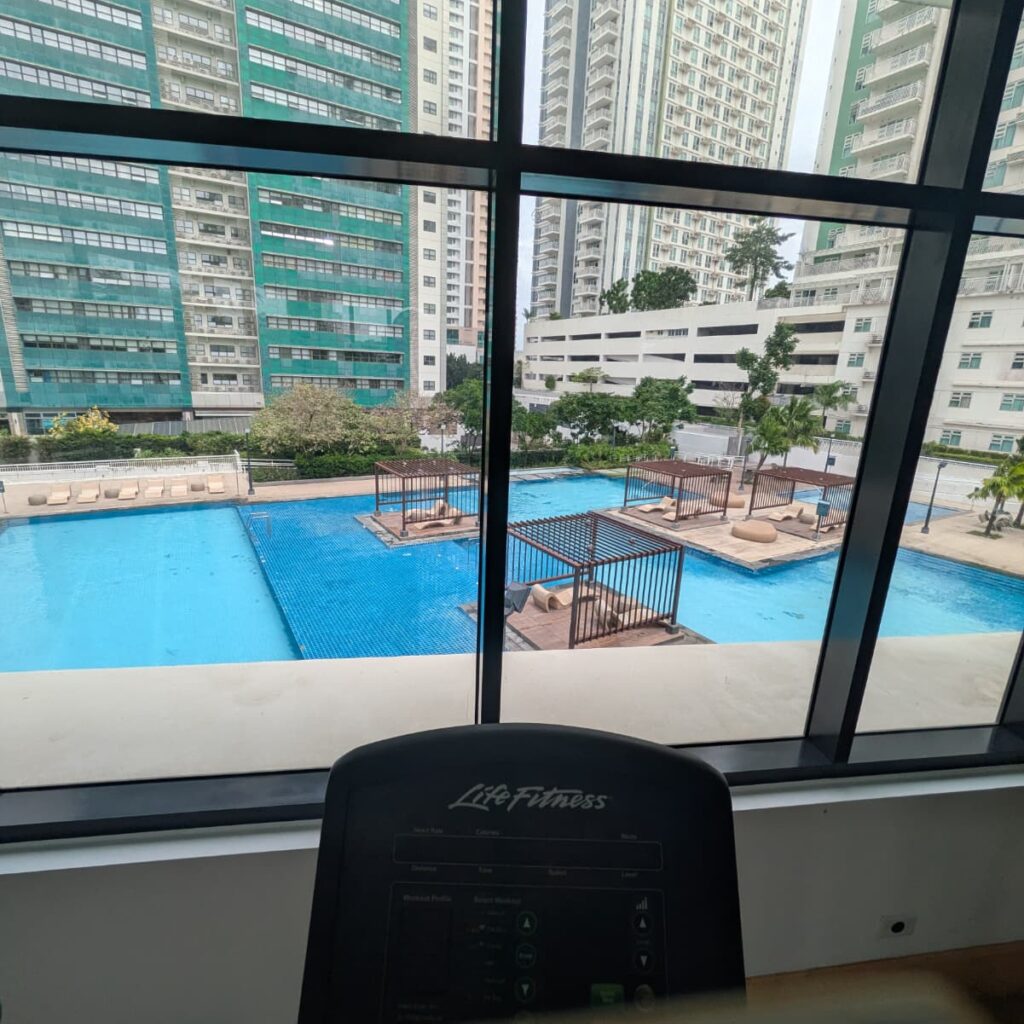
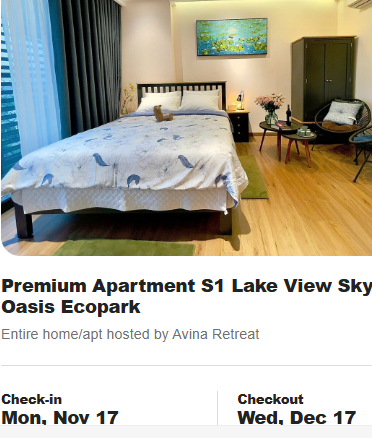
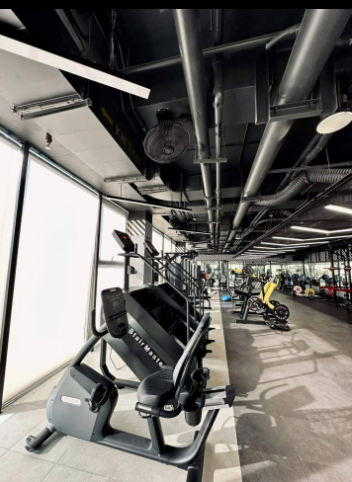
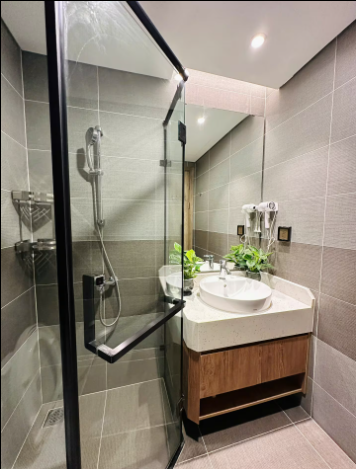
I knew it would be budget-friendly, but I didn’t expect a full-on resort situation—pool, gym, and a games room with a river view
 all for “are we sure this is real?” prices.

An entire month $263/$9 day (Pool, gym, games room studio on the lake.)

The history of Hanoi: A City That Refuses to Sit Still

Hanoi has been around for over 1,000 years, which basically means it has more history than most people have Instagram posts. It started as a sleepy riverside settlement until Emperor LĂœ ThĂĄi Tổ decided in 1010 to move the capital there and call it Thăng Long—“Rising Dragon”—because why settle for boring when you can be mythical?

Fast forward a few centuries, and Hanoi became a cultural, educational, and political hotspot, surviving invasions, occupations, and a fair share of bureaucratic headaches. The French showed up in the late 1800s, built boulevards, colonial buildings, and cafĂ©s where you can still sip coffee pretending you’re in Paris.

After a mid-20th century revolution and reunification, Hanoi officially became the capital of Vietnam, a city where ancient temples, motorbike chaos, and modern skyscrapers collide. Basically, it’s a city that refuses to sit still—and you’ll love every chaotic, delicious, history-packed second of it.

default

Paris and London – 100% tourist mode!

The days were officially counting down, and I needed to start migrating toward London for my 9:00 AM flight back to Arizona on September 28th, 2025.

This was immediately after I’d just crushed a bucket-list item in Venice, which—geographically speaking—put me on the wrong side of Europe for someone trying to go home.

The plan was simple and therefore doomed:

get closer to Paris, then slide into London like a responsible adult traveler.

The Universe, however, had other plans.

I missed a connection.

Fourteen-plus hours later, I found myself on a first-class high-speed train—not because I planned it, but because exhaustion, fate, and poor timing had teamed up against me.

Sometimes luxury isn’t a choice.
It’s a consequence.

My September 2025 European tour both started and ended in London. I passed through on September 1st on my way to Faro, Portugal, and returned at the end for less than 24 hours after bailing on Paris early.

I’d been to Paris about 20 years ago, and it only took about an hour to remember why it’s not for me. If you don’t speak French, people can be rude—I experienced that almost immediately while trying to buy a train ticket. Apparently asking for a ticket in English is a bold move.

If you love Paris (like my very fashion-conscious niece Amber), check out Norse Airlines—they’ll get you there cheaply. If you’re more like me, grumpy and impatient, plan a short visit and bail early.

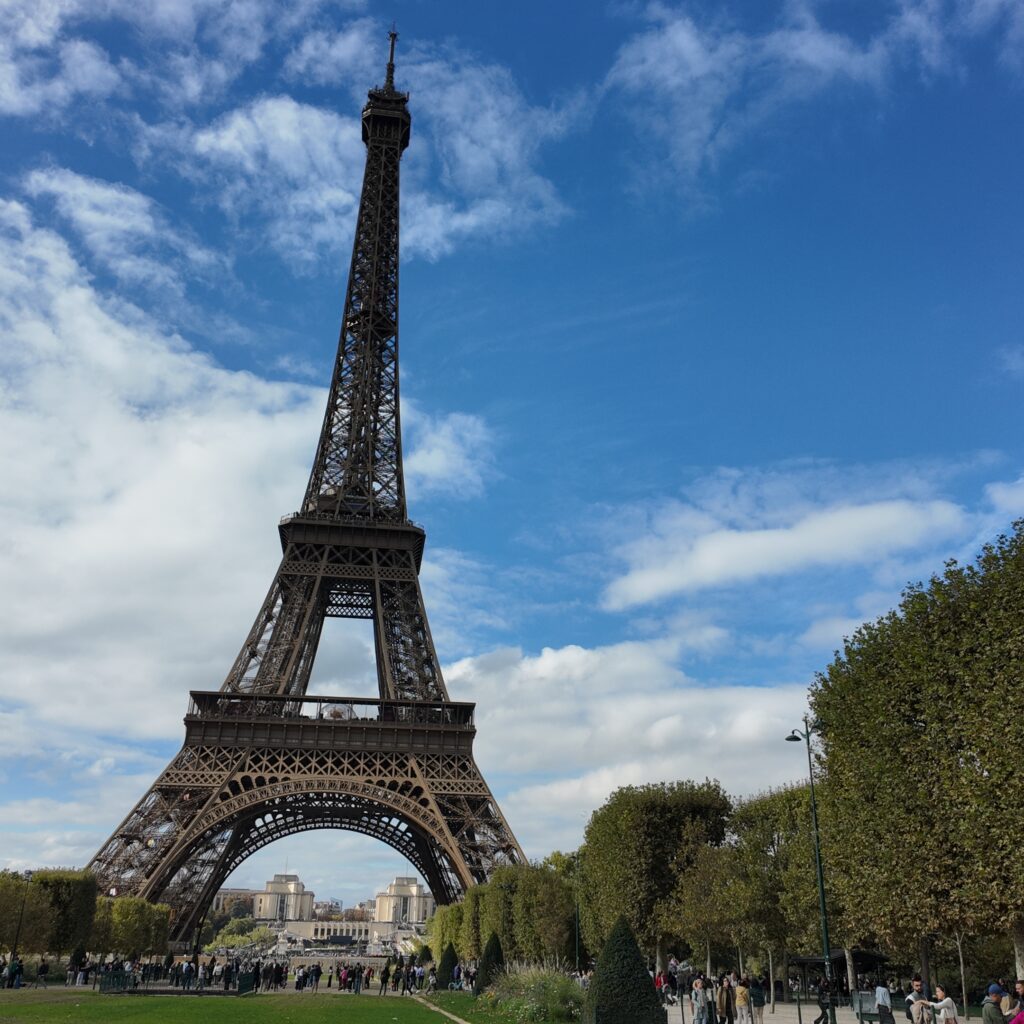
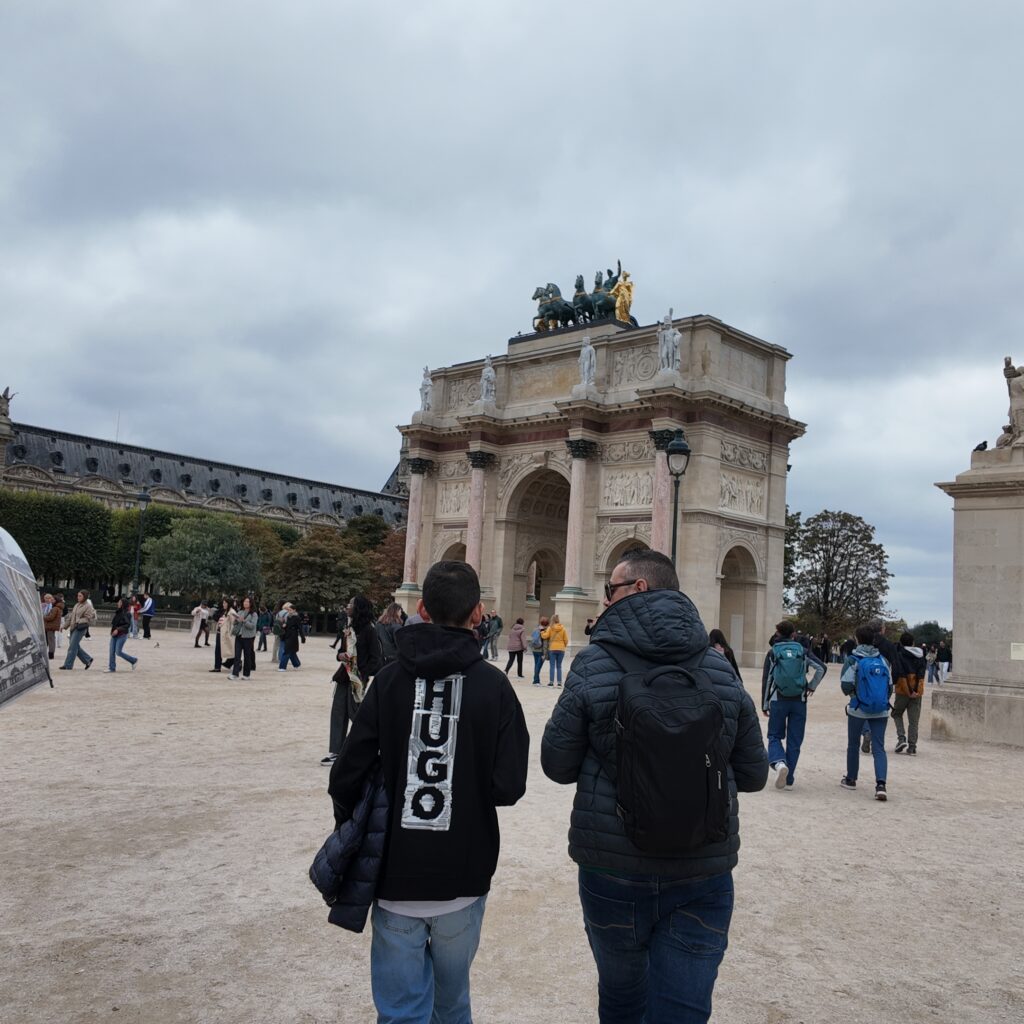
Below are a few photos from my brief stay in Paris—the week before the Louvre was robbed. I swear it wasn’t me. 😄

Eiffel tower ✅

Louvre ✅

Arc de Triomphe ✅

Notre Dame ✅

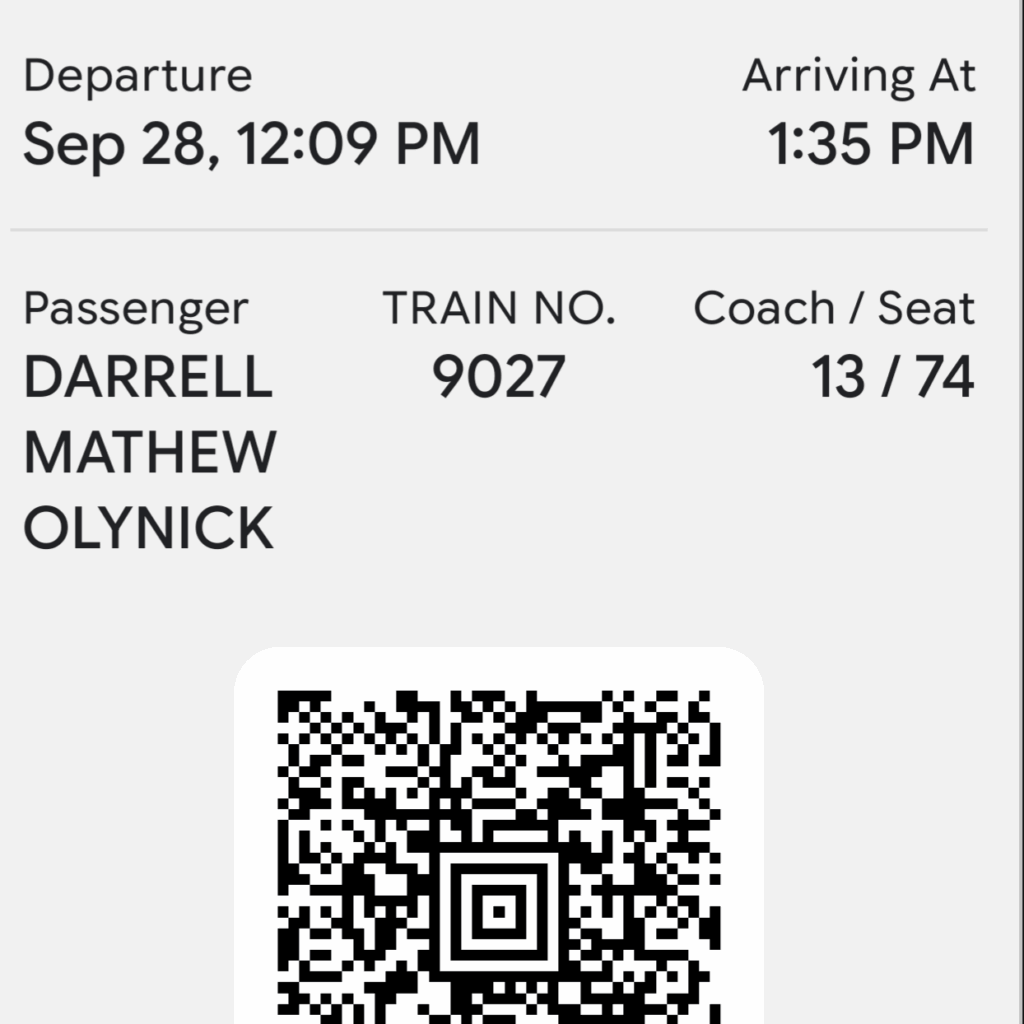
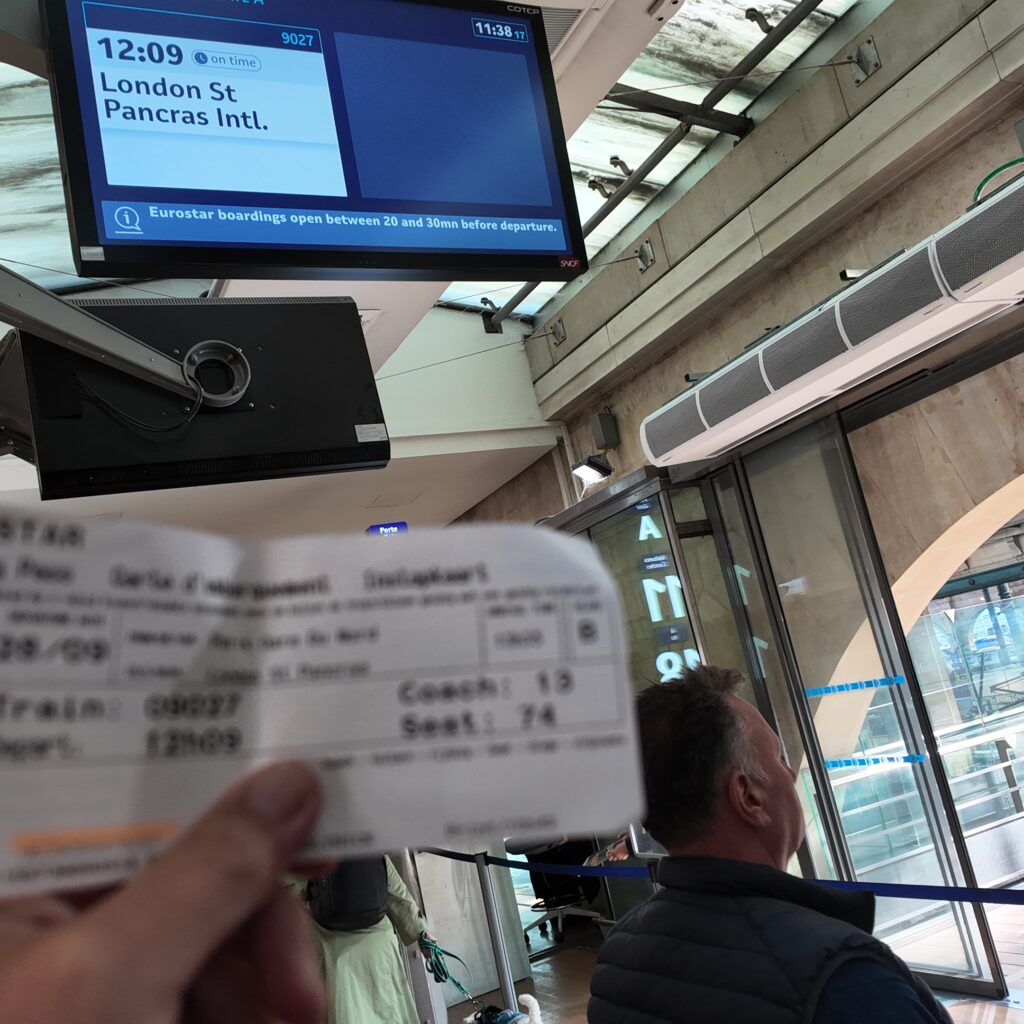
Train station to get to the Chunnel to London ✅

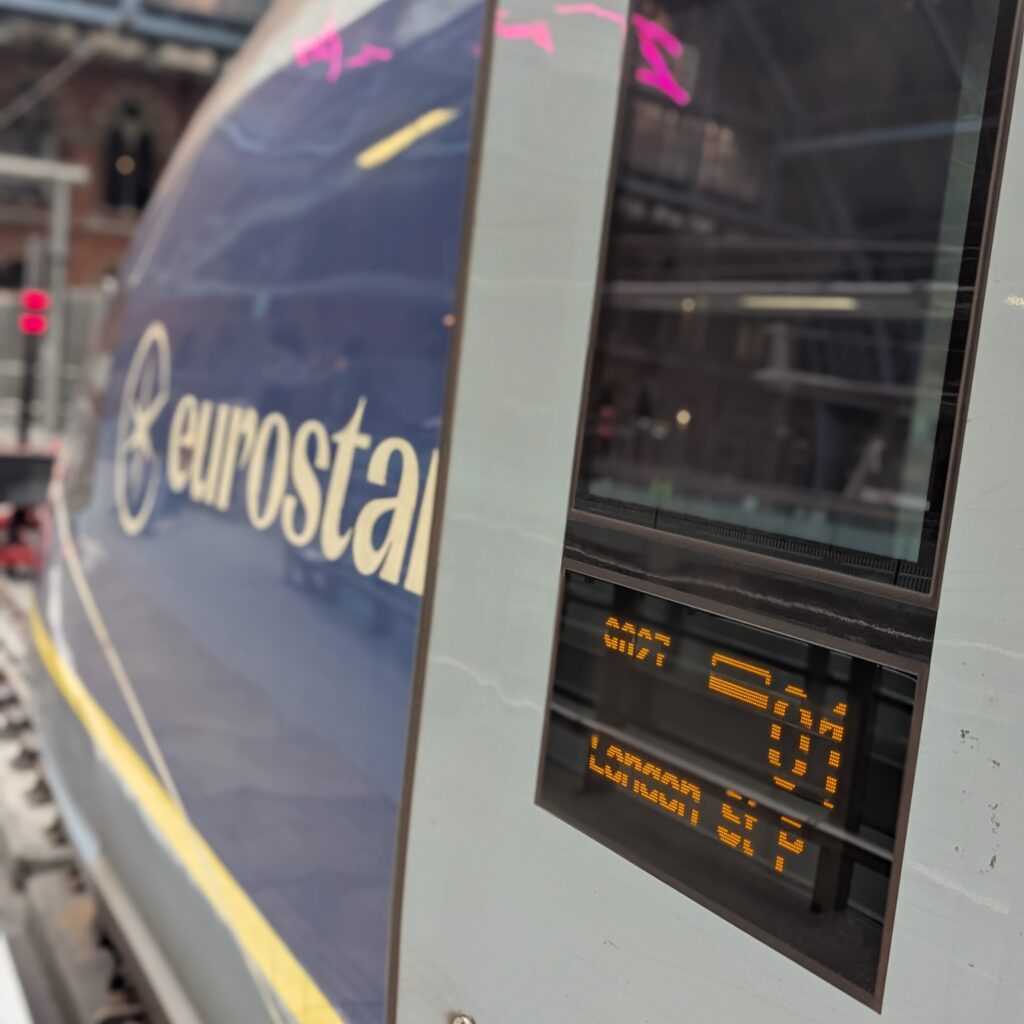
The high-speed Eurostar train between Paris and London is fantastic. It feels a lot like flying—security, early arrival, the whole routine—but it’s far more convenient than actually getting on a plane and dealing with an airport.

First things first, every time I arrive in London: 

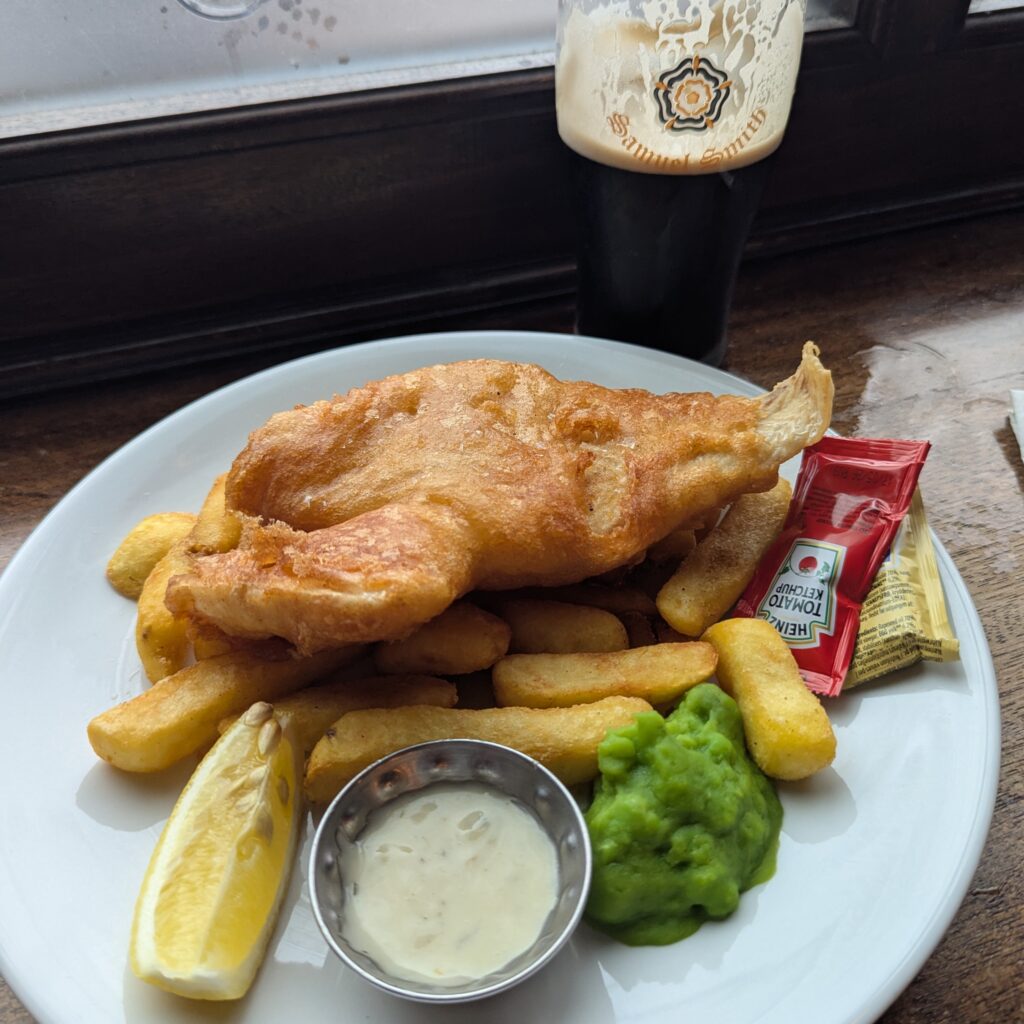
I find a pub, order fish and chips, and grab a cold pint. It’s not cheap—fish, chips, and a beer run about $40 USD—but it’s worth it every single time.

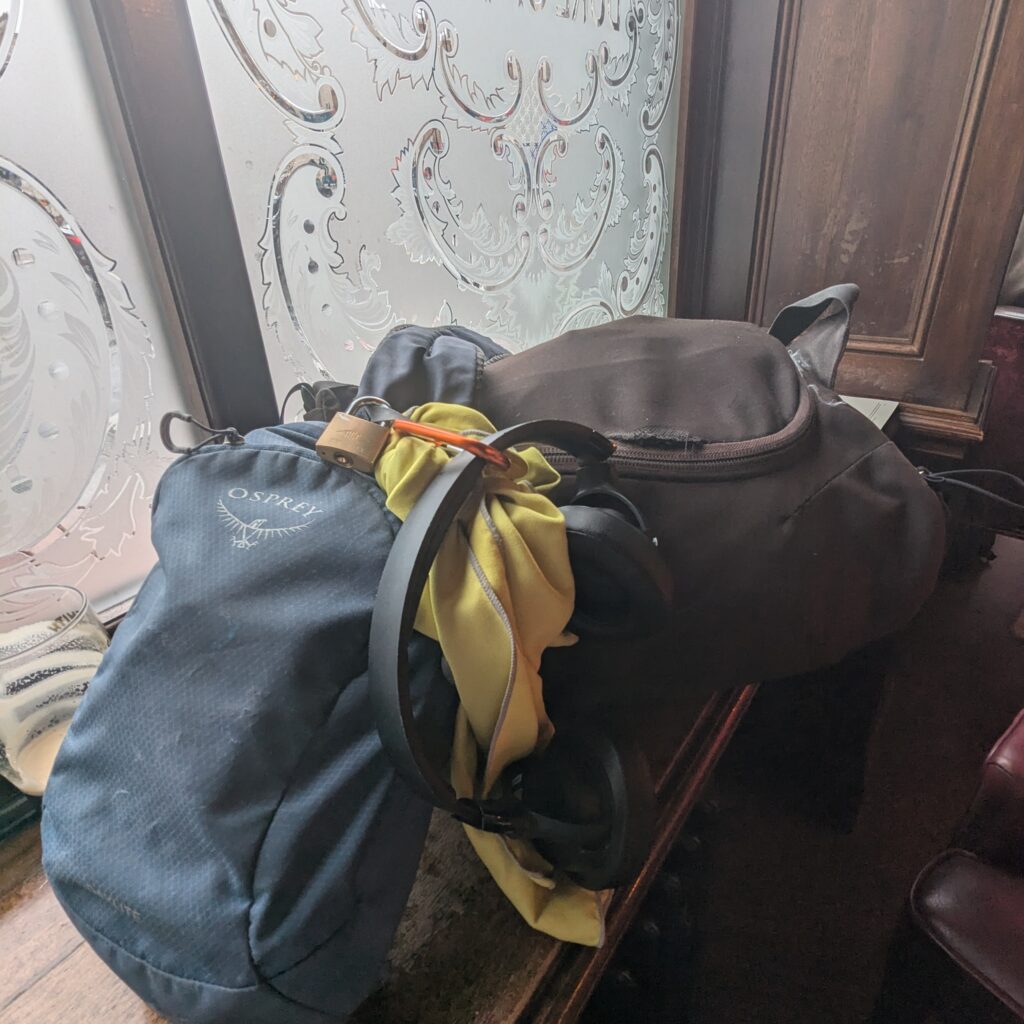
Check out how light I pack!

I landed in London at 2 p.m. and left the next morning, which meant attempting to see the entire city in under 24 hours. I did as much tourist stuff as humanly possible, and by the time I boarded my long flight home, I was running on fumes.

Fish and Chips ✅

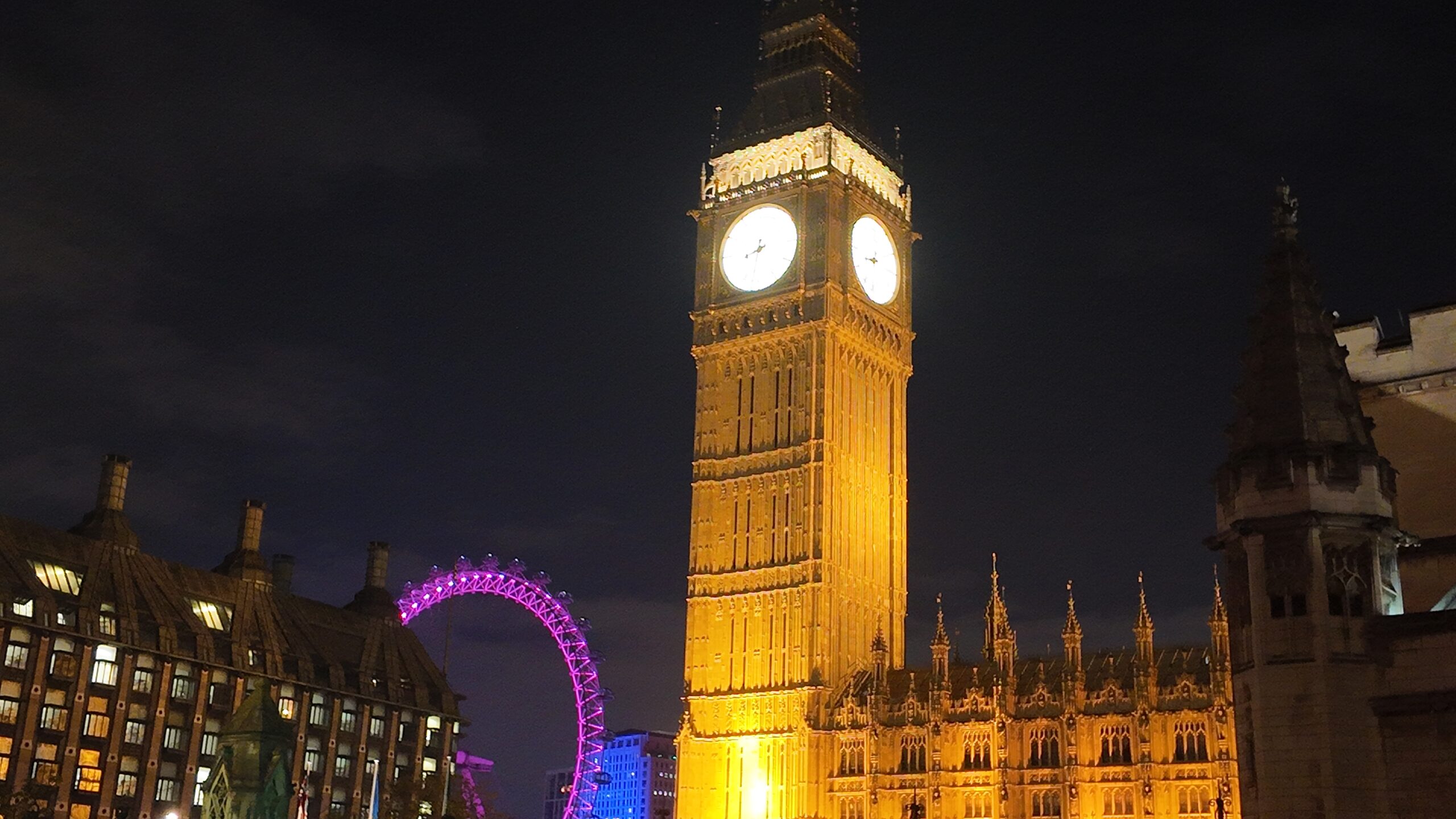
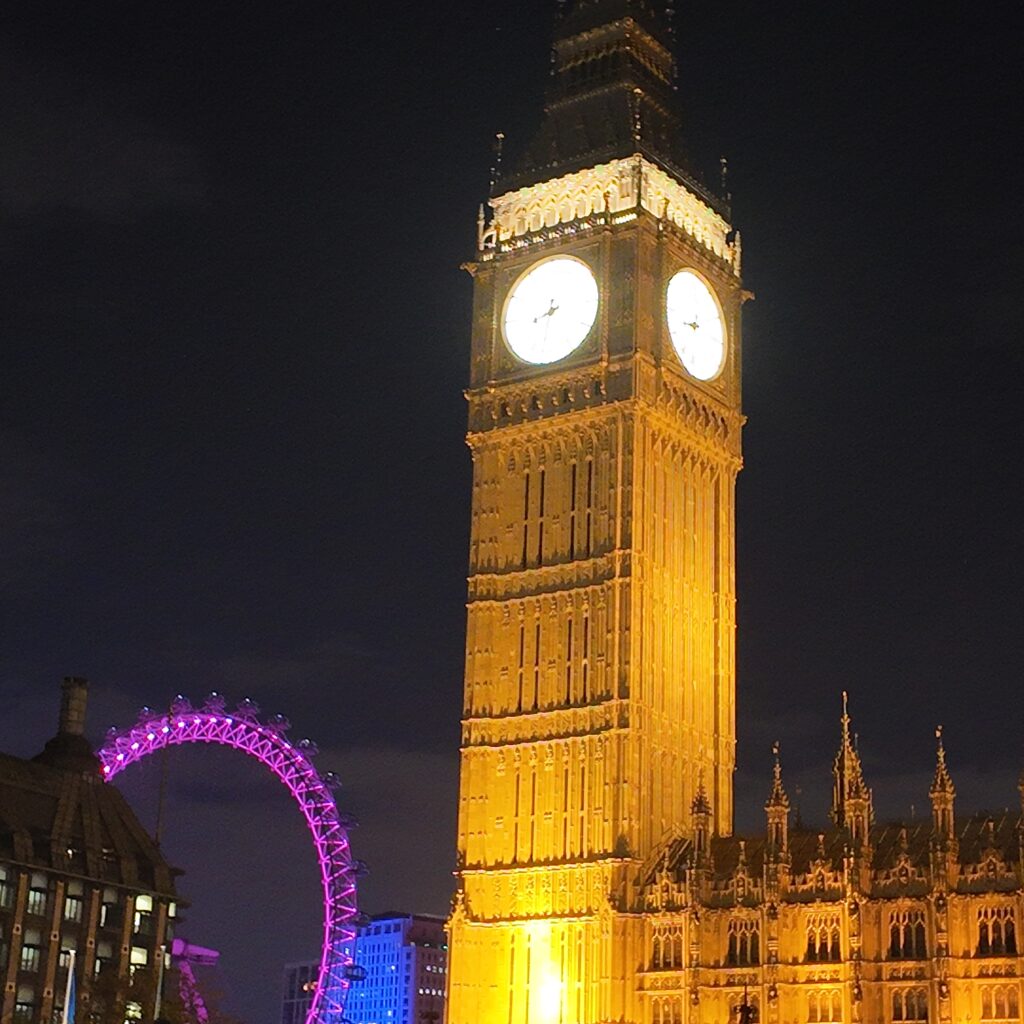
Big Ben✅

  London Eye ✅

Buckingham Palace ✅

Westminster Abbey✅

Mission accomplished! đŸ™ŒđŸ»

I racked up over 25,000 steps, took a nap that felt more like a system reboot, and then dragged myself back toward Arizona. Planes, trains, and automobiles—because apparently, I enjoy suffering in multiple forms of transportation to save a dime ..

âœˆïžđŸš…đŸš—

Paris to London train ✅

London to Los Angeles flight ✅

Los Angeles to Phoenix rental car ✅

eBiked home from rental car drop-off. ✅

I can’t even begin to calculate how many miles I traveled last week—and honestly, ignorance feels healthier.

Czech Republic to Germany (Oktoberfest on September 20, because of course), then Switzerland, Italy, France, London, and finally back across the pond on September 28.

At this point, my passport deserves a nap, my legs are filing a formal complaint, and my internal clock has completely resigned.

default

Venice, Italy – The Grand CanalđŸ›¶đŸ·đŸ‘đŸ»

I somehow managed to miss Venice the last time I was in Italy, so this time I overcorrected—with a casual 14+ hours on a train to make sure it happened.

To be fair, the journey was actually pretty incredible. We cut through a different part of Switzerland on the way to Milan, which would’ve been great if Milan hadn’t been in full Fashion Week mode. After about five minutes of that chaos, I was very happy to hop on the short train ride to Venice.

After that marathon travel day, my first Venice memory was asking someone in the train station, “Where’s the Grand Canal?” He pointed to my left and said, “You mean that one?”

Turns out the Venice Santa Lucia train station is literally sitting on the canal. Subtle city, Venice. Very subtle.

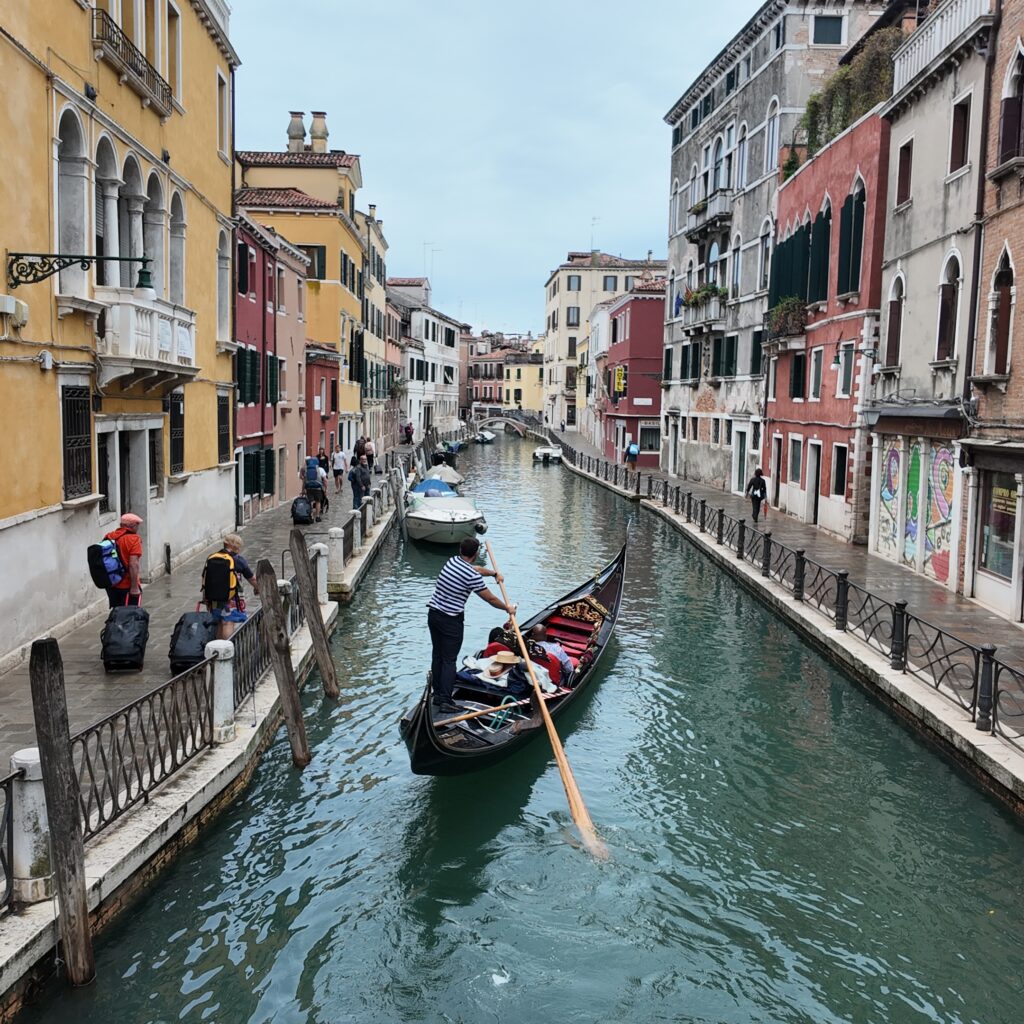
One of the things that completely blew my mind about Venice is that the water is the road. No streets—just canals. Water taxis, delivery boats, construction barges
 and yes, I even watched a casket float by with the family following along as part of a funeral.

It’s strangely beautiful and slightly surreal, and somehow all of it works. Watching everyone calmly navigate canal “traffic” like it’s rush hour on Main Street was one of the coolest parts of being there.

Pretty much everyone was lounging by the waterfront with a wine in hand, and of course, we all drowned in spritzers like it was a civic duty.

I enjoyed them so much that I stocked up when I got home—because nothing screams “this isn’t Venice” like sipping a sad spritzer in Arizona while staring at a cactus.

It’s not the Grand Canal, but it’s still pretty glorious during a Jay’s playoff game.

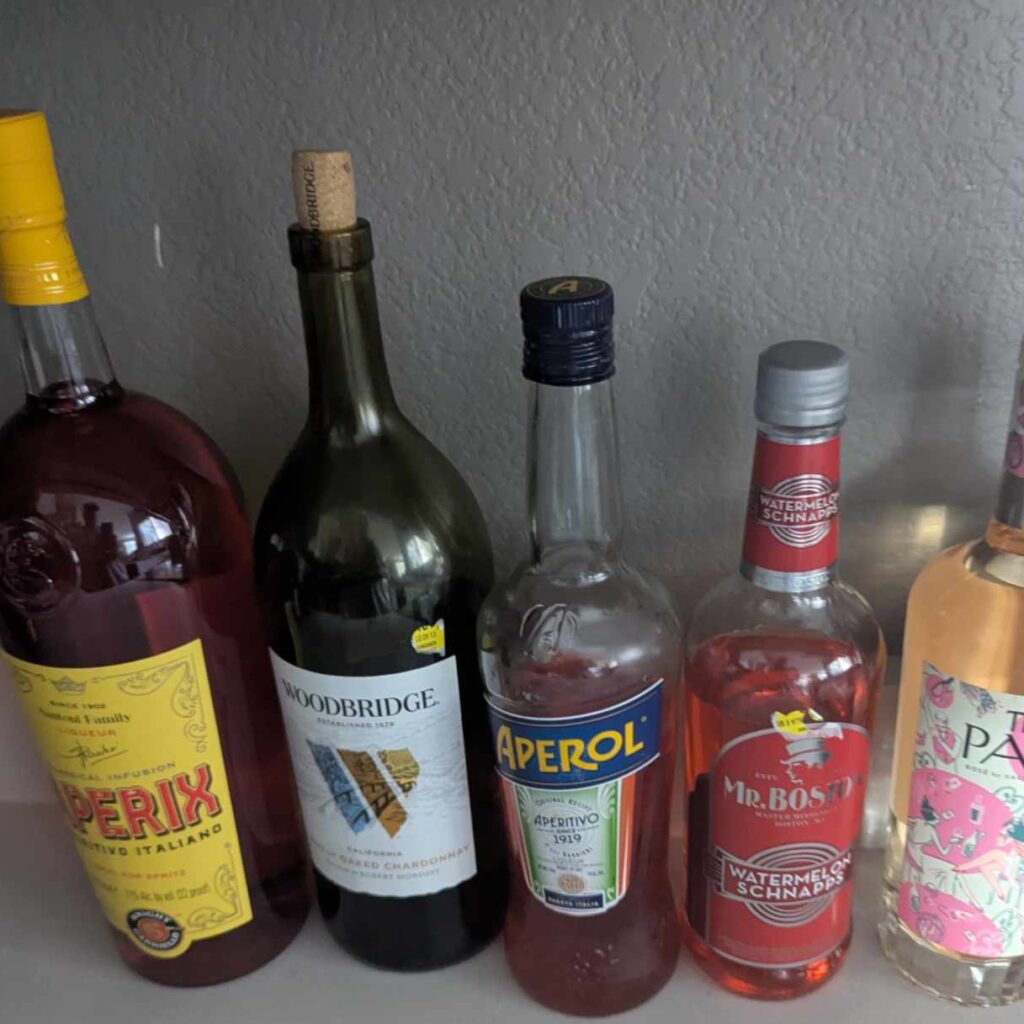
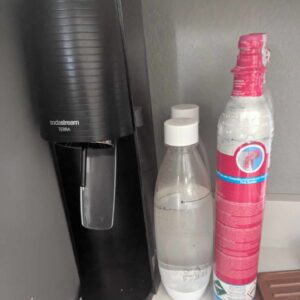
Mix some SodaStream soda water with your favorite alcohol flavoring (Aperol, Aperix, or Rosé—because why not), toss in white wine, fruit, and orange slices, and boom: Venice vibes at home. Bonus: it costs less than a dollar instead of €5–8+ per sad spritzer by the canal. 🙌

Here are a few more GEMs from my Venice adventure—because someone has to show off while I sip my homegrown “canal.” that hauls waste water in AZ.

Want more Grand Canal vibes (without the €8 spritzers)? Check out my videos on YouTube—watch canals, gondolas, and chaos unfold from the comfort of your own home.

www.YouTube.com/@NorthAmericanDarrell

Don’t forget to hit subscribe and dive into over 1,500 travel videos—because apparently, watching me roam the globe is considered quality entertainment.

Venice’s history began in the 5th century.

Refugees decided building a city on stilts in a swampy lagoon was a brilliant idea. By the Middle Ages, it became a maritime superpower, raking in riches while everyone else was figuring out taxes. Centuries later, it joined Italy, and today it’s a tourist mecca of canals, gondolas, and carnival chaos. Basically, it’s a city that floats, dazzles, and occasionally smells like history, depending on which alley waterway you visit.

default

Portugal – the beauty of the Algarves! 😍

My September 2025 European vacation began in Faro, Portugal, following a travel day that felt like it had its own time zone.

Uber from home to the airport!

light from Phoenix to LA 

8-hour layover in LA 

10-hour flight to London

3-hour London layover 

2-hour flight to Faro, Portugal. 

It was miserable. I even had loud, dry heaves when we touched down in London. I almost made it
 But nope. We had a “go around” because apparently, someone else’s plane hadn’t moved off the runway yet. That was the end of me for the day. đŸ“ąđŸ€źđŸ™‹đŸ»â€â™‚ïž

I really should cut people some slack when they say they don’t want to travel like me—clearly, they have better judgment but sitting at home is not an option.

The first week in Portugal was pure exhaustion—jet lag hit hard, and I barely had time to remember what day it was before I was off on the next adventure.

Totally worth it—Spain and Portugal were both at the top of my bucket list. I’ve barely scratched the surface of either, but who cares? 

Dropping pins does not need full coverage.

📍🌍😎

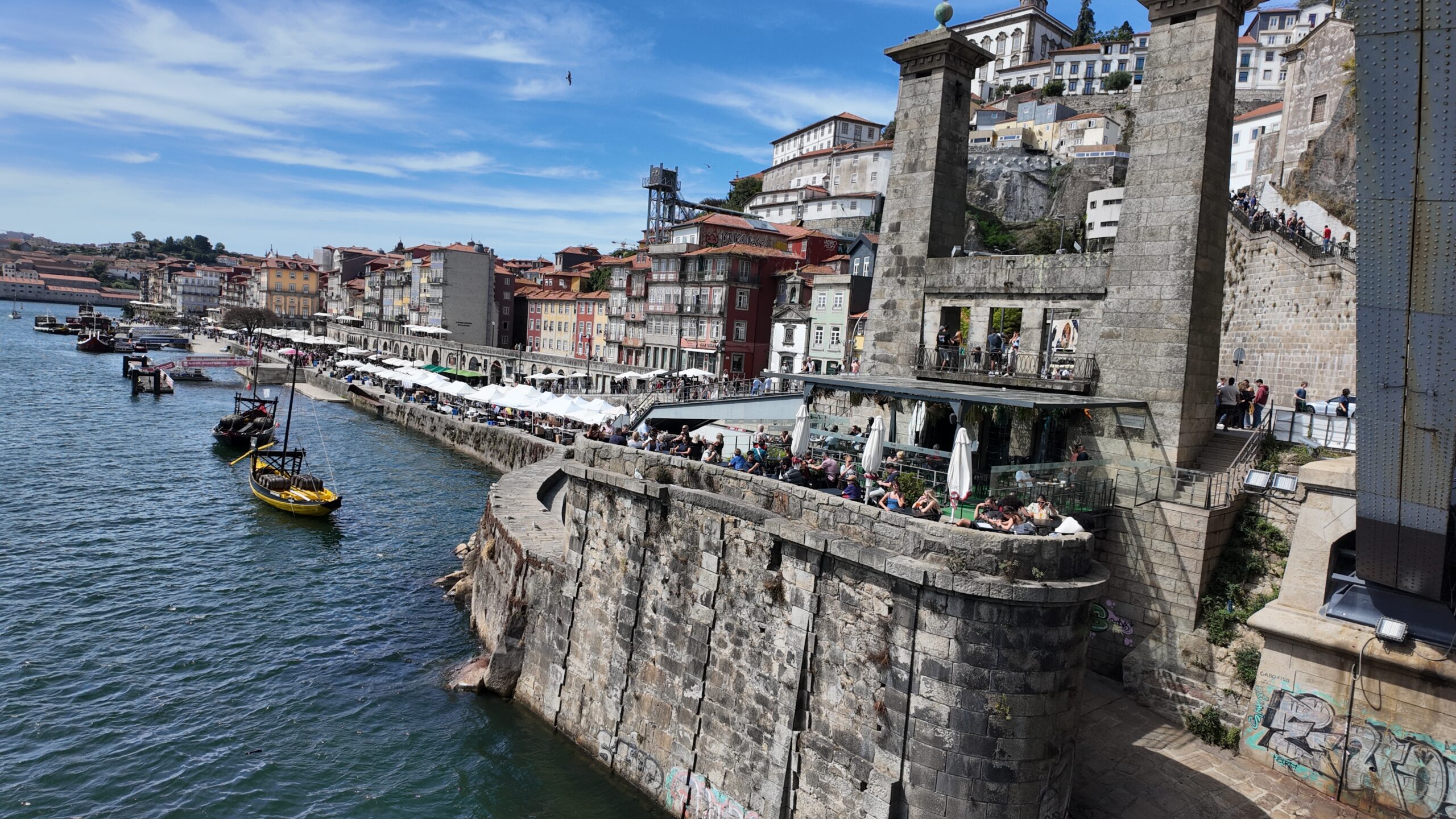
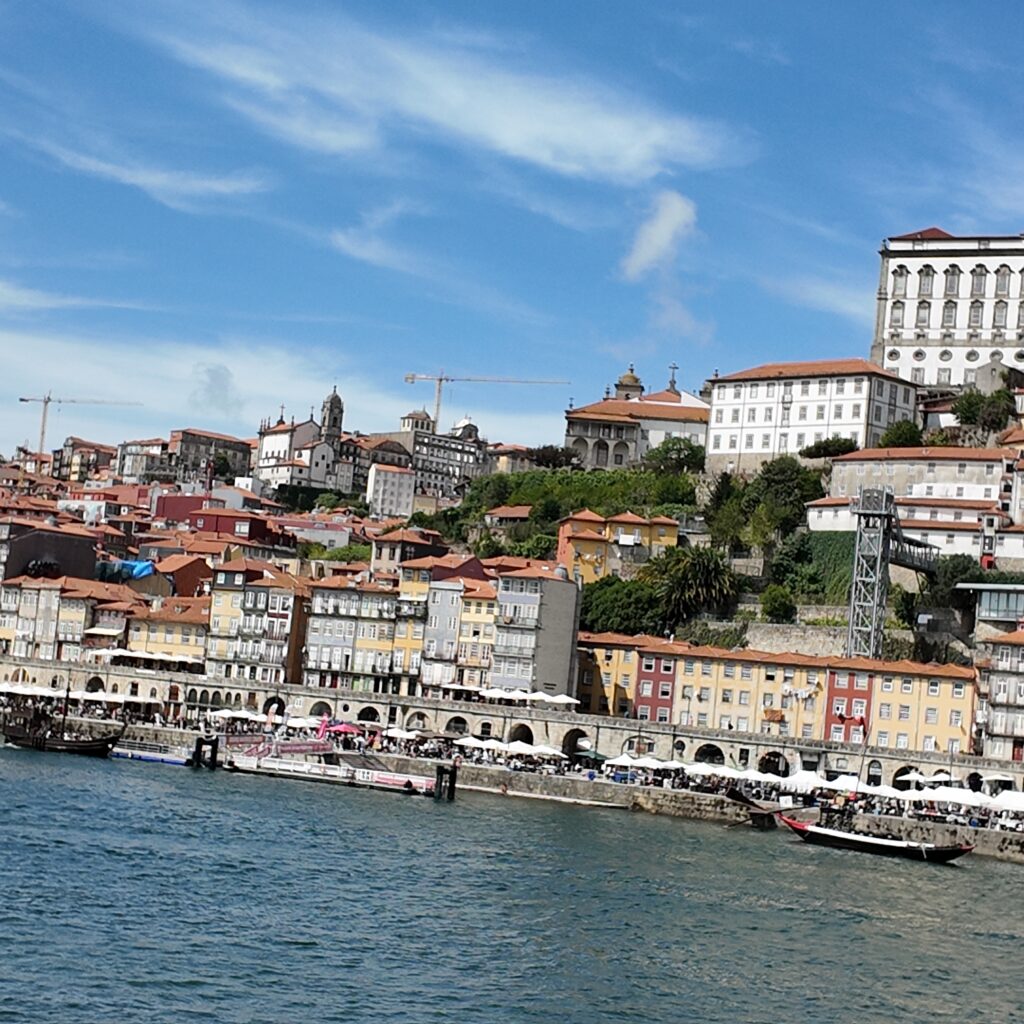
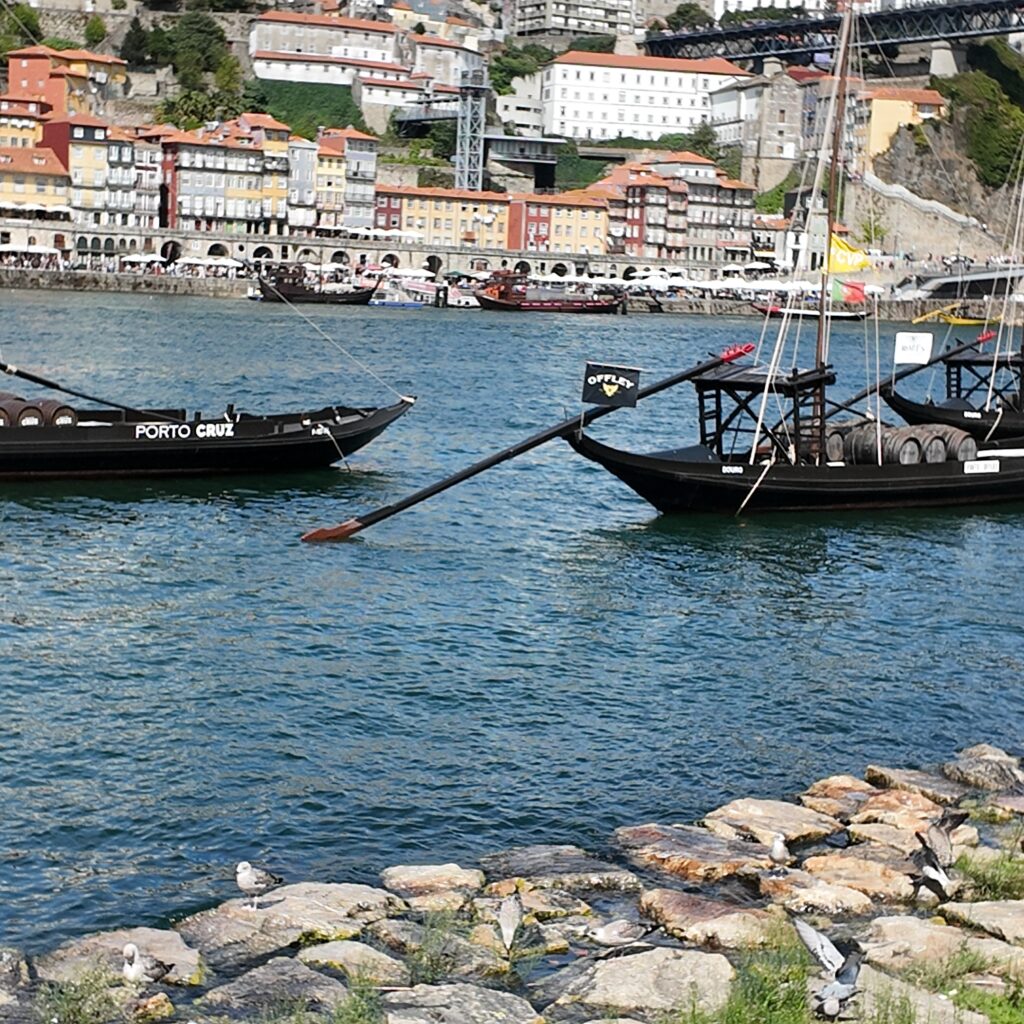
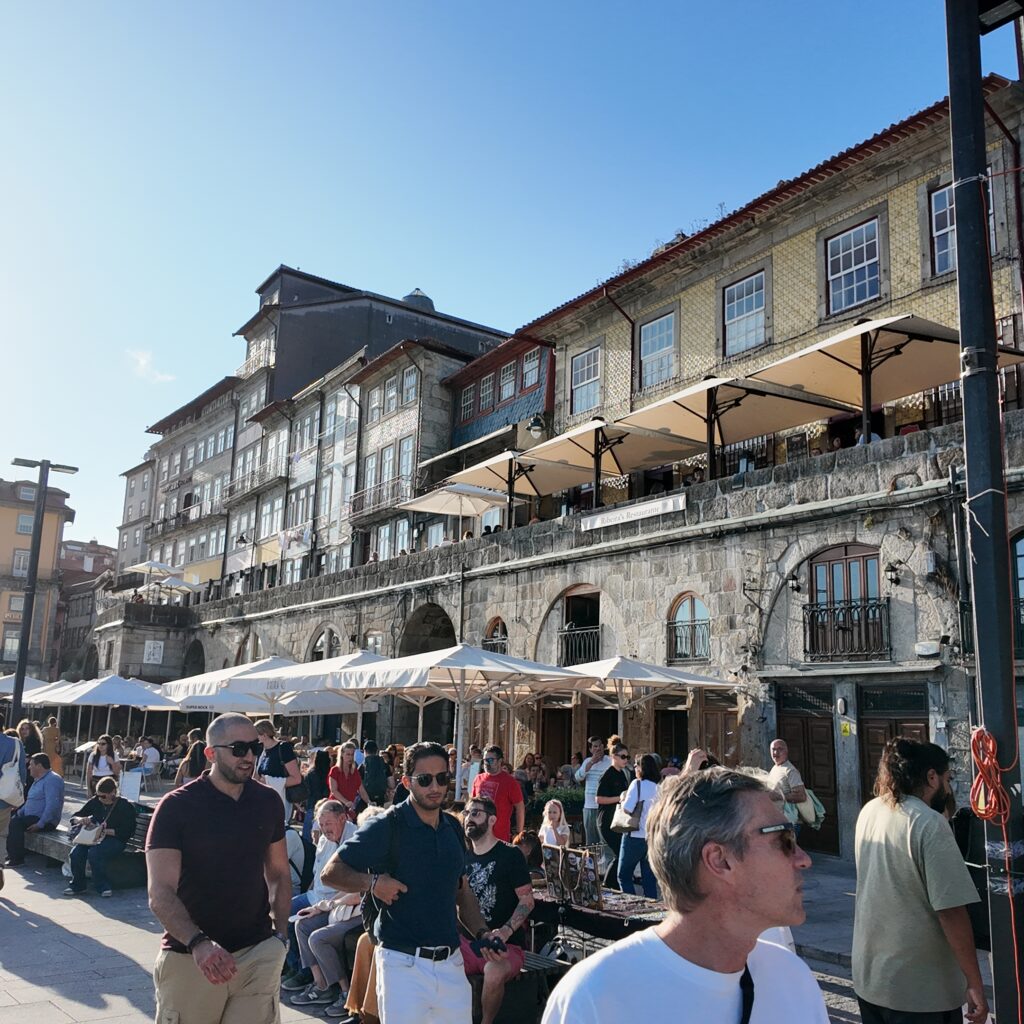
I had a great time in Faro and Lagos, just hanging out by the water and soaking it all in. But Porto—hands down—stole the show. It had been at the top of my bucket list for ages, and it did not disappoint. I also made sure to take in the short bus rides and longer train journeys along the coast, which were spectacular, pretending to be a local.

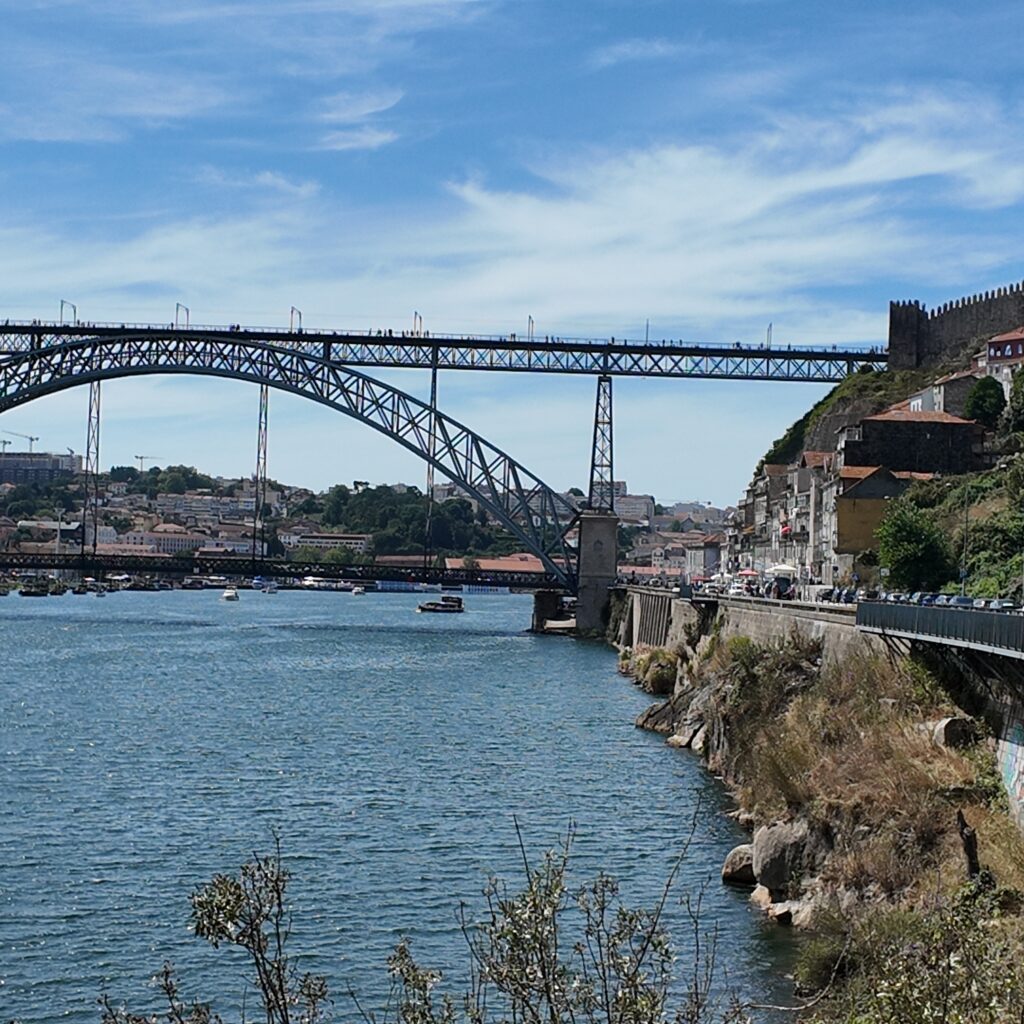
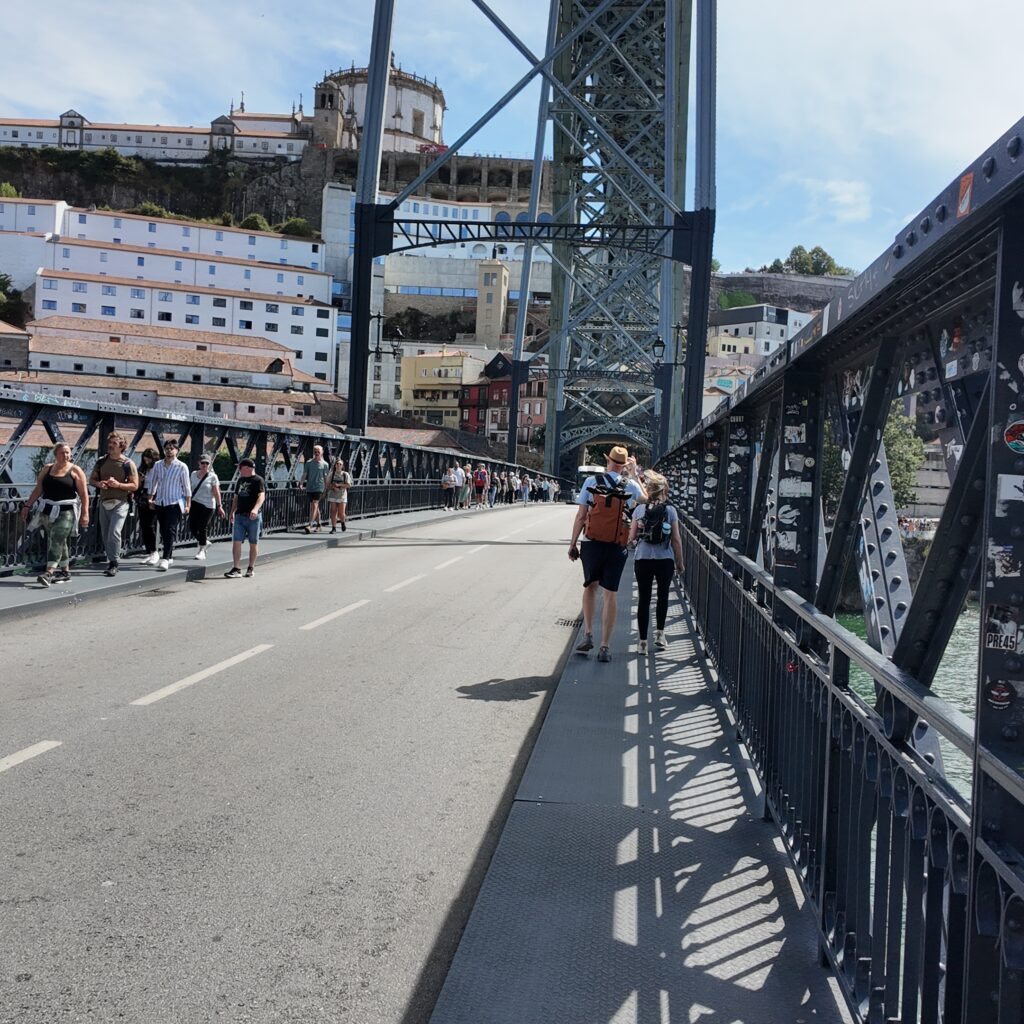
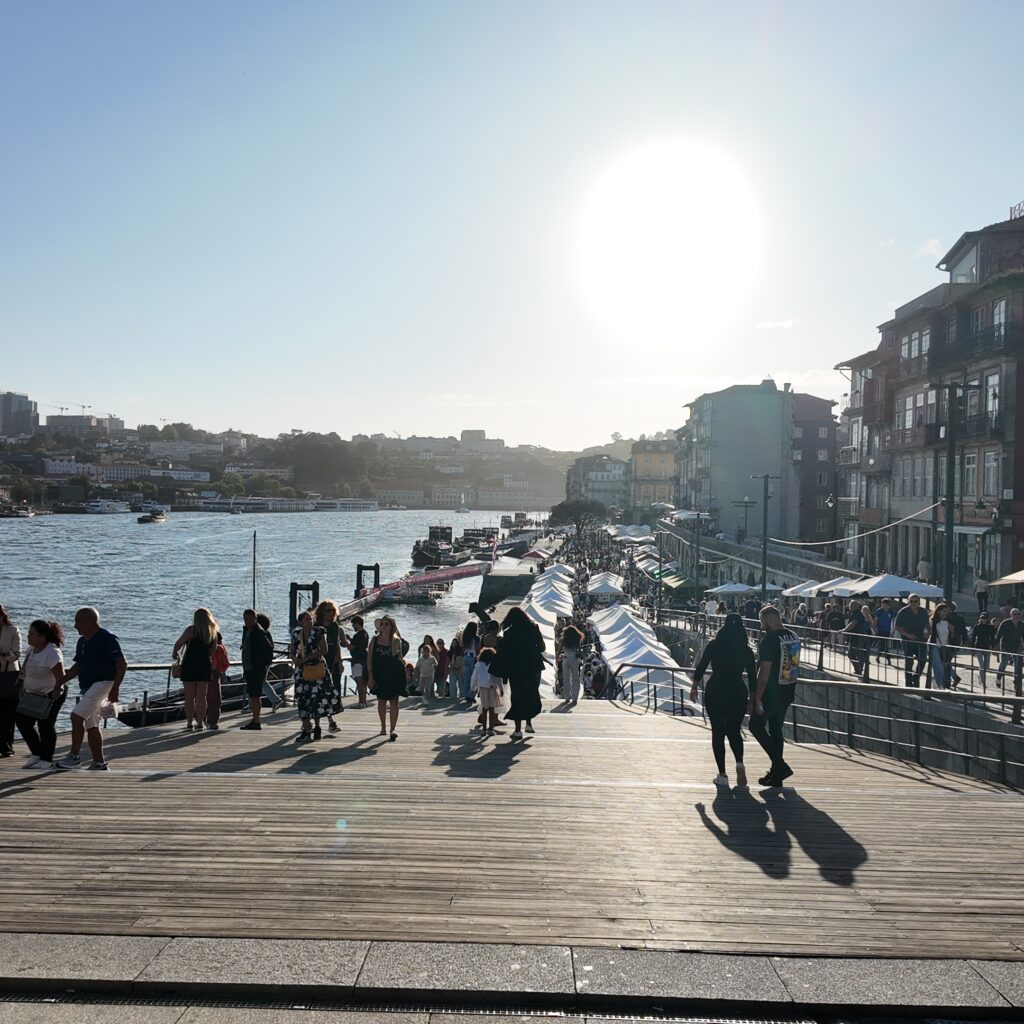
The city is split by the Douro River, and there are six famous bridges to cross at various points. The crown jewel is the Dom Luís Bridge—a stunning double-deck metal arch that links Porto with Vila Nova de Gaia. Honestly, I couldn’t stop taking pictures; it’s one of those “blink and you’ll miss it” moments that you also want to document from every possible angle.

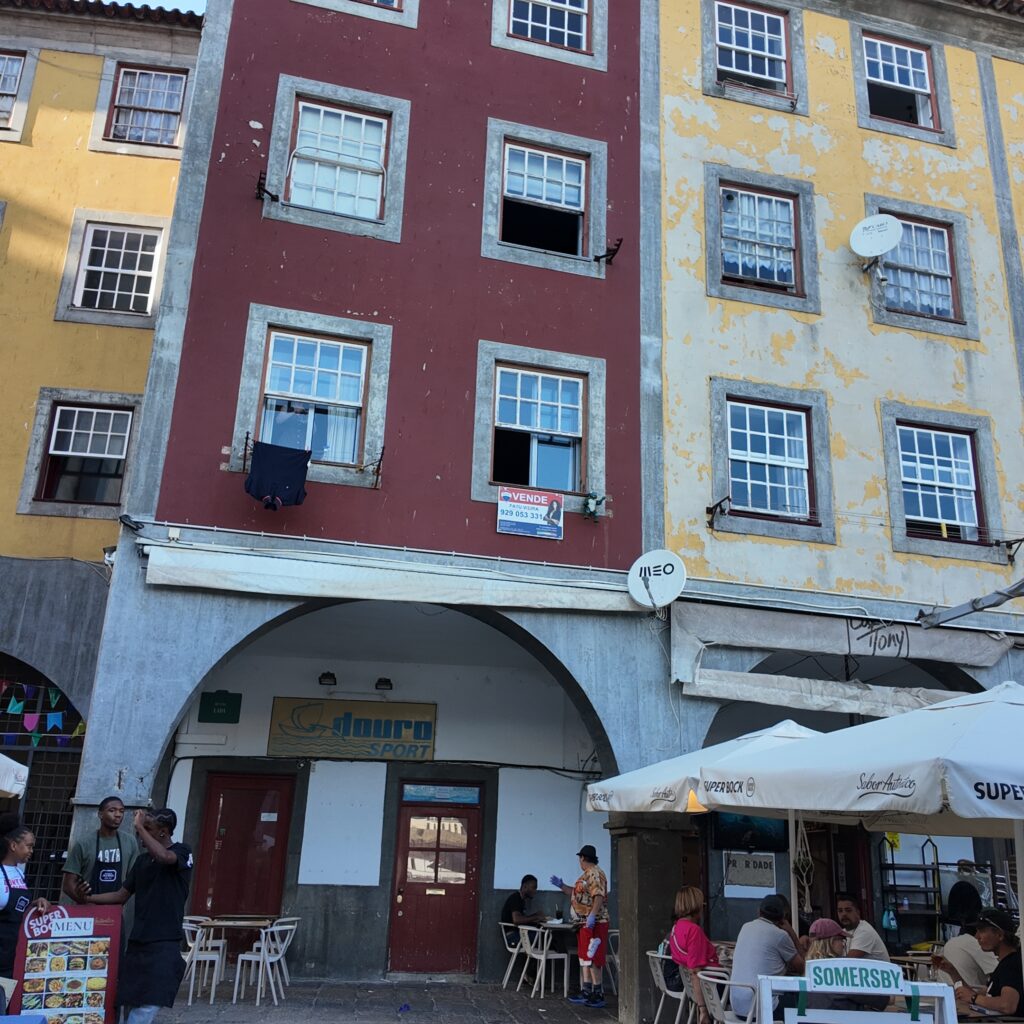
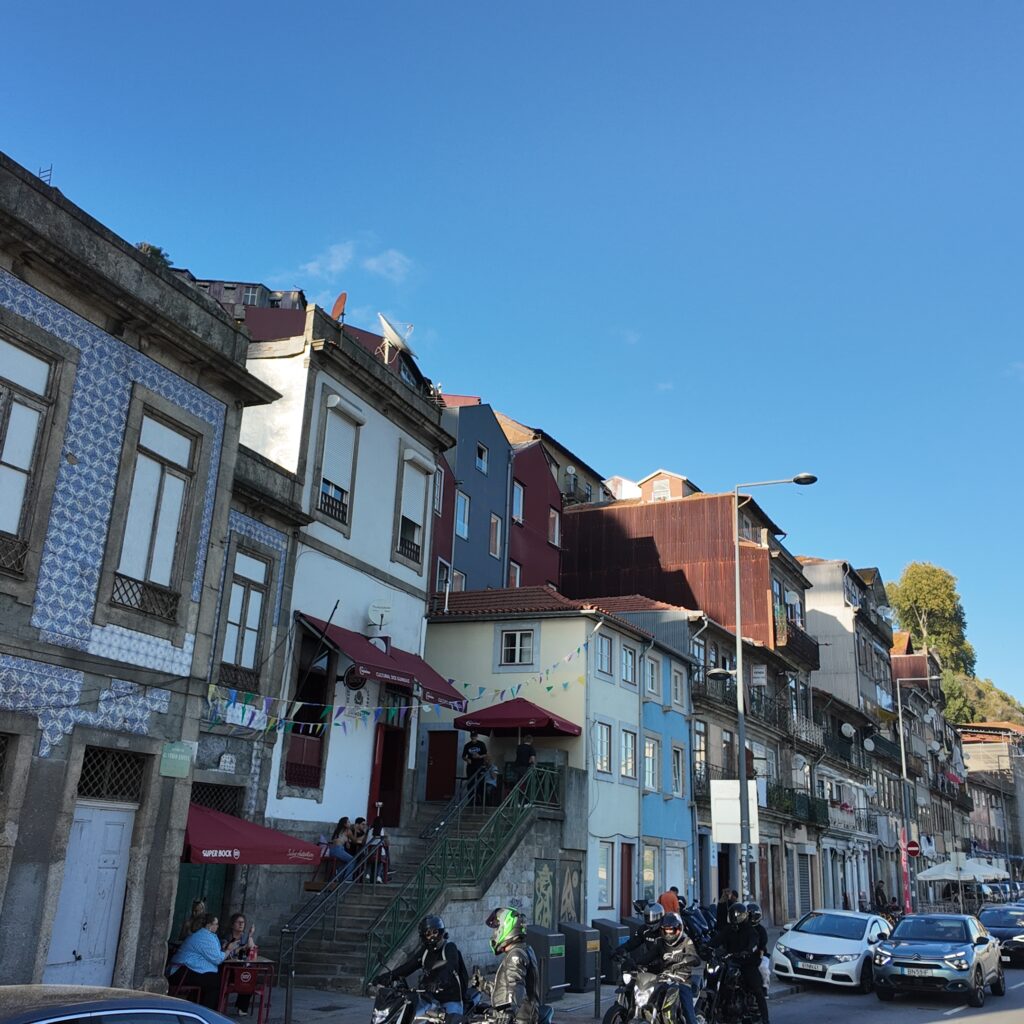
I spent a solid two days in Porto walking over 20,000 steps each day—up and down the river, soaking in the stunning architecture. The buildings lining the water are even more jaw-dropping in person. There’s also a gondola that gives you a sky-high view, but the line was so long I decided my legs had already earned a vacation of their own.

Want more Portugal chaos, cobblestones, and coastal views? Check out my YouTube channel for all the videos—no jet lag required.

www,YouTube.com/@NorthAmericanDarrell

Hit subscribe to dive into the full 1,500+ travel video catalog—because why stop at one continent when you can live vicariously through all of them?

Portugal’s history: Small Country, Big Ambitions

Portugal started getting serious in the 12th century, when Afonso I declared, “I’m king now,” and voilà—Portugal was officially a thing. Not content with being a tiny corner of Europe, the Portuguese set sail during the Age of Exploration, sending legends like Vasco da Gama around Africa to India and basically telling the world, “We’ll take it from here.”

They built an empire stretching across Asia, Africa, and Brazil—riches, spices, and cultural chaos included—while most Europeans were still figuring out how to map their own backyard. Today, Portugal is chill, gorgeous, and full of history: sun-soaked beaches, pastel-colored streets, port wine, and the occasional reminder that this tiny country once ruled the seas.

default

Prague, Czech – beer is served half full?!đŸ€”

As September 19th, 2025 crept closer, I was happily settled in Warsaw—but quietly plotting Munich for the first weekend of Oktoberfest. With my Eurail pass, booking the trip was almost absurdly easy: 

Warsaw to Prague, then a short hop into Munich.

Portugal. Poland. Iceland. And now Prague.

Everything was lining up so cleanly. Routes connected. Dates made sense. Just a perfectly unfolding chain of cities—one rail segment at a time.

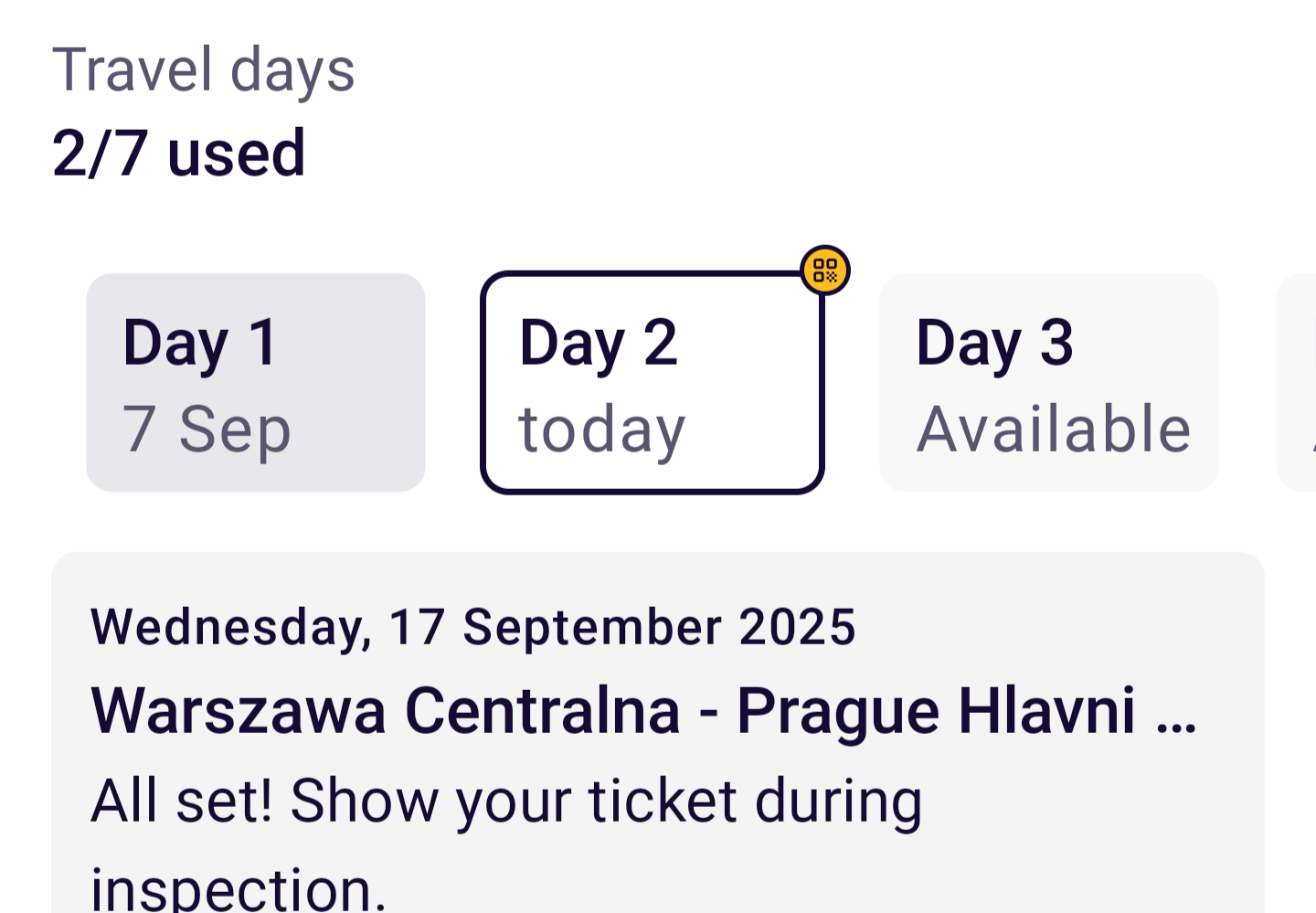
This was day two using my Eurorail pass. Day one was used getting from Faro to Porto Portugal along the amazing coast. Massive wins using the pass the first two days.

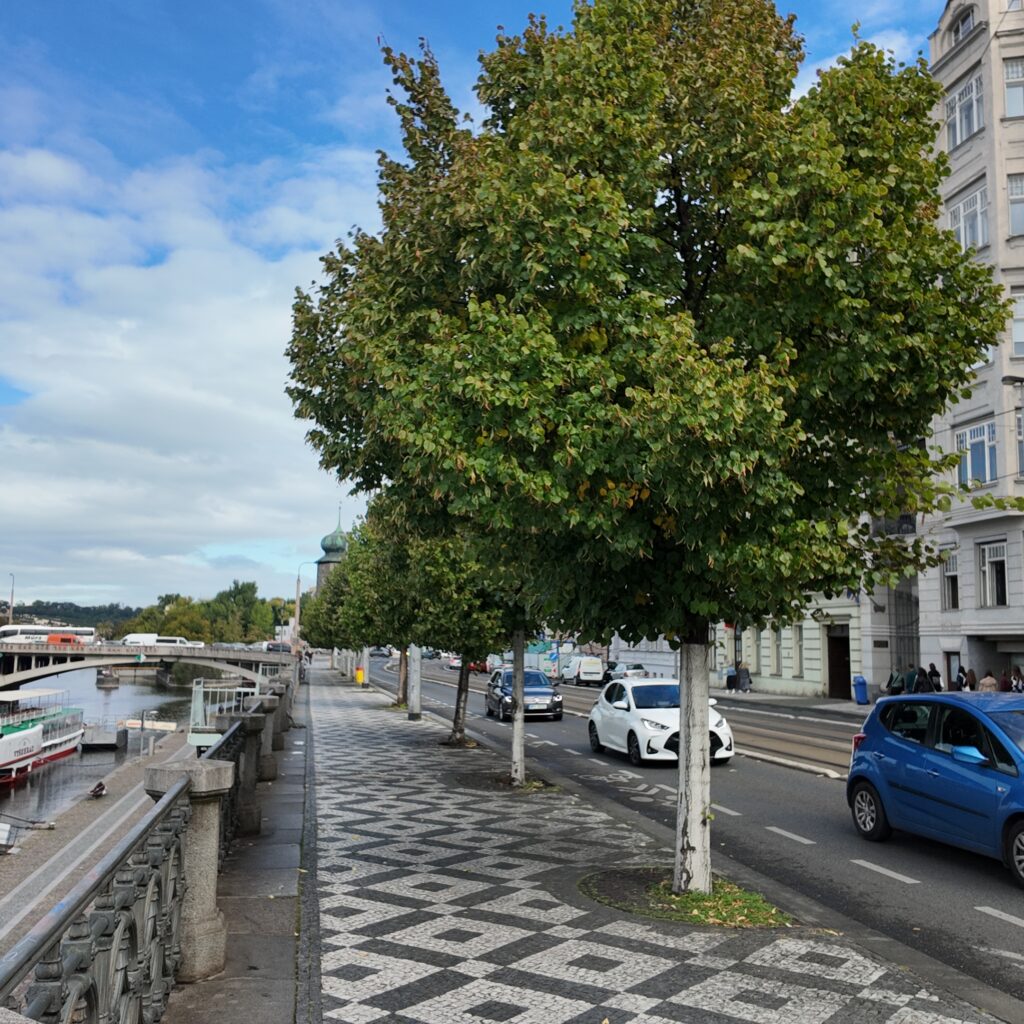
The Czech Republic has always intrigued me—between its legendary international hockey and, of course, its world-class beer, how could it not? I only spent a couple of days in Prague, but every minute landed. The city feels effortlessly historic without being frozen in time, the beer is somehow even better than advertised, and there’s a rhythm to the place that invites you to slow down and look around.

It was one of those stops that proves you don’t need weeks somewhere for it to leave a mark. Sometimes a place shows you exactly what it is right away—and Prague did that beautifully.

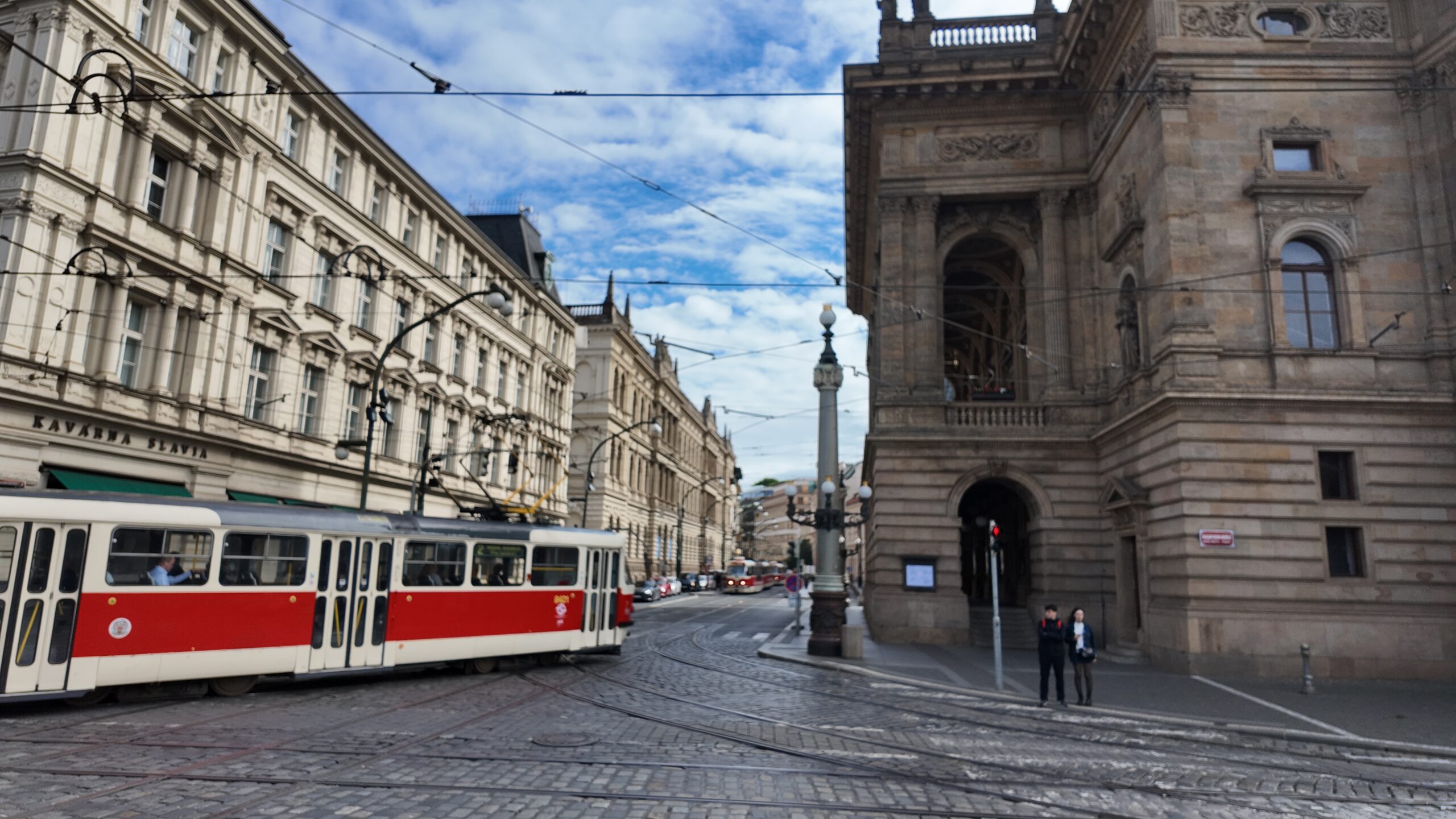
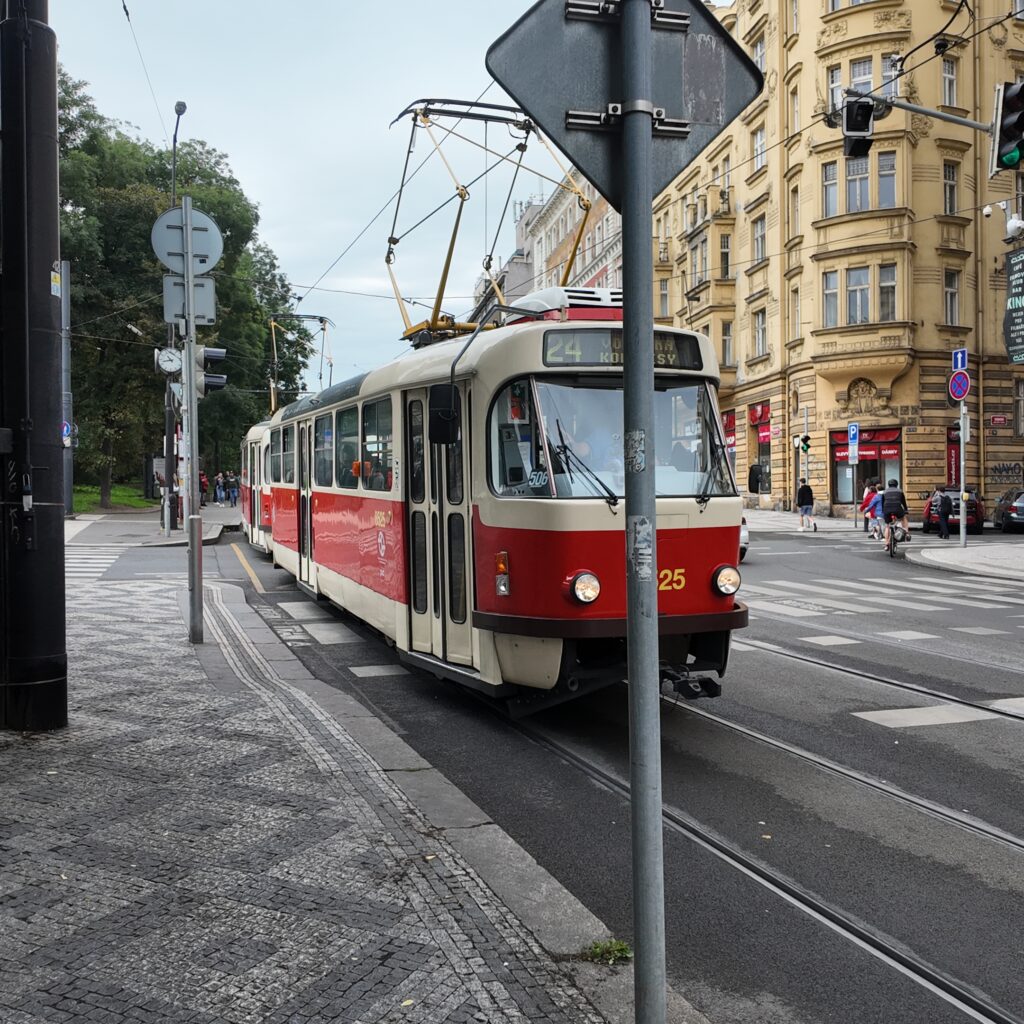
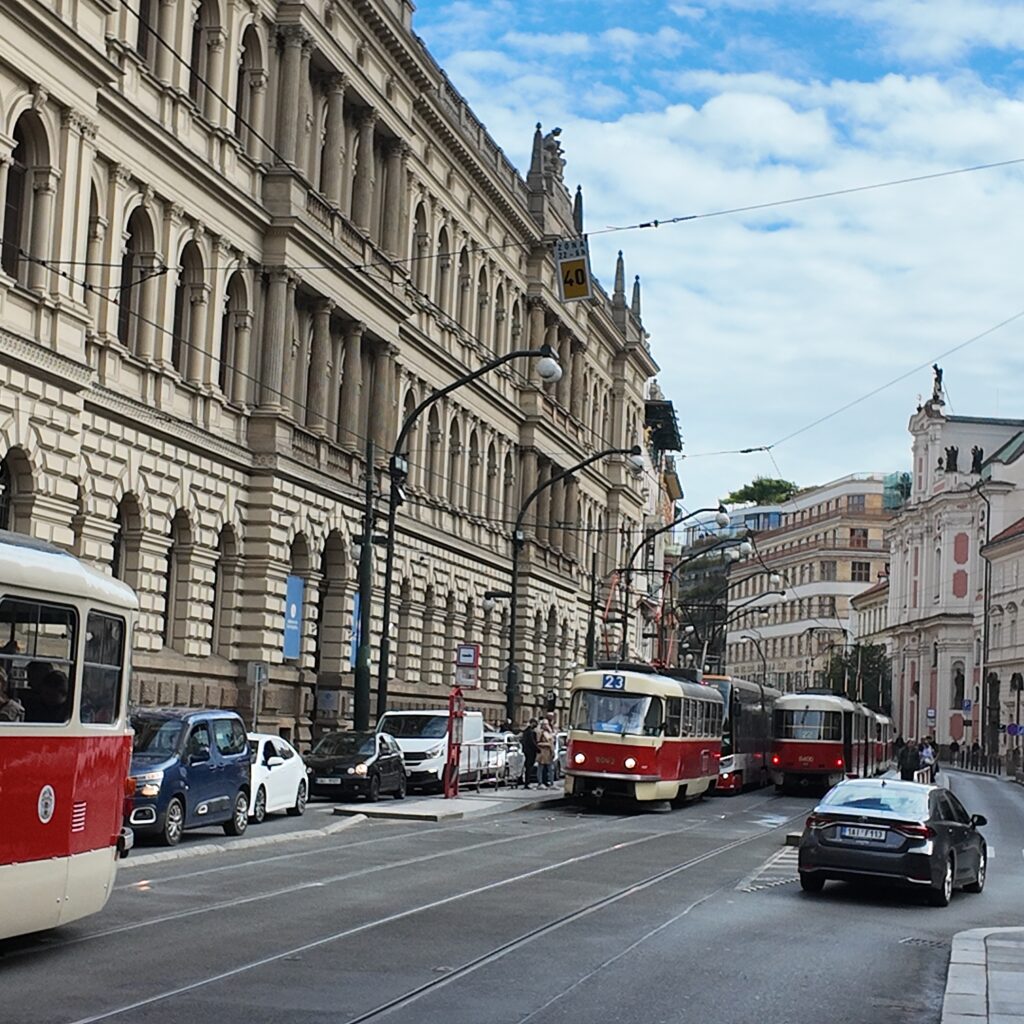
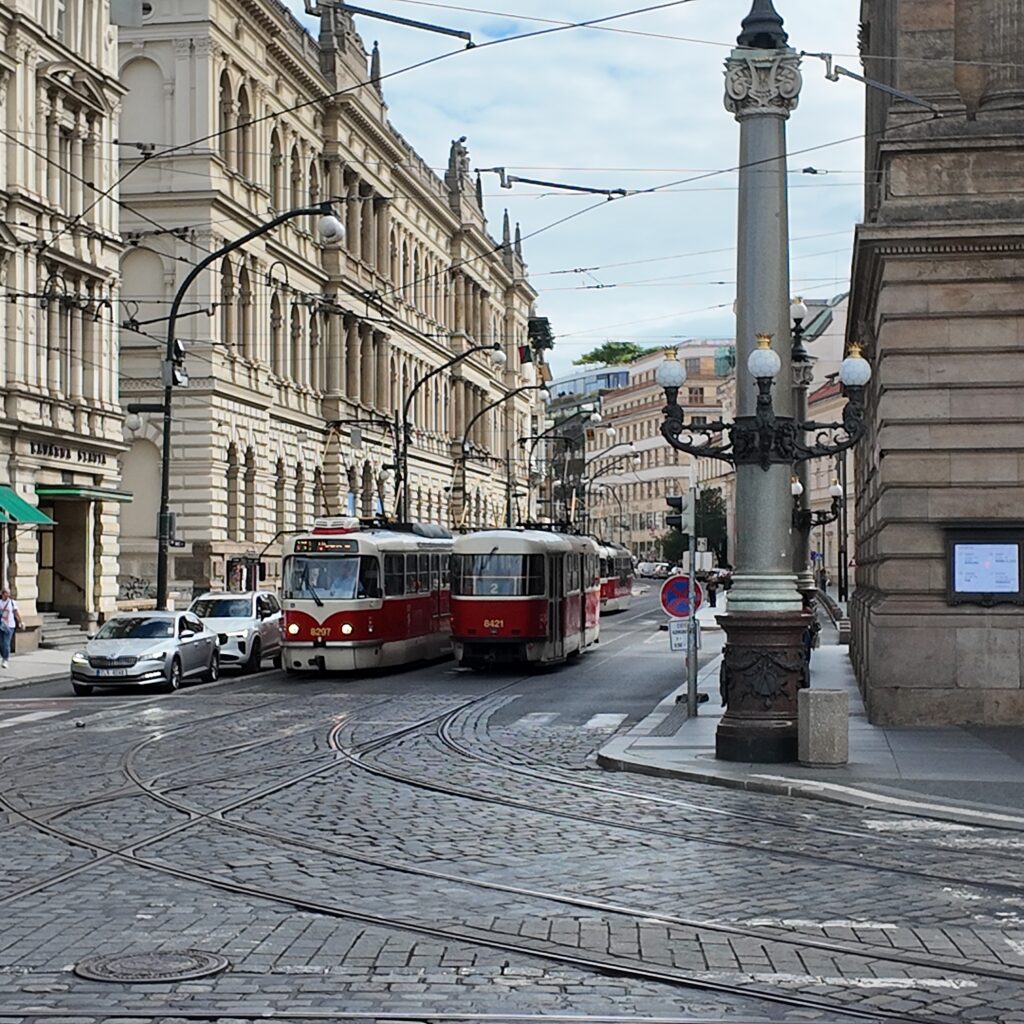
There’s something undeniably awesome about streetcars sharing the road with everyday traffic. I first saw it in Vienna and thought, “Okay, that’s pretty neat.” But Prague? Prague turns it into an art form.

You’ve got ancient, rattling trams rubbing elbows with sleek, modern ones—both weaving through cars, bikes, and pedestrians like they’re operating inside some chaotic, high-speed safe zone. Everyone somehow knows where everything else is going. No hesitation. No drama. Just motion.

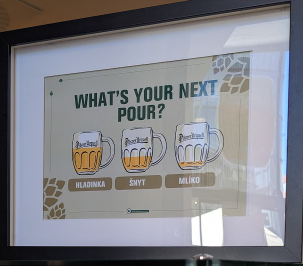
The beer in Prague is something else entirely. They pour it with half the glass—sometimes more—foam. There’s even a style called Mlíko where about 75% of what you’re holding is foam
 and you pay full price for the privilege.

I ended up in a lively debate with a bartender about it. He swore it “tastes better that way.” I countered with my very scientific position: 90% of a beer lives in the top 10% of the glass—and yes, we are both professionals. We laughed. The foam probably laughed. And I still drank it.

Because when in Prague, you surrender to the professionals. đŸ»

Czeck beer musuem ... If you;re ordreing a "Mliko", it's apprantly your last beer of tghe night. I still do not understand! LOL
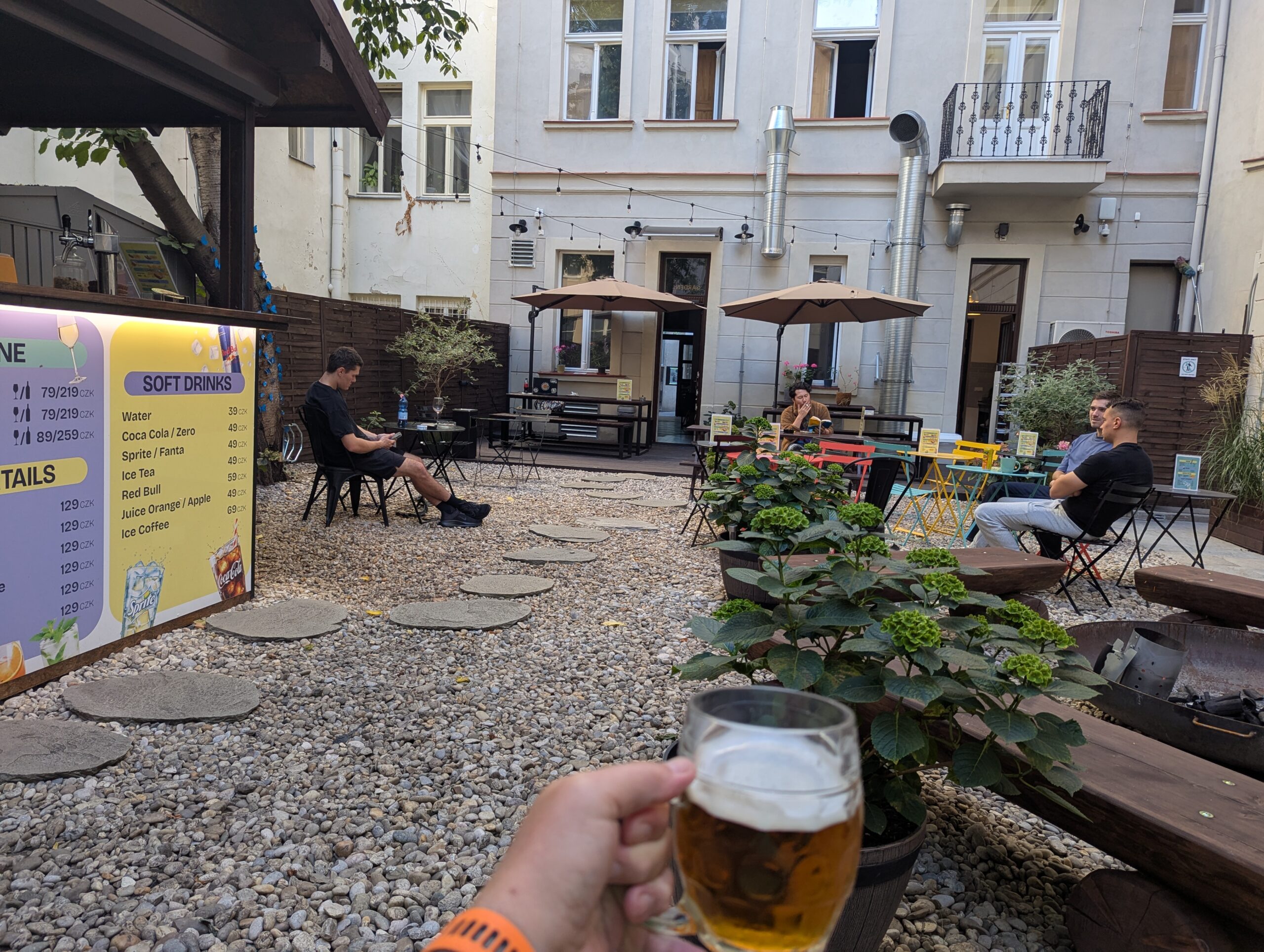
Beer in my amazing $20 a night hostel courtyard! That is how much beer you get once the foam goes away! đŸș

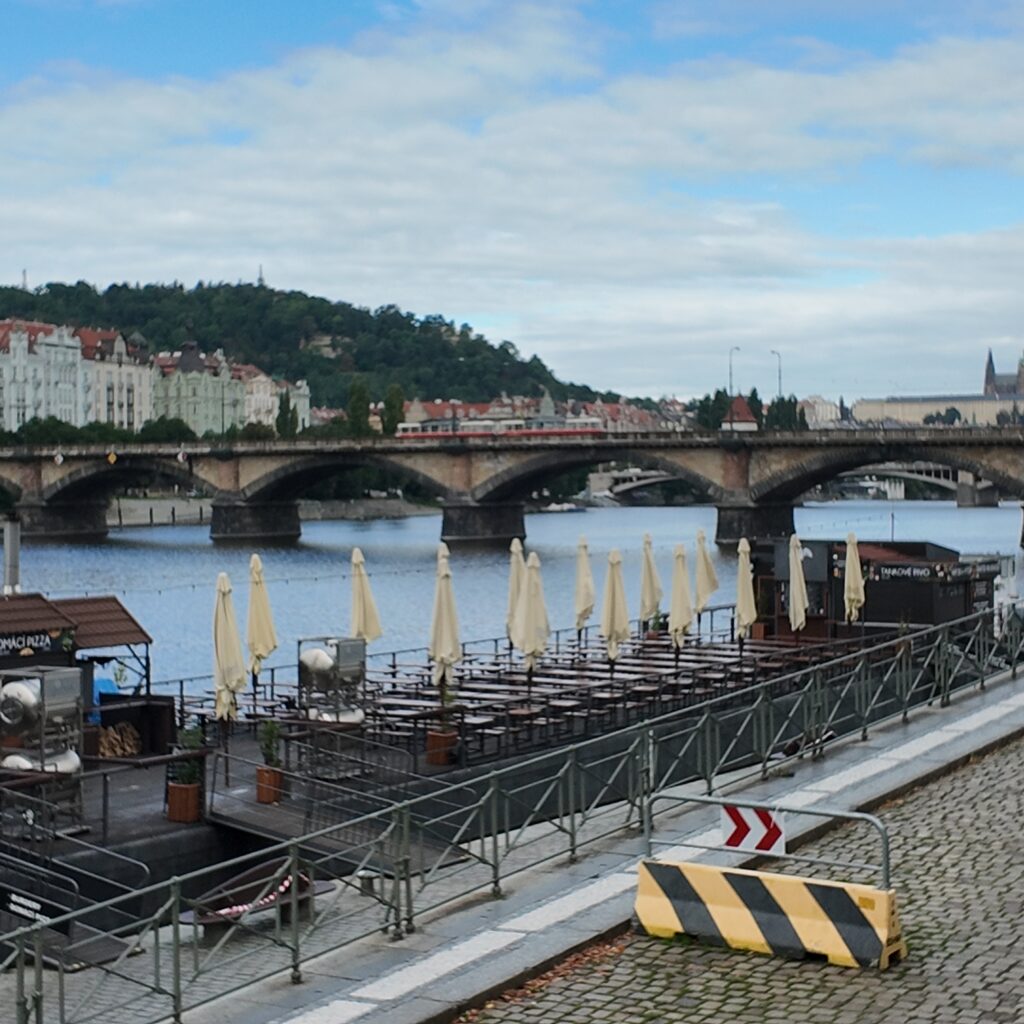
The city itself—and especially the riverside—was incredible. I can only imagine how stunning it must be in winter
 though, to be honest, I’d probably never make it outside in that kind of cold.

So instead, here are a few pictures and videos—so you can admire Prague from a warm, safe spot, just as nature intended.

Want more Czech Republic adventures—and proof that I walked way too much? Head over to my YouTube channel for videos, chaos, and maybe a beer or two:

www.YouTube.com/@NorthAmericanDarrell

There are over 1,600 travel videos from around the globe—enough to make your couch feel like first class.
Apparently, my wandering now qualifies as educational content.

Prague history: The City That Time Forgot
 and Then Perfected

Prague started way back in the 9th century as a collection of hilltop settlements around what’s now Prague Castle—basically, medieval real estate with a view. By the Middle Ages, it became the capital of Bohemia and a cultural powerhouse, where kings built castles, churches, and universities while everyone else was still figuring out plumbing.

Under Charles IV, the city got fancy: the oldest university in Central Europe, bridges, cathedrals
 Prague basically said, “We do grandeur better.” Fast forward a few centuries, and the city survived wars, empires, and communism, only to emerge in 1989 via the Velvet Revolution as a stunning, slightly magical city where Gothic spires, cobblestone streets, and craft beer coexist in perfect harmony.

PXL_20250909_163011199

Warsaw, Poland – Just like Ukraine!

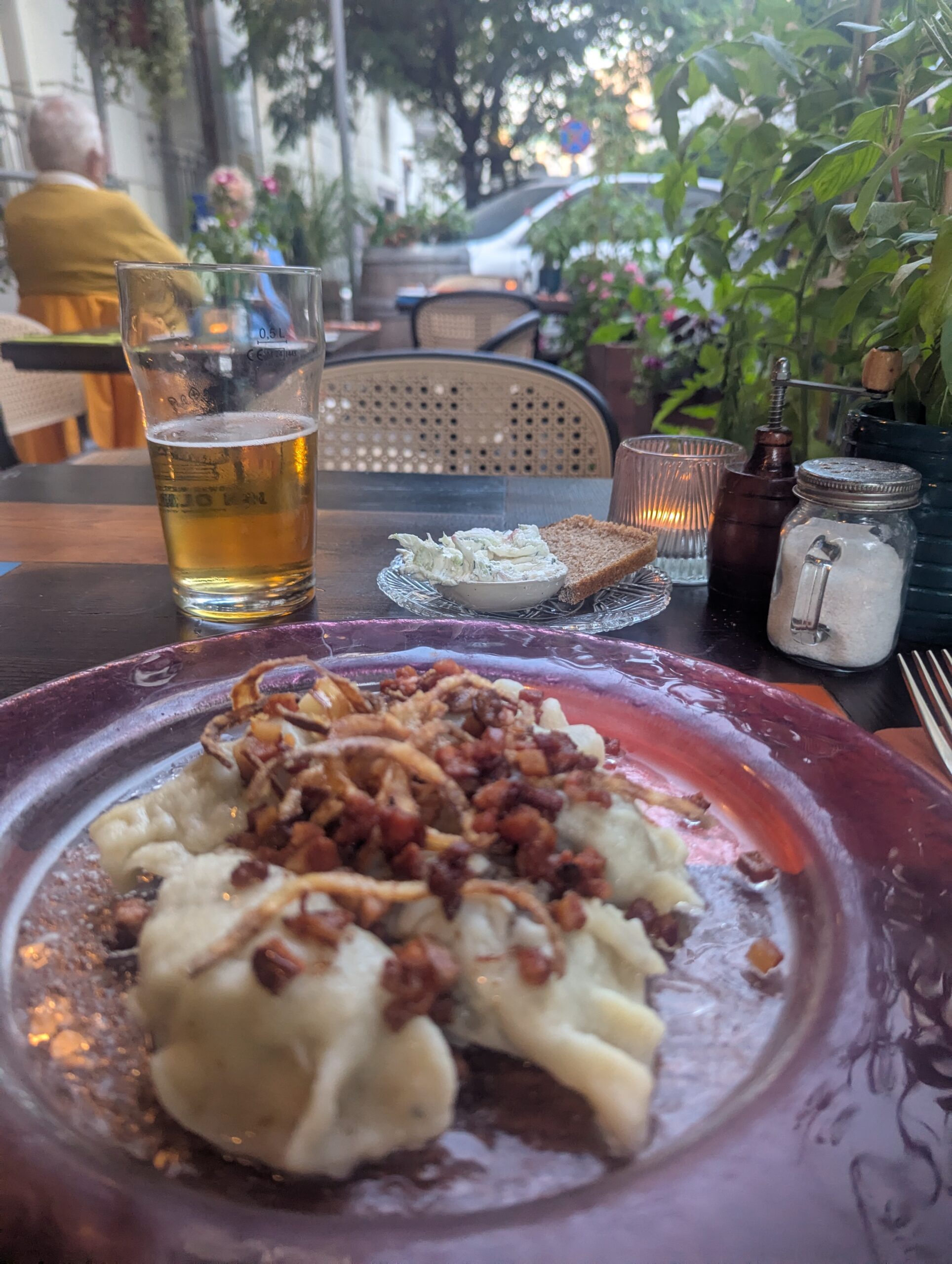
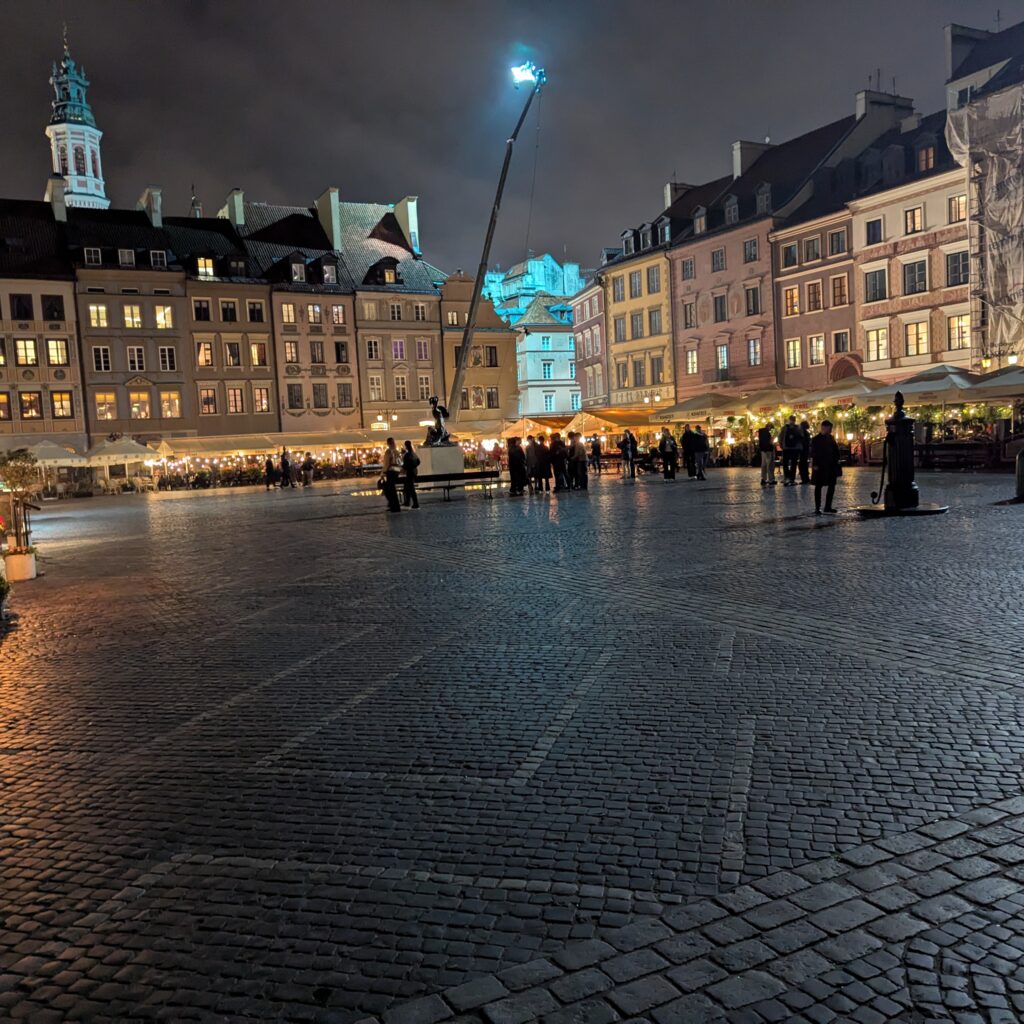
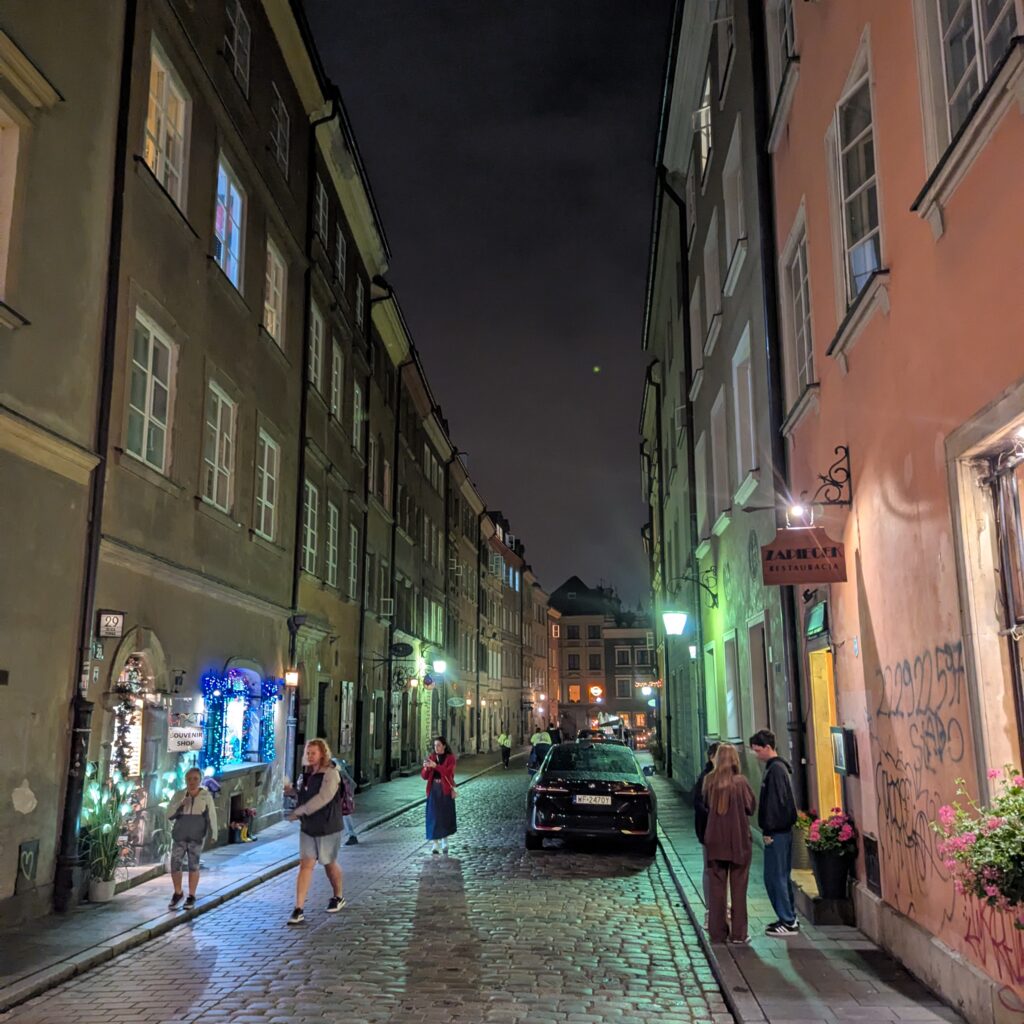
I have to say, Warsaw ended up being one of my favorite stops on the entire trip. There were no flashy tourist traps or overproduced experiences—just a calm, lived-in city with an easy rhythm and, most importantly, incredible food.

Everywhere you turned, people were speaking Polish (and Ukrainian), and pierogies weren’t just a menu item—they were practically a food group. Warm, simple, comforting food done right.

In a quiet, unexpected way, it reminded me of my mom in Heaven. The kind of comfort you don’t plan for, but recognize immediately when it shows up.

I spent three days in Warsaw before launching into a 48-hour Iceland whirlwind using my Wizz Air Pass—essentially a masterclass in how much jet lag one human can endure in two days.

Booking the flights there and back at the same time made me feel like a travel genius
 or someone who should probably be supervised, but no one wanted the job.

Coming back to Warsaw was pure relief. Slow walks, nonstop eating in Old Town, and convincing myself that aggressively shoving pierogies into my face absolutely counts toward my 10,000 daily steps. Balance is important.

Want more Warsaw adventures, pierogies, and wandering chaos? Check out my YouTube channel for all the videos—no passport required.

www.NorthAmericanDarrell.com

Smash that subscribe button and step into the beautifully chaotic universe of 1,600+ travel videos—with more questionable decisions added weekly.

Watch me:

Wander the globe with zero chill

Battle jet lag like a caffeinated (possibly drunken) superhero

Make deeply questionable food choices

And survive airports that appear to actively hate humanity

All from the comfort and safety of your couch

While you roast me. đŸ€˜đŸ»


Just real travel, bad ideas, and solid stories.

—all from the safety of your couch while making fun of me! đŸ€˜đŸ»

Warsaw history: The Phoenix City

Warsaw started out in the 13th century as a sleepy riverside settlement, minding its own business along the Vistula. By the 16th century, it said, “Move over Kraków, I’m the capital now,” and quickly became Poland’s political and cultural hub.

Over the centuries, foreign powers—Russia, Prussia, Austria—kept trying to boss Warsaw around, and the city responded with uprisings, rebellions, and general stubbornness. 

Then came World War II, when almost everything got flattened
 but Warsaw didn’t just sulk. It rose from the rubble, rebuilt its Old Town brick by brick, and now stands as a gleaming, slightly sarcastic symbol of resilience: “You can’t break me, folks, nice try.”

default

ReykjavĂ­k, Iceland – Hot springs! ♚

I didn’t end up using my Wizz Air All You Can Fly pass as much as I originally planned.

After experiencing European train travel, I found myself preferring it. Trains were smoother, more comfortable, and often more enjoyable overall, which made short-haul flights feel less appealing by comparison.

That said, I still managed to squeeze in a 48-hour trip from Warsaw to ReykjavĂ­k, finally checking Iceland off my bucket list.

That journey wrapped up my 23rd, 24th, and final flights on the €499 pass.

Looking back, it was a busy, sometimes chaotic stretch of travel—but also a reminder of how fortunate I am to keep moving, exploring, and learning what styles of travel work best for me.

Hot springs entry came with a free beauty mask, mine did not work! 😆

A big part of using an AYCF pass is always having your next destination locked in. If you don’t, you risk getting stranded somewhere, staring at a snack bar and wondering if your life has quietly turned into a low-budget travel documentary. Since Iceland can only be reached by plane, that mattered. Thankfully, I booked my return flight at the same time as my departure, guaranteeing I’d make it back to the mainland. Score one for planning—or possibly luck.

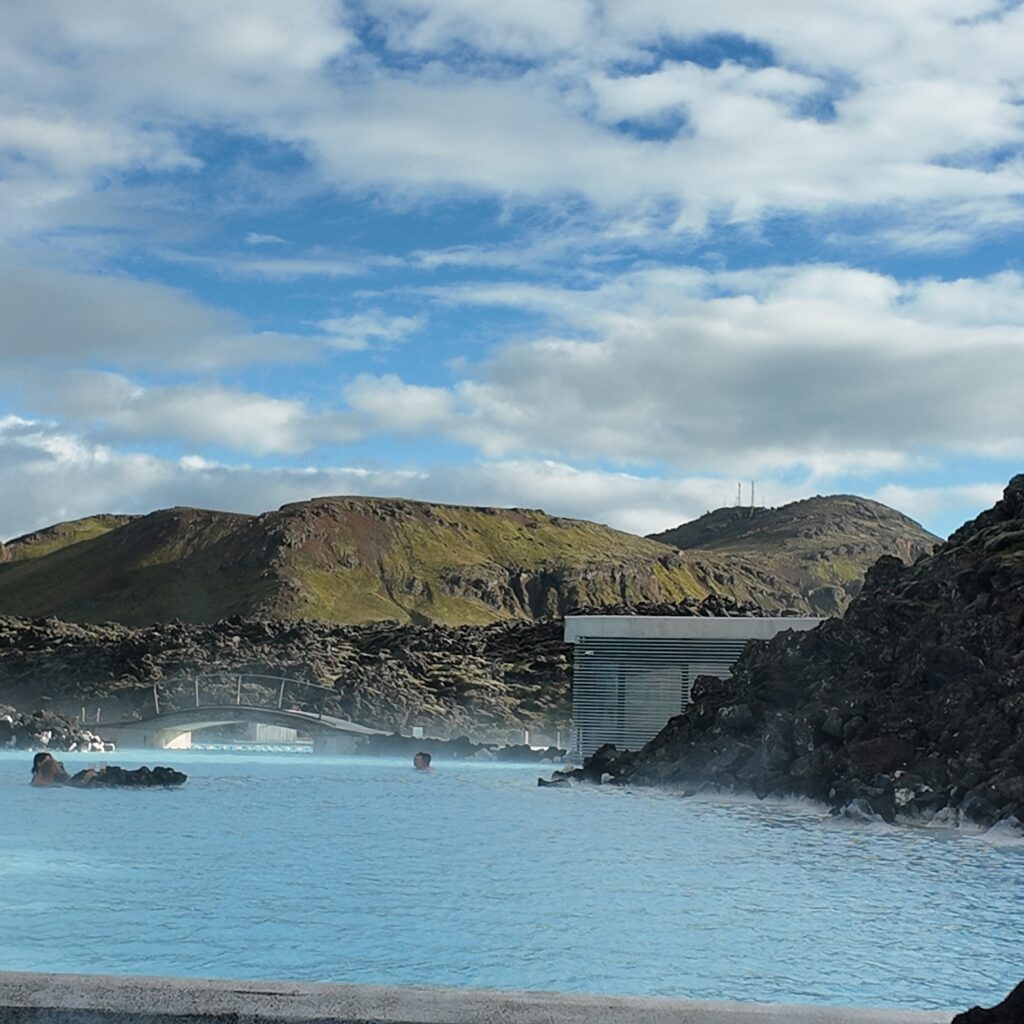
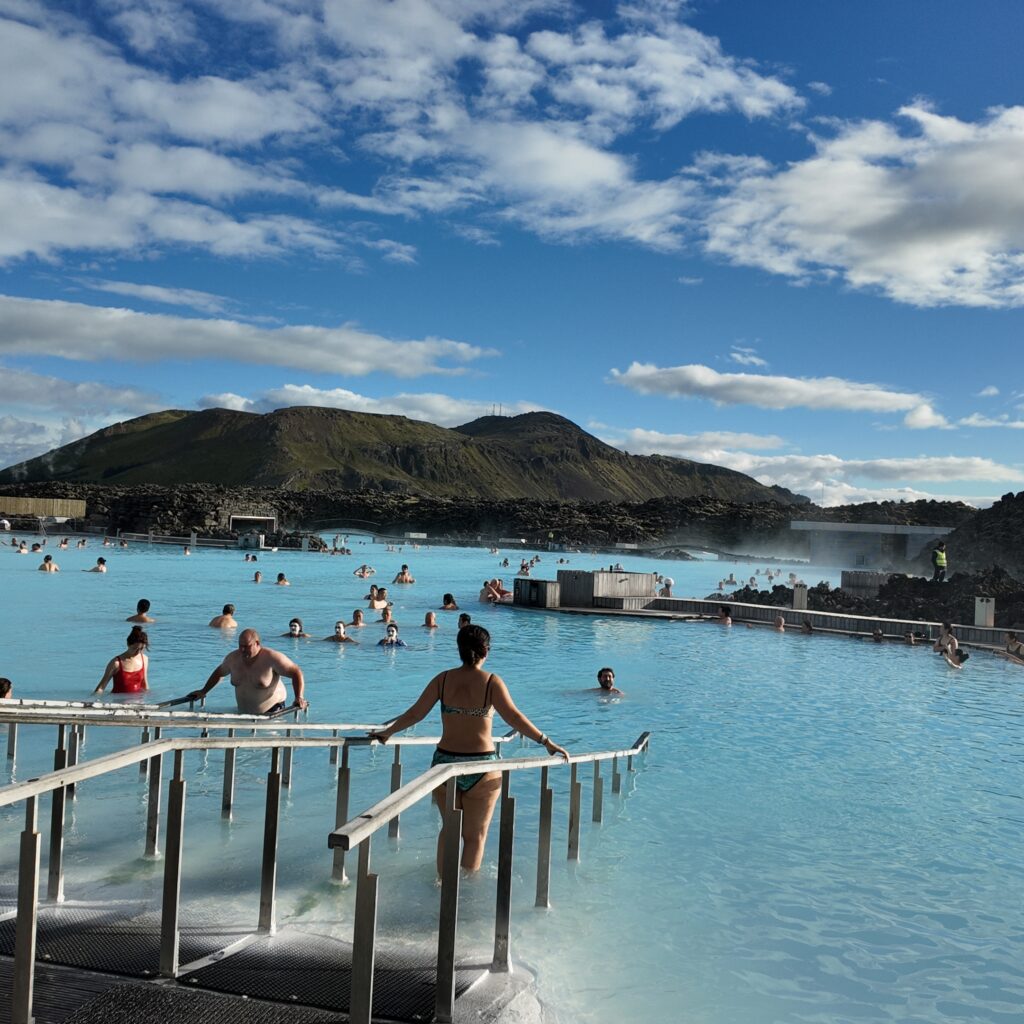
I didn’t do much while I was there. I mostly walked around Reykjavík and visited two hot springs, which was exactly the point of the trip. Ironically, there was a public pool and hot spring complex right next to my hostel. After weeks away from my usual spa routine, it felt incredible. I rotated between three temperature-controlled pools, cold plunges, saunas, and steam rooms like a professional relaxation athlete.

I enjoyed it so much that I went back again the next morning before heading to the Blue Lagoon.

While soaking, I met a traveler from Seoul, a professional writer who was going through a rough patch. I got him laughing by telling him I spend hours writing things that almost nobody reads. He even offered to show me around when I visit Seoul in March—which perfectly sums up why I travel in the first place: strangers, shared moments, and unexpected laughs.

No cameras were allowed at the hot springs, which honestly felt like a gift. The attendant said phones distract from relaxation—and she was probably right. She also likely saved me from posting a thousand blurry photos of me pretending to be interesting.

Sometimes the best travel moments are the ones that don’t end up on camera at all.

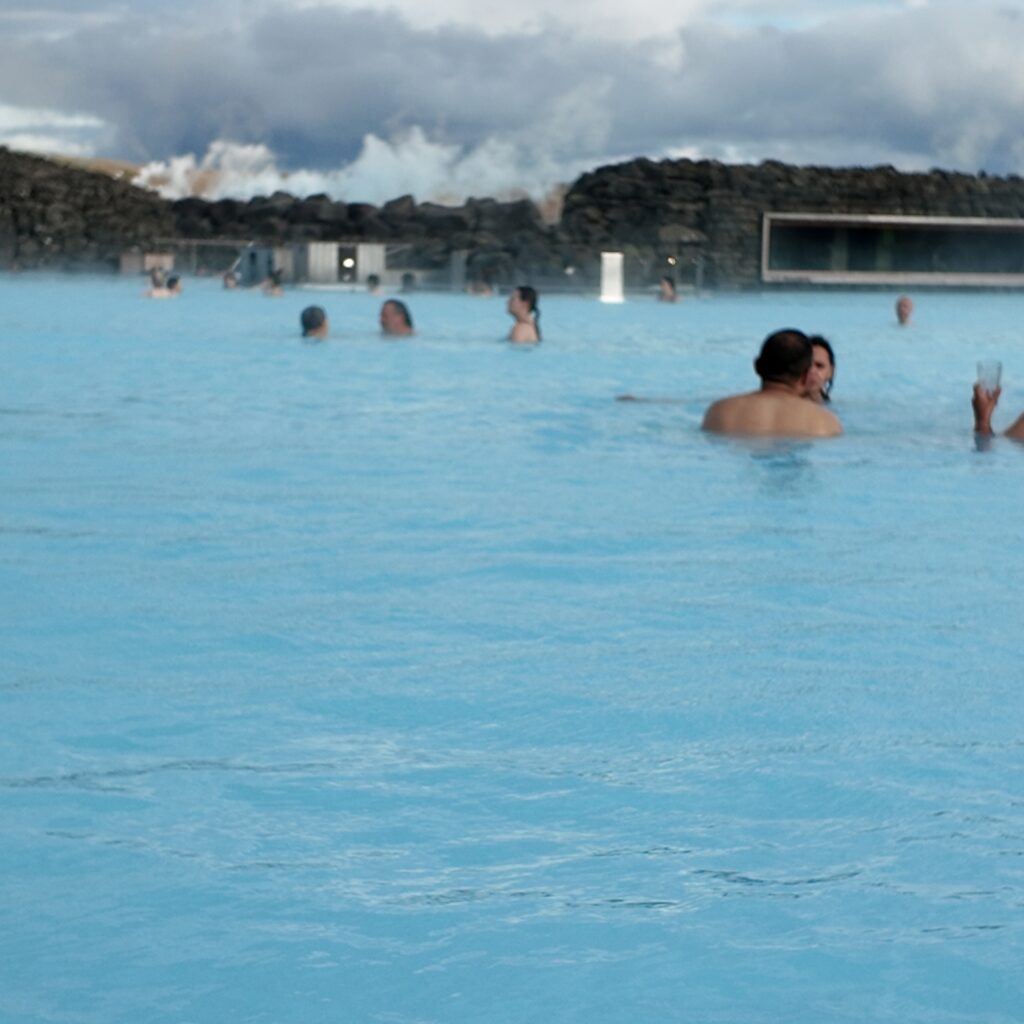
Below are just a few snapshots and short videos from the Blue Lagoon—because words don’t quite do justice to soaking in steaming geothermal water while convincingly pretending you’re a sophisticated spa-goer.

If you want more, check out my YouTube channel for the full adventure (and all the bubbles I responsibly chose not to photograph):

NorthAmericanDarrell – YouTube

And yes—feel free to smash that subscribe button like it just stole your passport.

Iceland’s Hot Springs: Nature’s Hot Tub Since Forever

Icelanders didn’t waste time—they landed in the 9th century and thought, “Why chop wood when we can just soak?” And so began the country’s love affair with geothermal hot springs, perfect for bathing, cooking, and gossiping about Viking drama.

By the Middle Ages, these steamy pools were community centers, where locals scrubbed, plotted, and probably swapped embarrassing stories. Fast forward to today, and Iceland has turned those natural hot tubs into luxury spas like the Blue Lagoon, proving that even a volcanic island can serve up relaxation, selfies, and a little Icelandic sass.

default

Switzerland – Amazing!đŸš‚â›°ïž

Heading into my month-long European adventure, taking the train through the Swiss Alps was right at the top of my must-do list.

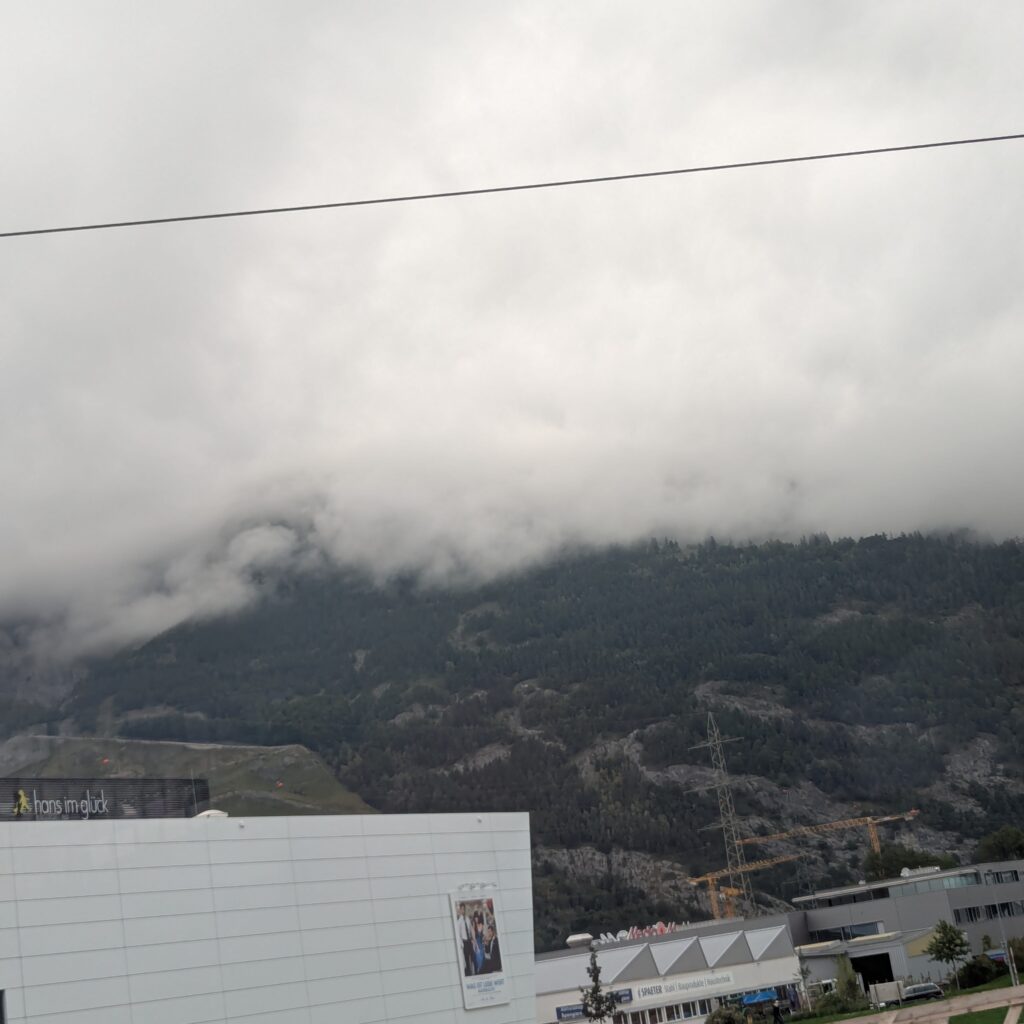
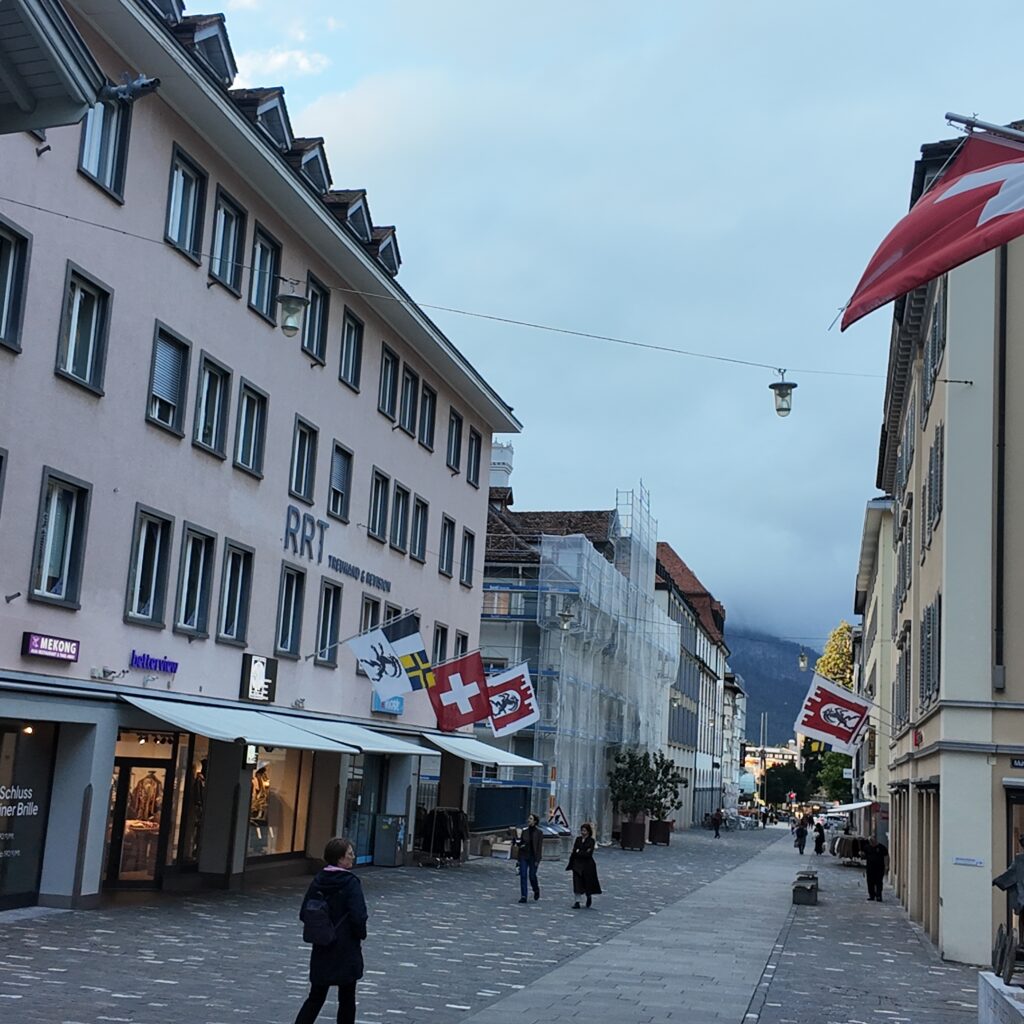
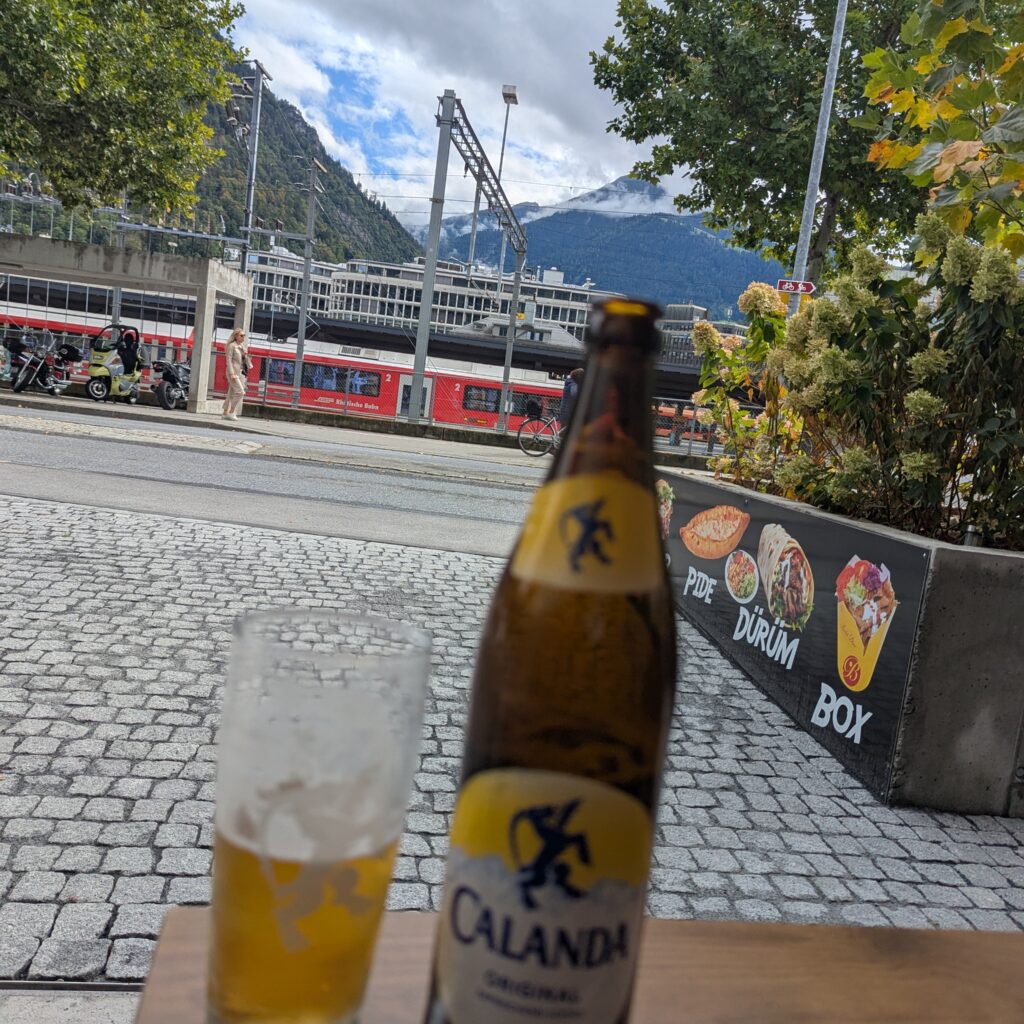
I hopped on in Munich on day one of three and made my way to the stunning mountainside town of Chur. I scored a hostel that used to be the town jail—steel doors everywhere, and I couldn’t help but wonder what stories those walls would tell. Mostly, I imagined about that one or maybe two times I spent in the slammer AKA the drunk tank! 😆

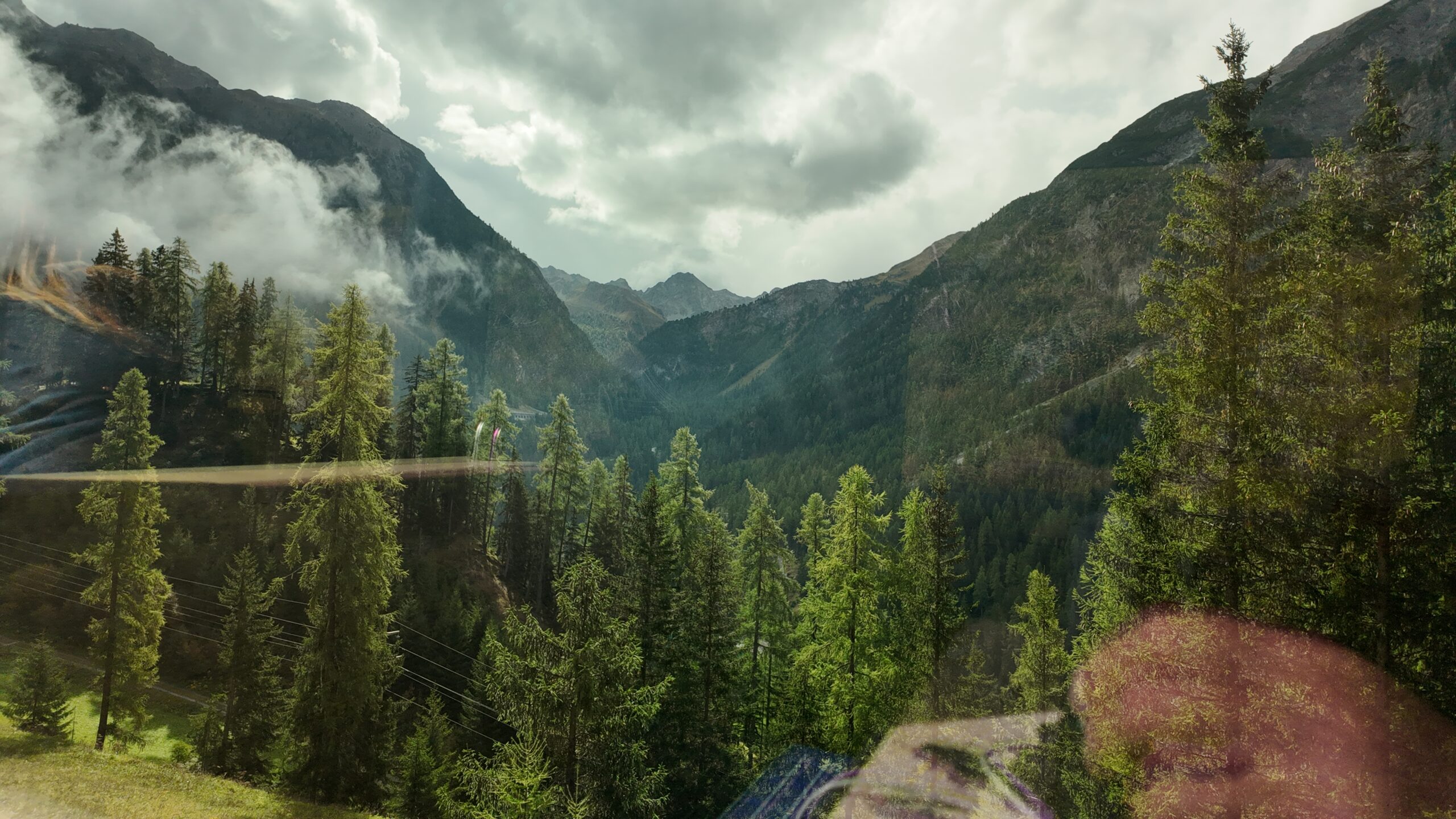
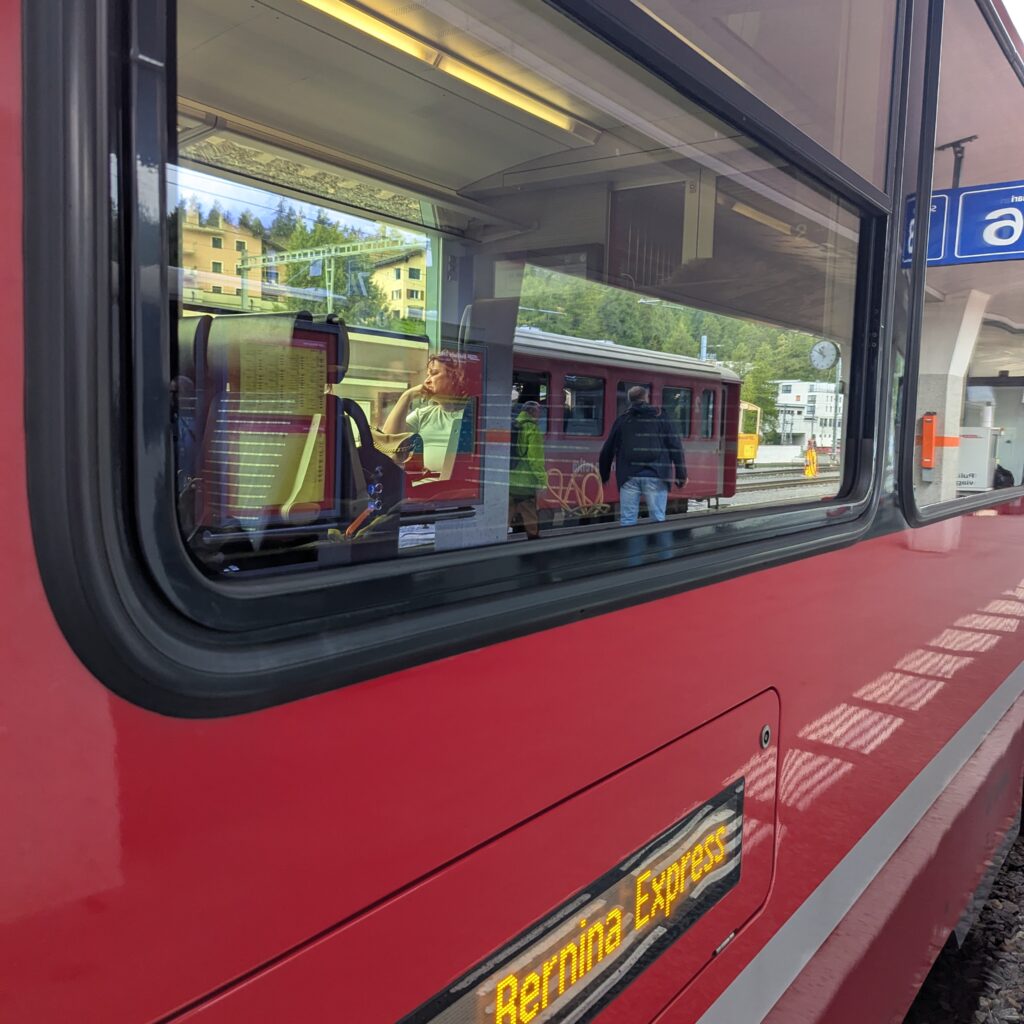
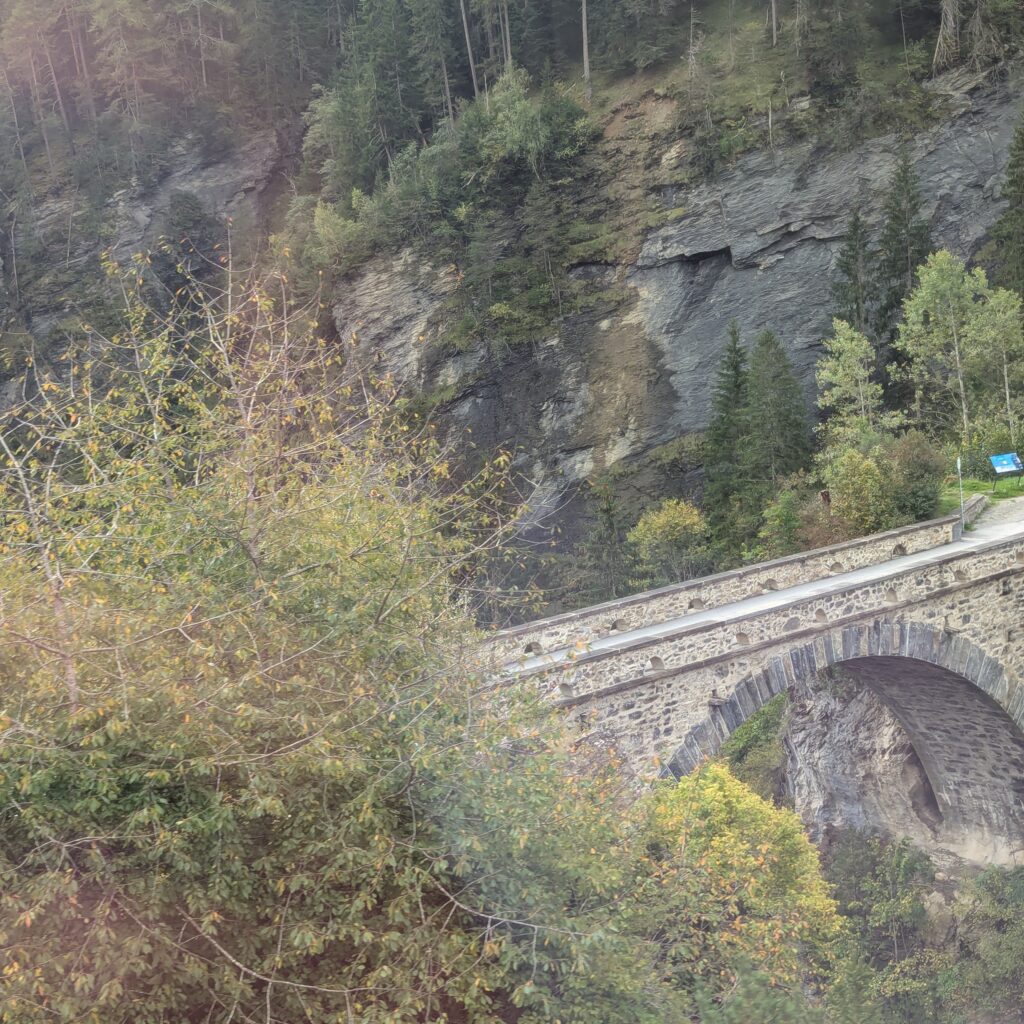
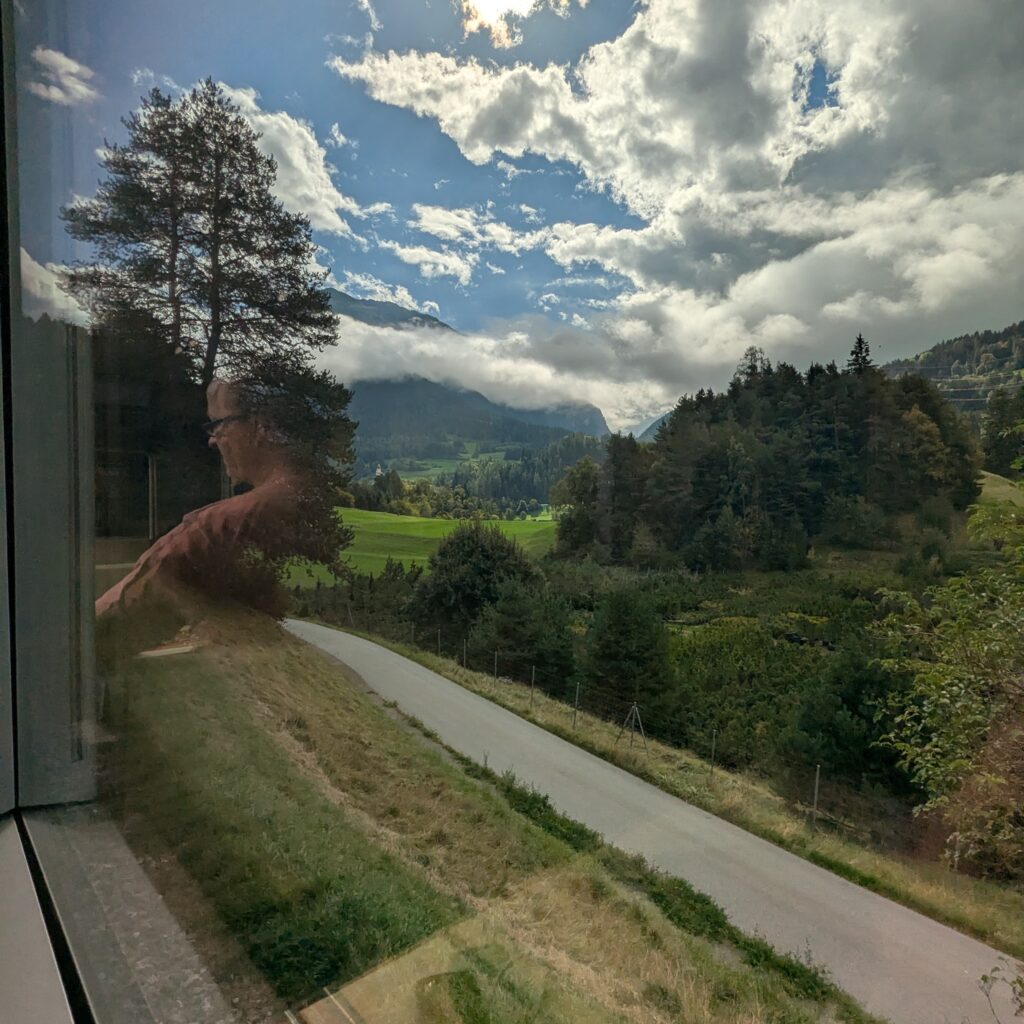
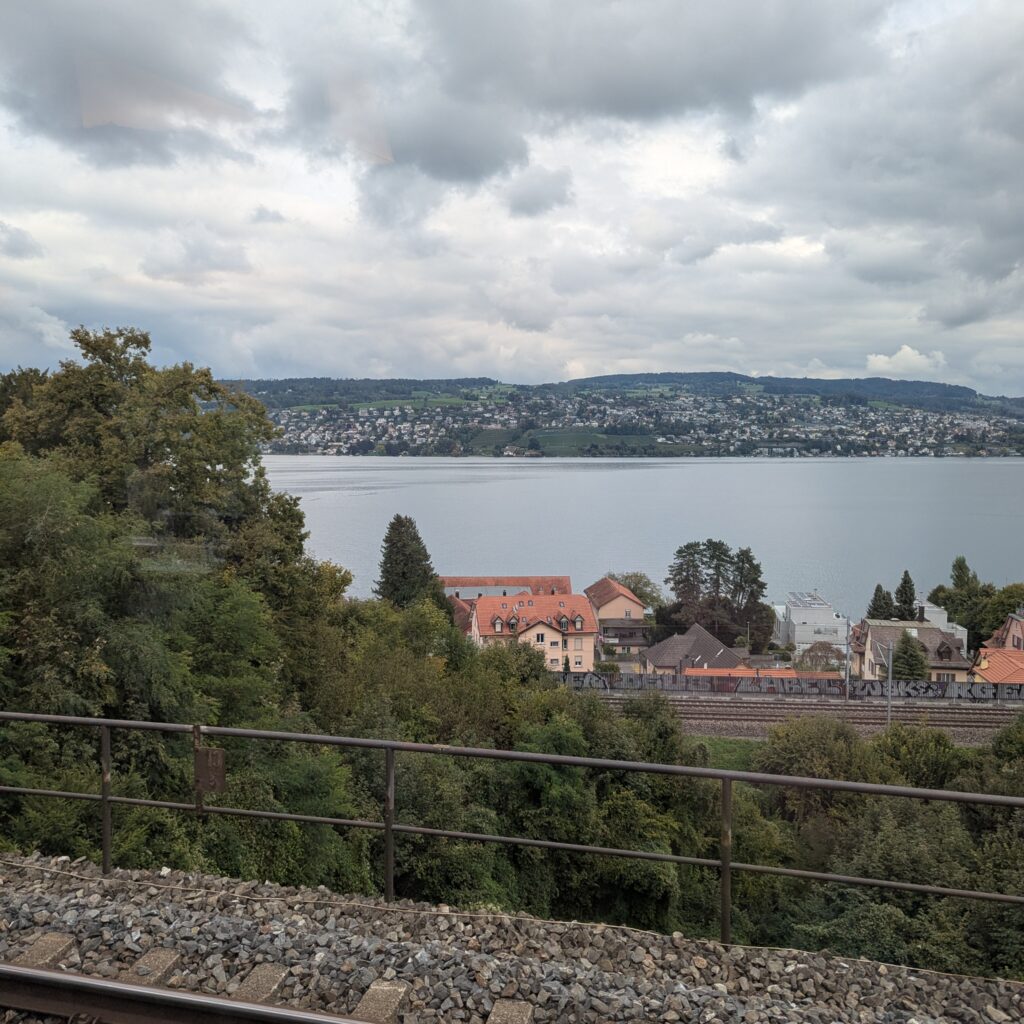
Day two was pure magic as I boarded the Bernina Express in Chur. The train snaked through the Swiss Alps like a caffeinated serpent, eventually dropping me off in Milan, Italy. From there, I hopped on a quick train to Venice for the next two nights—more on that in another blog.

Behold—the most famous leg of the trip: the Bernina Express! Stunning views, dizzying mountains, and just enough adrenaline to make you question why you didn’t just stay home with Netflix.

Day two was pure magic as I boarded the Bernina Express in Chur. The train snaked through the Swiss Alps like a caffeinated serpent, eventually dropping me off in Milan, Italy. From there, I hopped on a quick train to Venice for the next two nights—more on that in another blog.

Behold—the most famous leg of the trip: the Bernina Express! Stunning views, dizzying mountains, and just enough adrenaline to make you question why you didn’t just stay home with Netflix.www.youtube.com/@NorthAmericanDarrell

Consider subscribing as there are over 1500 travel videos and more added every week.

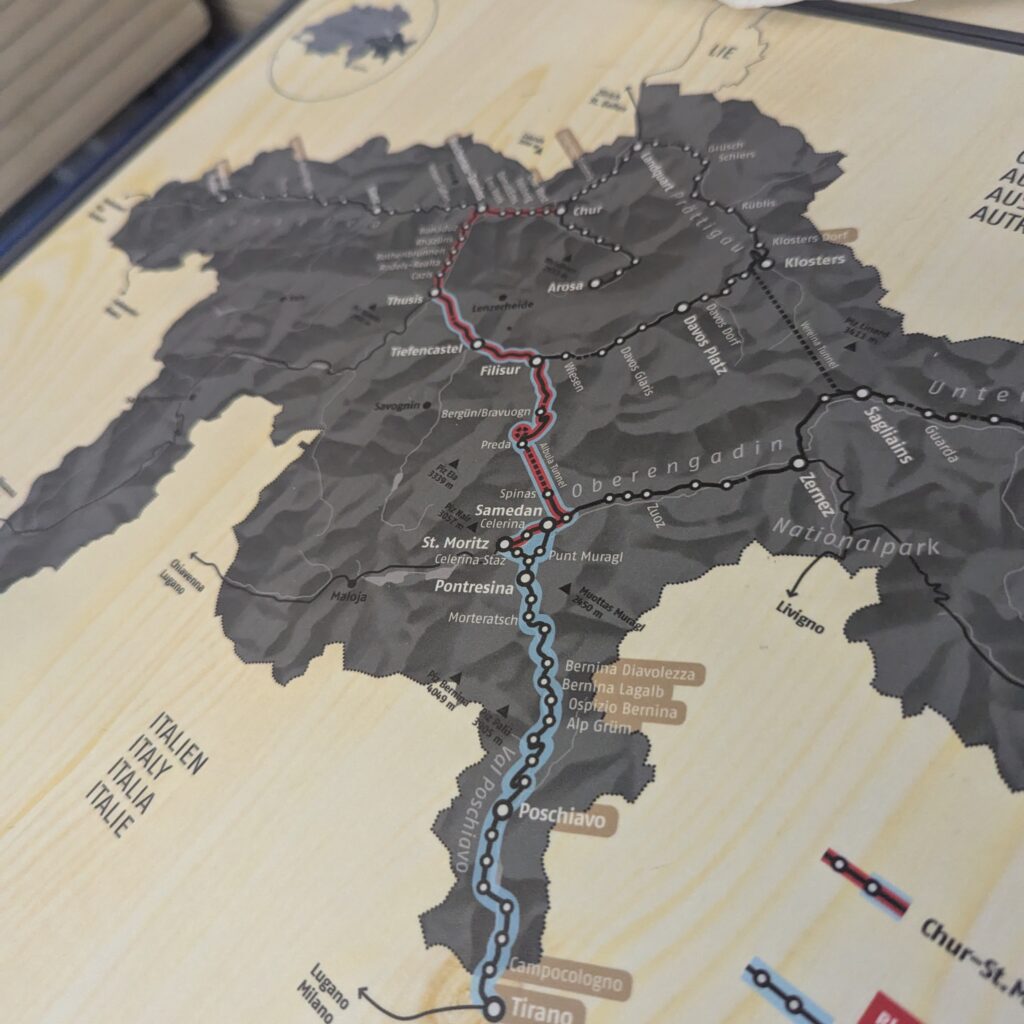
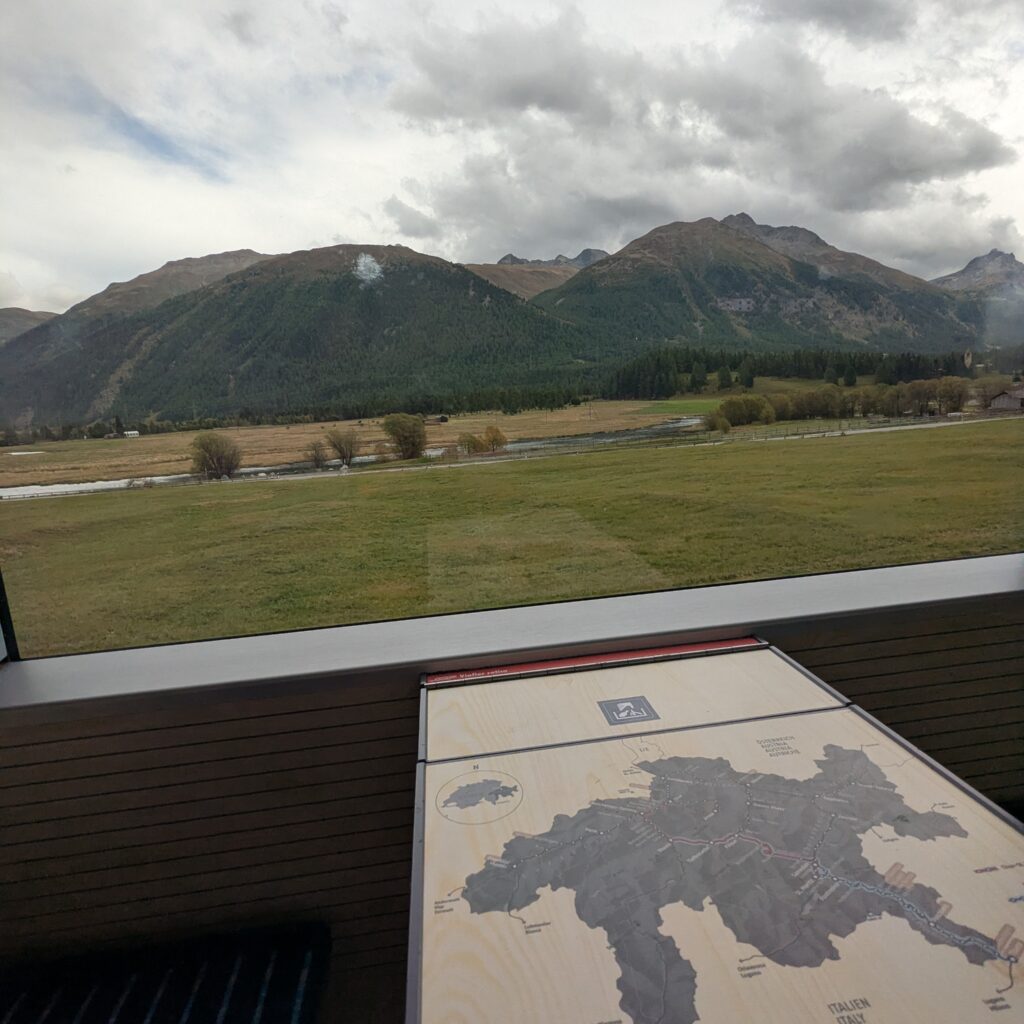
Some of the train tables had maps of the train routes in Switzerland.  It was enjoyable to follow instead of constantly looking at my phone, which I probably would have done anyway.  Here are some more videos, keeping in mind there are a lot more on my YouTube channel.  

www.YouTube.com/@NorthAmericanDarrell

I only stayed one night in Switzerland between train days.  There were many small towns along the way that were beautiful, but Chur was highly recommended.  The Hostel was an old jail that I read about, and really neat to experience.  All the doors were metal with heavy locks, and I wish those walls could talk.

Here is a walk around the amazing city of Chur, Switzerland, where I spent the night in jail. 😆

Swiss Railways: Trains, Mountains, and Obsessive Precision

Switzerland decided in the mid-1800s that it wasn’t going to let a few Alps get in the way of progress. The first line opened in 1847 between ZĂŒrich and Baden, and soon engineers were drilling tunnels, building bridges, and basically showing the mountains who was boss.

By the early 20th century, Swiss trains were punctual, efficient, and amazingly scenic, carrying passengers and freight across the country with clockwork precision. Today, the railways aren’t just transportation—they’re a national flex: ride a train, admire a glacier, and know that the Swiss probably have a spreadsheet tracking your exact arrival time. 🚂🇹🇭

555776621_1848596082425396_4926212415565141928_n

Munich đŸ»Oktoberfest 2025!đŸ»

When I realized my European adventure perfectly overlapped with Oktoberfest, I knew I was about to enter an adventure of epic proportions. 

Step one: surrender to the siren call of beer tents, pretzels the size of my forearm, and lederhosen-clad revelers who move faster than logic allows. đŸș

Each beer tent was a chapter: the first introduced me to the sacred art of “prost” -ing strangers; the second tested my limits with bratwurst heavier than my backpack; the third
 well, let’s just say gravity, hops, and I had a complicated conversation.

By the end of it, I had danced, sang, spilled, and cheered my way through the city. I emerged a wiser, stickier, and infinitely more entertained traveler, ready to continue my European quest. Oktoberfest didn’t just happen—it conquered me, one absurdly large beer at a time.

I figured getting to Munich for Oktoberfest would require strategic planning, so I made sure to stage myself nearby in the days leading up to opening weekend.

That “nearby” turned out to be Prague, Czech Republic, the week before—and it couldn’t have been easier.

Thanks to my Eurail pass and a reserved seat, the train ride was smooth, inexpensive, and almost luxurious compared to the chaos I knew awaited me in Munich. Little did I know, I was just a few hops away from becoming a full-fledged Oktoberfest warrior. đŸș

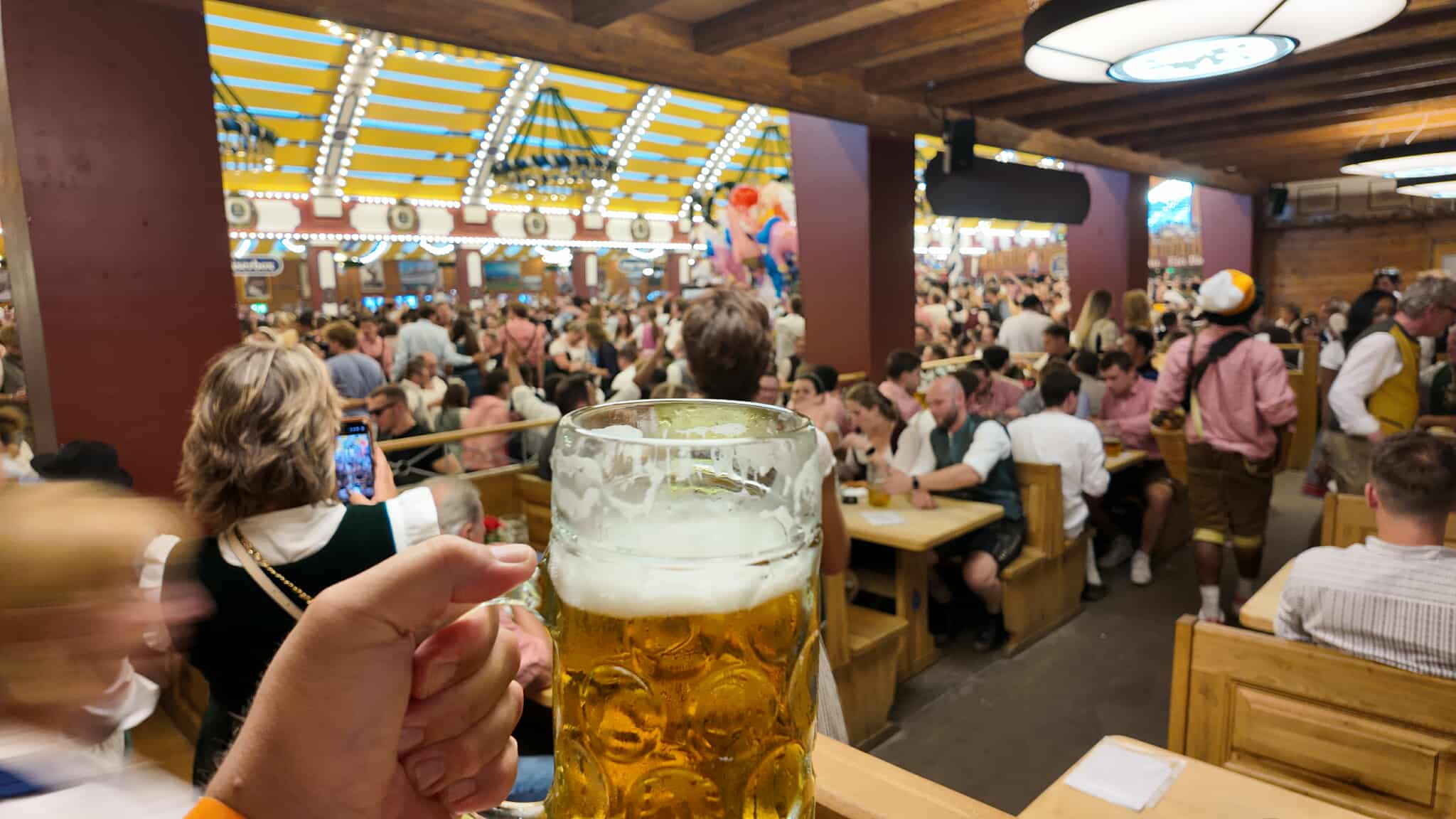
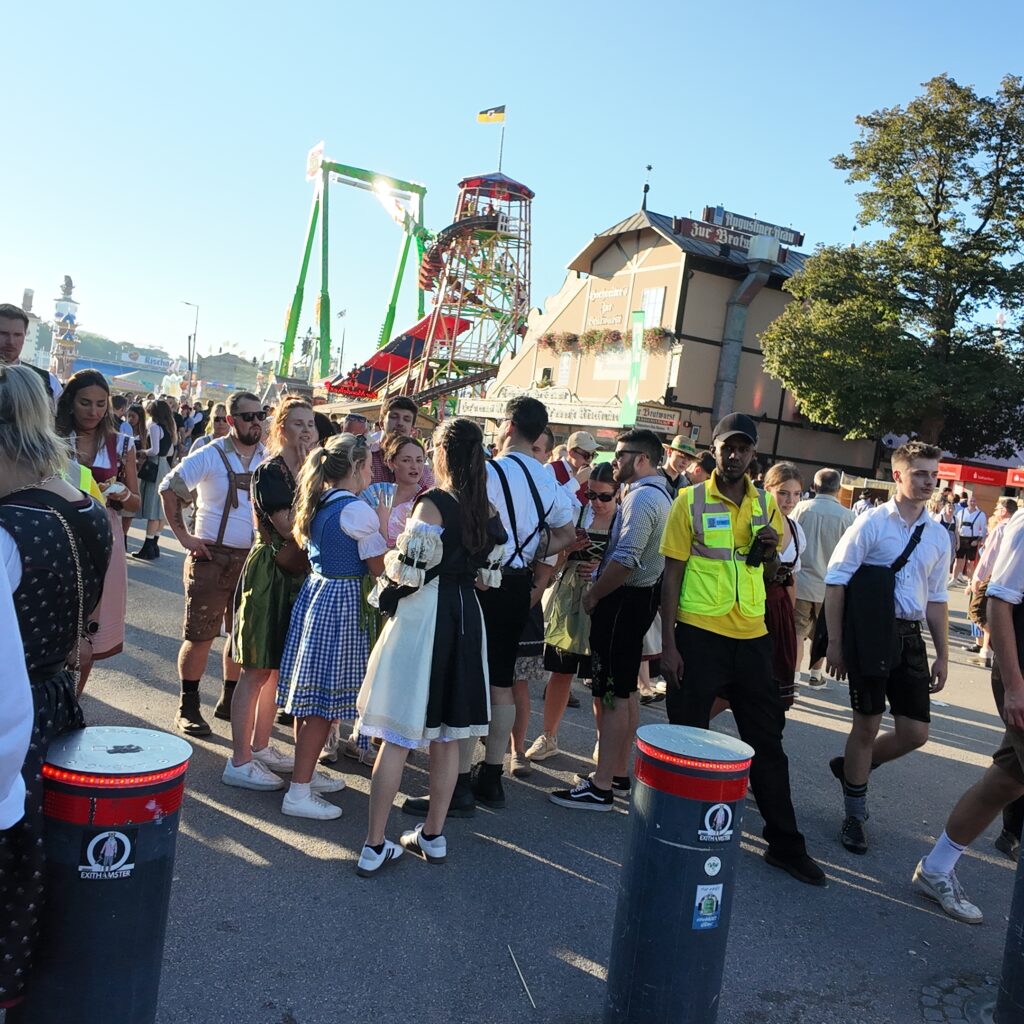
Captain Obvious alert: the beer tents were the best part. I wandered through three of the big ones, but spent most of my time at the massive LöwenbrĂ€u tent. The sing-alongs were pure magic—everything from Taylor Swift to Bon Jovi, and a few questionable karaoke choices in between. đŸșđŸŽ€

The crowd chants—“Oggy oggy oggy!” met with “Oi oi oi!”—followed by a rousing “Prost!” were absolutely unforgettable live. Honestly, it felt like being in a human blender of beer, music, and pure joy.

I could probably post a hundred pictures and videos, but who has that kind of time? Let’s just say, every snapshot screams: “I survived Oktoberfest and lived to tell the tale.”

For more Oktoberfest madness (and my epic camping adventure), head to my YouTube channel. You’re welcome.

www.YouTube.com/@NorthAmericanDarrell or by clicking the link below:

www.YouTube.com/@NorthAmericanDarrell

Subscribe now or risk missing me almost getting lost in 1,500 plus uploads.

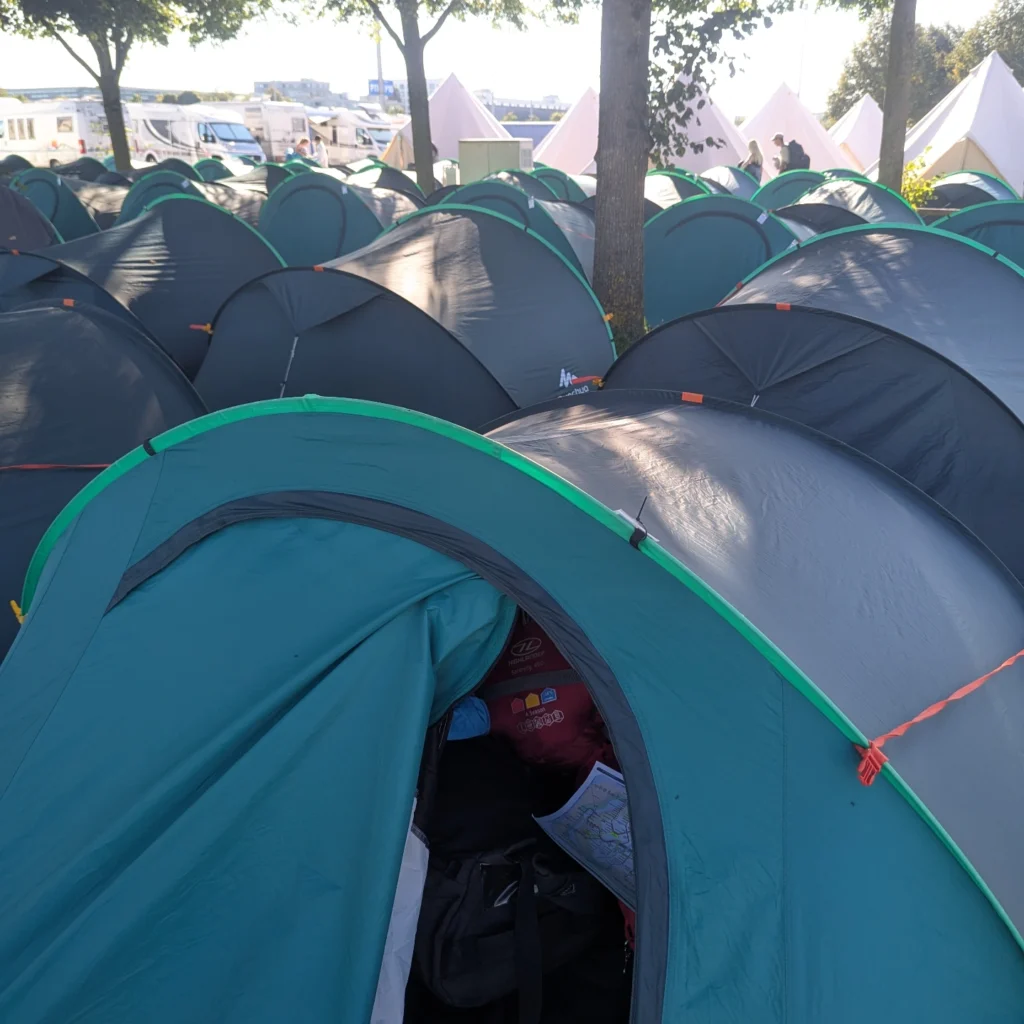
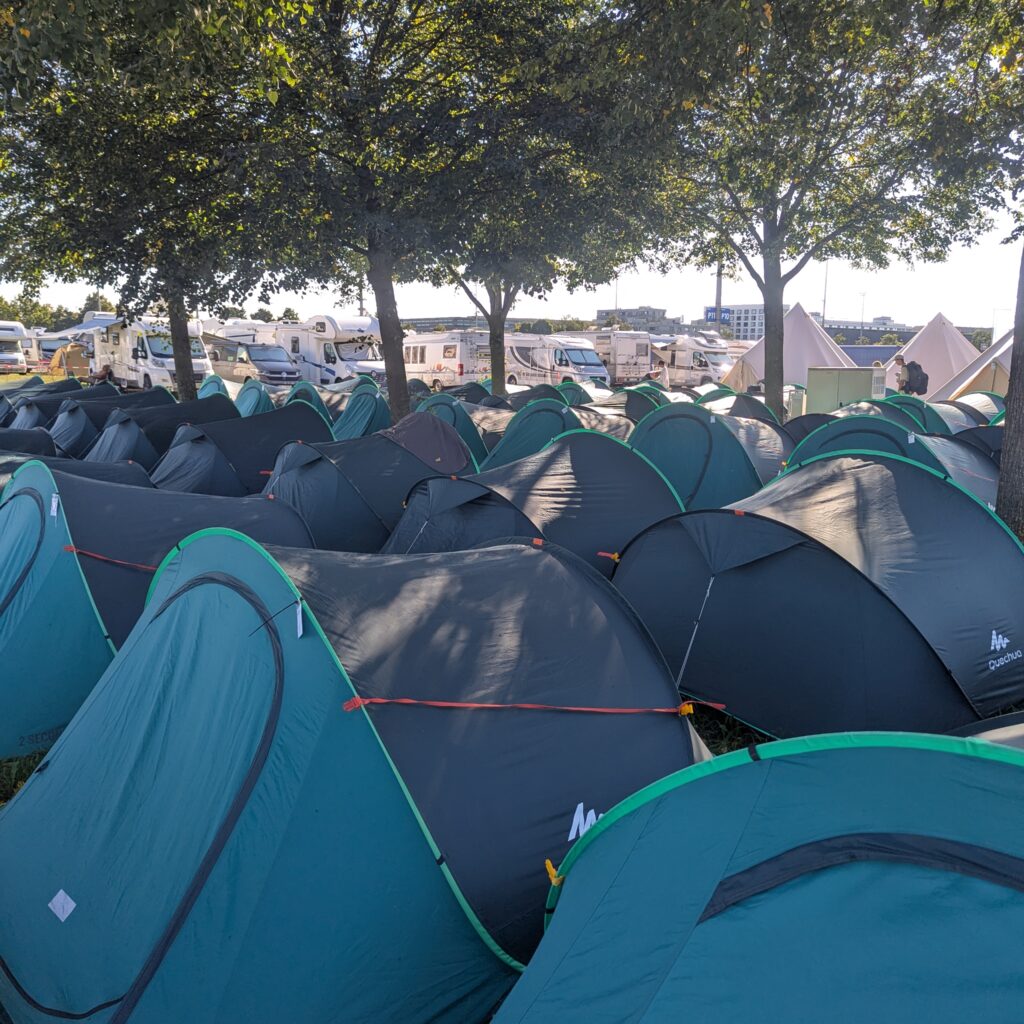
Accommodations for Oktoberfest were a bit tricky, but I ended up camping about a 30-minute train ride from the grounds. Perfect setup for the budget-minded traveler! They had single tents, double tents, and massive teepees with eight beds—basically a Bavarian version of “choose your own adventure.”

I went with the single tent—two nights for about $110 USD. Considering hotels were starting at $300 a night that weekend, I basically felt like I’d won the lottery. Simple breakfast included, plus a beer garden at the campground. And yes, there were plenty of RVs with German plates parked around—it looked like Oktoberfest on wheels. I half considered renting one and joining the mobile beer brigade. đŸș

The campground was like a state-run utopia for campers: spotless, orderly, and temporarily blessed with toilets and showers scrubbed multiple times a day. I timed it perfectly—striding in like a hero to claim the freshly sanitized throne and shower of destiny. 🚿đŸ’Ș

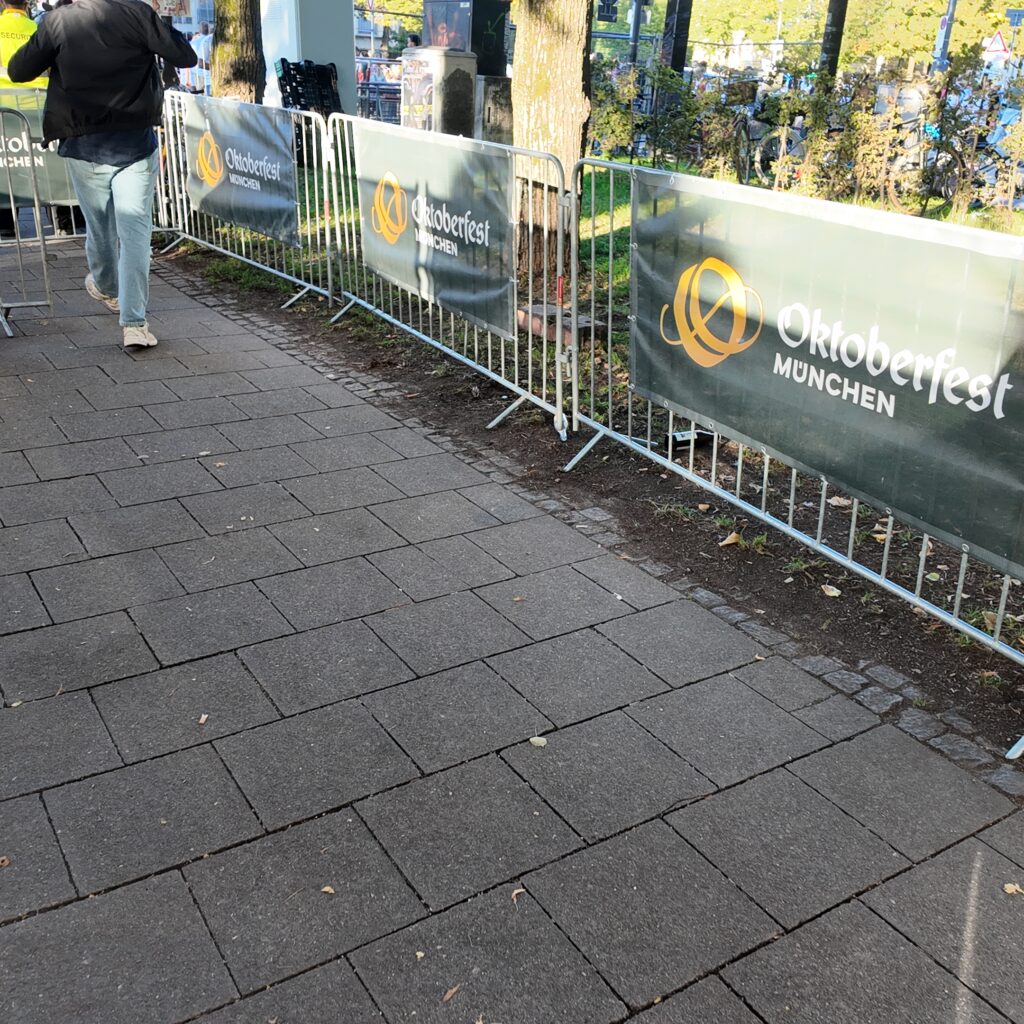
The Oktoberfest grounds and tents were massive—bigger than I ever imagined. Beyond the beer tents, there were rides, games, and food stands everywhere. In just two days, I managed to try five different German dishes—because, obviously, one can’t survive Oktoberfest on beer alone.

The Oktoberfest festivities literally take over Munich—and from what I hear, much of Germany. It’s an unbelievably proud tradition.

I met a guy who’s been pouring beers for over 40 years, with 30+ of those in this tent.

Honestly, I think that’s the pinnacle of German beer-pouring gigs! đŸș

The beer steins were all one liter each and cost about €16 (~$20 USD / $25 CAD). I could only handle two.

Asked around—apparently most locals manage 3–5. Incredible. đŸșđŸ’Ș

đŸșđŸšœđŸșđŸšœđŸșđŸšœđŸșđŸšœ

đŸ›ŒđŸ»đŸšœđŸšœđŸšœđŸšœđŸšœđŸšœ

Oktoberfest history:

Oktoberfest started in 1810 as a royal wedding party for Crown Prince Ludwig of Bavaria—complete with a horse race. The party was such a hit that it became an annual tradition, eventually swapping horses for beer tents, carnival rides, and way too much food. Today, millions flock to Munich to drink liter-sized steins, eat giant pretzels, and stumble out of tents like proud, slightly tipsy Bavarians. Basically, it’s a royal wedding that got wildly out of hand—and somehow the world loves it.

bucket1

Sept. 2025-Europe bucket listâœˆïžđŸš…

I wrapped up my month-long European adventure in September 2025, and it felt like the right moment to take stock.

Once I got home, I updated the list with a fresh perspective, fewer expectations, and a little more honesty about what actually matters on the road.

Turns out, it worked out great.

Some boxes got checked.
Some stayed open.
And a few new ones appeared that weren’t even on the list to begin with.

Spontaneity is kind of the adventure, isn’t it?

We all have bucket lists! Daily, montlhy, yearly or even a lifetime. Retire early and travel overwhelms my bucket list!

The best part is realizing that no bucket list is crazy—as long as you’re willing to work toward it, tolerate the criticism, and put in the effort
 all while actually enjoying the process.

And the criticism? That’s the funny part.

When people critique your life choices, it’s worth asking:
Is this really about you

Or is it about them?

Because people living their own lives rarely have time to criticize yours.

If they criticize, tell them to take a look in the mirror, as there is something wrong with them.

Let’s review the September 2025 European adventure, now that the dust (and jet lag) has settled:

Fly from Phoenix to London on September 1st, and return from London to Phoenix on September 28th via Los Angeles

✅ Nailed it.

Use my Wizz Air all-you-can-fly pass and a 7-day Europass

✅ Worked exactly as planned (which still surprises me)

Get stuck in airports and/or train stations with no seat availability and “make the best of it

❌ Shockingly
 this never happened. Europe chose kindness

Another adventure of a lifetime!

Final score:
Plans made ✔
Plans survived ✔
Memories upgraded ✔

Will do it again in the fall of 2026—zero contingency planning, and more trains.

Wizz air flies to 52 different countries!
The Wizz pass was $499 Euro. I do not plan to sign up once it expires on Septebmer 24th, 2025 towards the end of this trip.
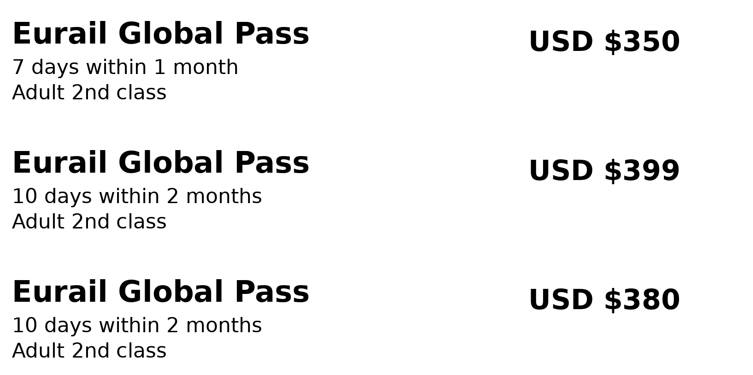
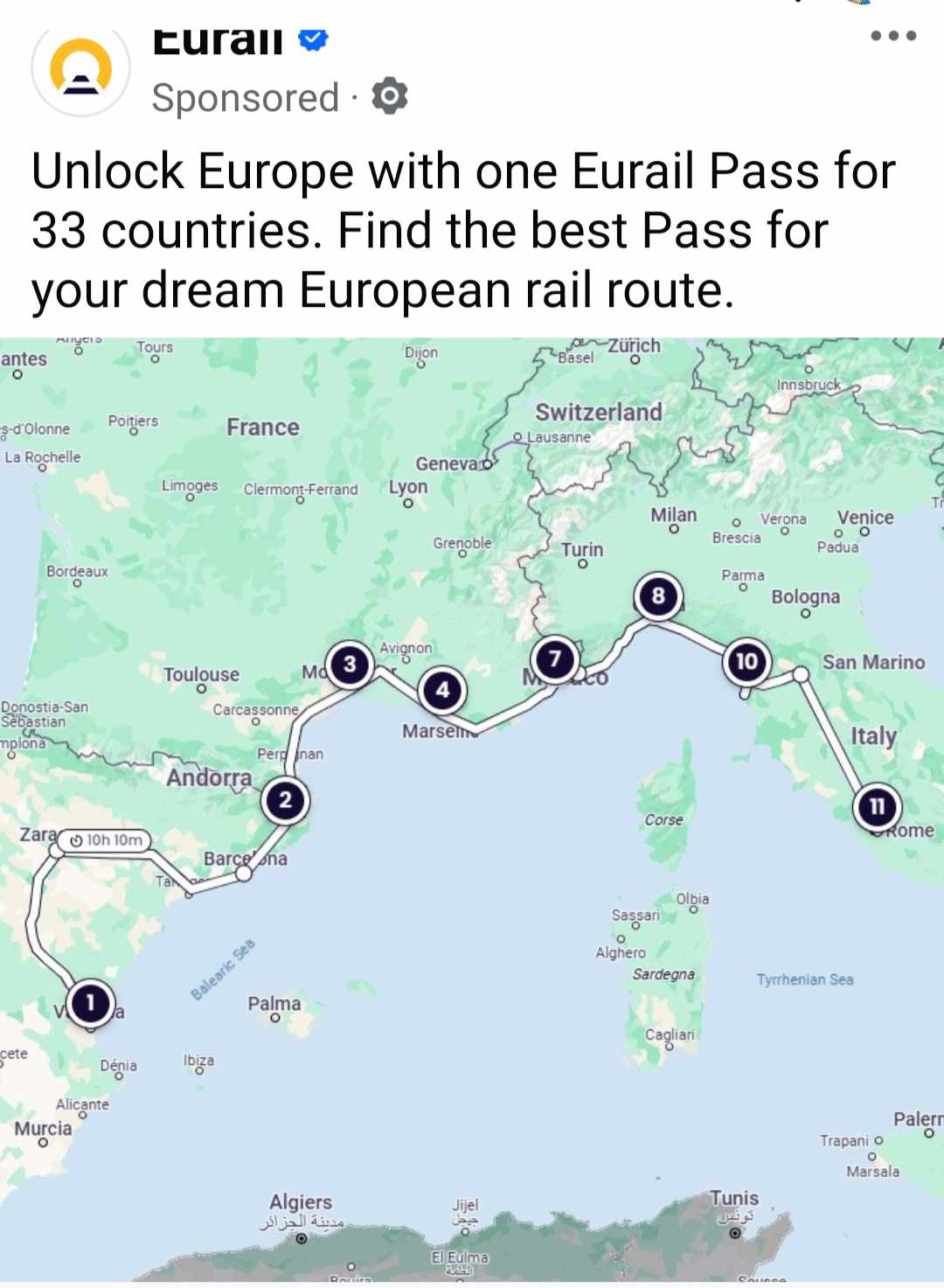
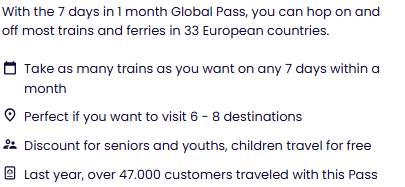
Europass covers 33 countries.

The Europass cost $350 for seven days, which breaks down to about $50 per full 24-hour day.

For the flexibility it offered—multiple trains, zero stress about individual tickets, and the freedom to change plans on the fly—it was money well spent.

Here is my updated hit/miss bucket list updated:

Portugal (Faro, Lisbon, and Porto) ✅

 Coast of Spain (I have been to Madrid and Barcelona) ❌

Octoberfest in Munich, Germany ✅

Ride the train through the Swiss Alps ✅

Poland ✅

Prague ✅

Take a short bus ride into Lviv, Ukraine ❌

Southern Italy ❌ (I purposely missed a flight to Sicily)

I went to Venice instead ✅

The coast of Croatia train tour into Eastern Europe❌

Iceland (Wizz flies into Reykjavik) ✅

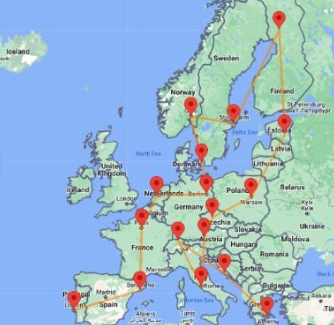
The Baltics (Hopefully Germany plus more) ❌

 Denmark❌, Estonia❌, Finland❌, Germany✅, Latvia❌, Lithuania❌, Poland✅, and 

Sweden. ❌ (I had a flight booked to Stockholm but decided against it) ❌


(I consider the ❌ plus more buckets in the fall of 2026 trip below):


Here’s an update on my Wizz Air All-You-Can-Fly (AYCF) pass, based on three separate trips to Europe over 12 months—

It 100% delivered on the spontaneous hype.

November 2024:

London, UK

Varna, Bulgaria

Budapest, Hungary

Vienna, Austria

Abu Dhabi/Dubai, UAE

London, UK (second time)

March 2024

London, UK

Barcelona, Spain 

Madrid, Spain

Naples, Italy

Rome, Italy

Sharm El Sheikh, Egypt

Athens, Greece

September 2025:

London, UK

Faro, Portugal (took train to Lisbon and Porto)

Warsaw, Poland

Reykjavik, Iceland

(Cancelled flights to Stockholm and Sicily)

Here are the train routes I took on the Europass:

Faro, Italy to Porto, Italy via Lisbon

Warsaw, Poland to Prague, Czeck

Prague, Czeck to Munich, Germany

Munich, Germany to Chur, Switzerland

Chur, Switzerland to Lucia, Switzerland

Lucia. Switzerland to Zurich, Switzerland

Zurich, Switzerland to Strasbourg, France

(Switzerland trip over two days including the famous Bernia Express)

Bernina Express | Switzerland Travel Centre

Strasbourg, France – Paris, France

Paris, France – London, England (Chunnel)


Previous European trains taken:

Madrid to Barcelona return on high-speed train

Naples, Italy to Rome, Italy

Paris, France – London, England (Chunnel)


Some ferries were included in the Europass that I never used:

          Ferries in Europe | Eurail.com

Bucket Lists: Adulting with a To-Do List of Awesome

People make bucket lists because “someday” is never specific enough—and staring at the same couch for 40 years eventually loses its charm. A bucket list is basically a socially acceptable way to chase your wildest ideas without anyone demanding a permission slip.

It’s equal parts motivation and bragging rights. Whether you’re skydiving, eating gelato in Rome, or learning to surf, you get to cross it off, post the proof, and casually say, “Yeah
 I did that.”

Bottom line: bucket lists exist to remind you that life is short, the world is huge, and your comfort zone is wildly overrated.

Screenshot_20240917-163621

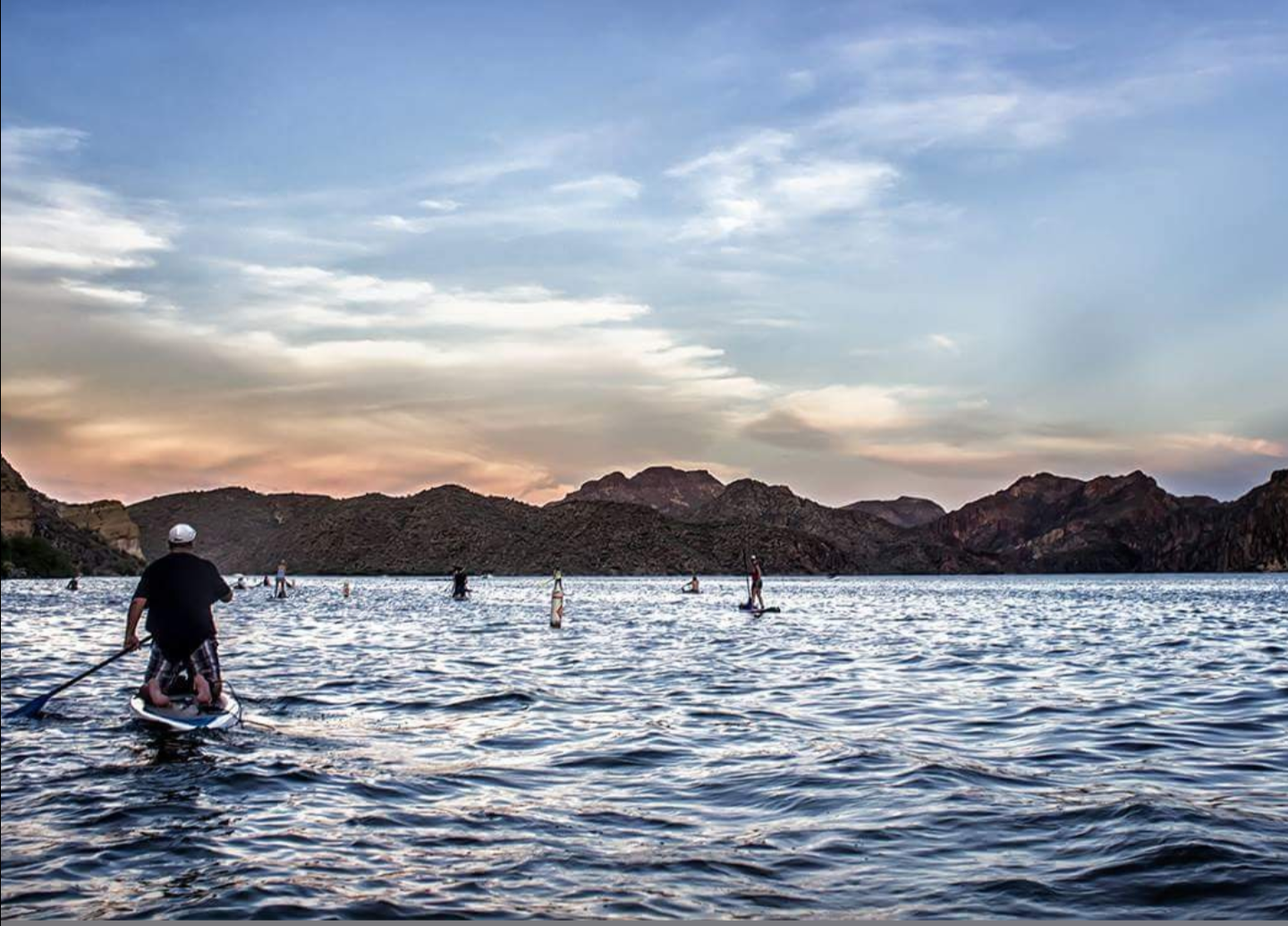
Paddling! It was fun until it wasn’t!! 😎

Paddleboarding is basically walking on water without sinking immediately—and yes, it’s as impressive as it sounds. You get a full-body workout, pretend you’re a young, serene yogi, and occasionally faceplant for dramatic effect, reminding me that I am fat and old!

It’s peaceful when you want it, social when you want it, and gives you a legitimate excuse to fall in, splash like a kid, and call it “part of the experience.” Honestly, it’s the perfect mix of exercise, adventure, and low-key humiliation—basically everything life should be.

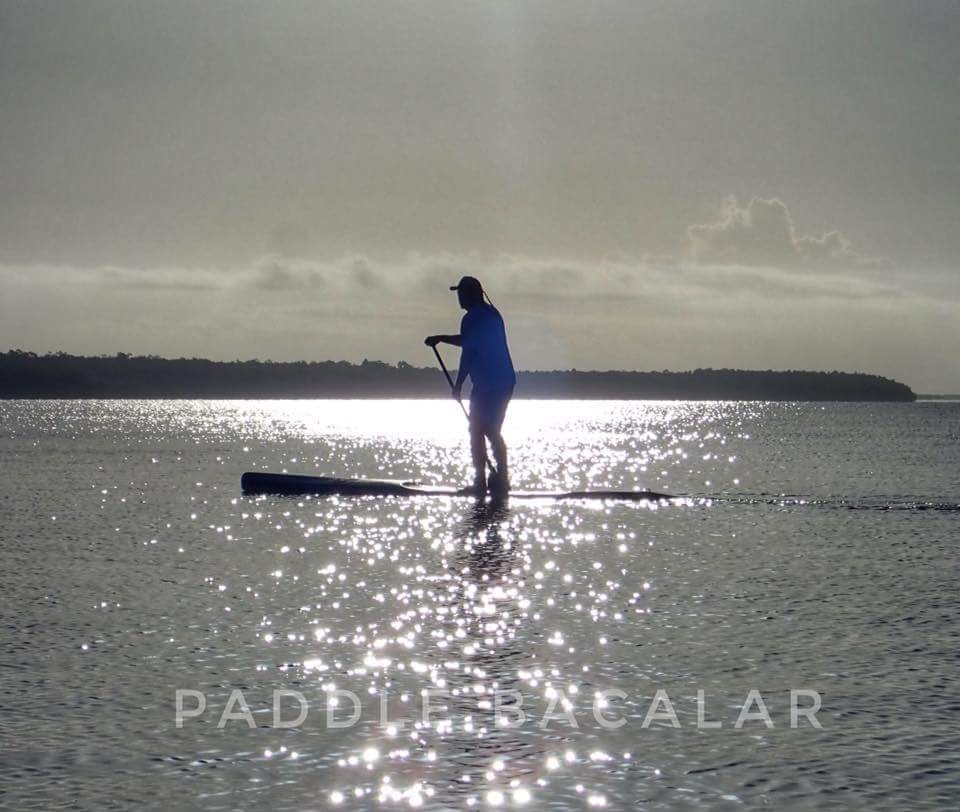
Behold the legendary paddle of Bacalar, Mexico—borrowed from a friend’s Airbnb empire of water fun. One glide across those turquoise waters and suddenly “amazing” doesn’t even begin to cover it. Truly unforgettable.

Here is the flight path from home in Phoenix, AZ, to Bacalar, Mexico.  

It is best to fly into Cancun or Chetumal and take the ADO shuttle bus to Bacalar.

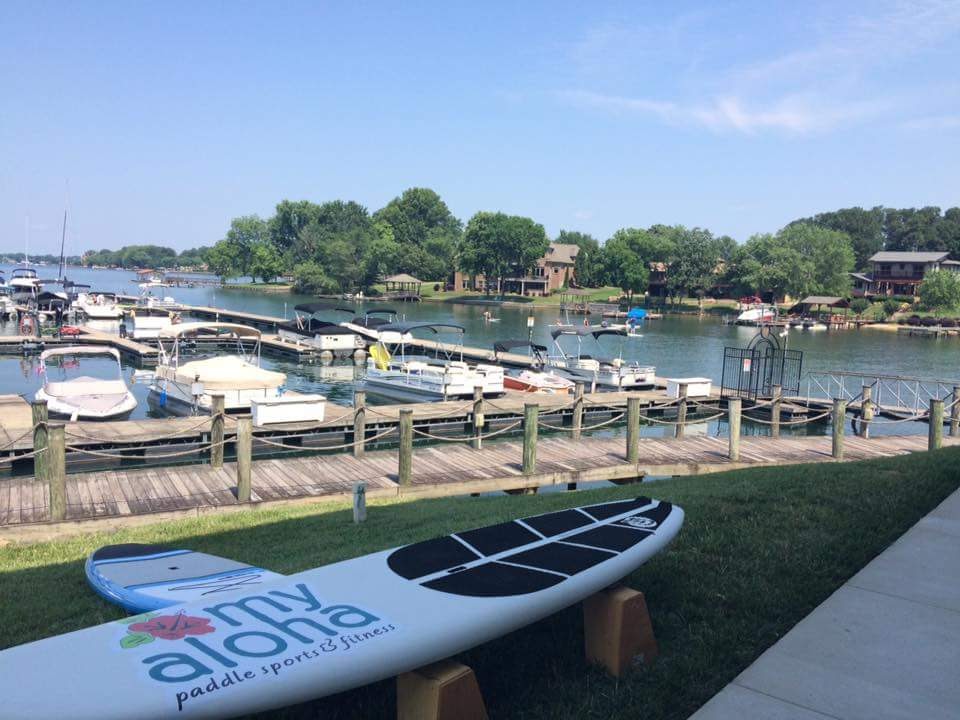
I first hopped on a paddleboard in 2010 after moving from Georgia to Mooresville, NC, chasing that sweet Aloha-on-the-water vibe I’d always loved about Hawaii. With Lake Norman just five minutes away, my board and boat became my weekly ritual in “the massive calm cove”—perfect for workouts. It was like pretending I was already on island time, living a young better looking and in shape lifestyle.

I lived five minutes away from Lake Norman and kept my boat docked there with my paddleboard.  It was an amazing workout in “the massive calm cove, and I would go a couple of times a week.

Fast forward to September 2015: my boat and two paddleboards were packed and ready for the epic trek from NC to AZ—because why leave your favorite toys behind?

It took me four long days of driving from NC to AZ. 

I dropped the boat off at storage, and sadly, that is where it stayed the majority of its years before selling it in 2022. 

It still looked so amazing for a 20-year-old boat and still trimmed out at 50+ M/PH when it sold. 😟

I should have pulled my UTV to AZ instead of my boat; I sold the wrong toy before I moved! 

A UTV would have gotten so much more use in the AZ mountains and/or making it street legal!

Let it go, Darrell, let it go! 😜

Well, I did let them go and lost my ass on both of them eventually! 

Just in the wrong order! 😎

I knew East Mesa’s lakes were tiny, but I didn’t realize weekends meant waiting to launch, only to get spun around in a human-sized washing machine. Paddleboarding through the constant wake? Forget it—I kept falling. 

After hauling my “Bring Out Another Thousand” money pit from NC to AZ, it barely saw the water at all.  If you disagree, visit Lake Lanier or Lake Norman, where the coves are bigger than the lakes in AZ.  Excuse de jour … 

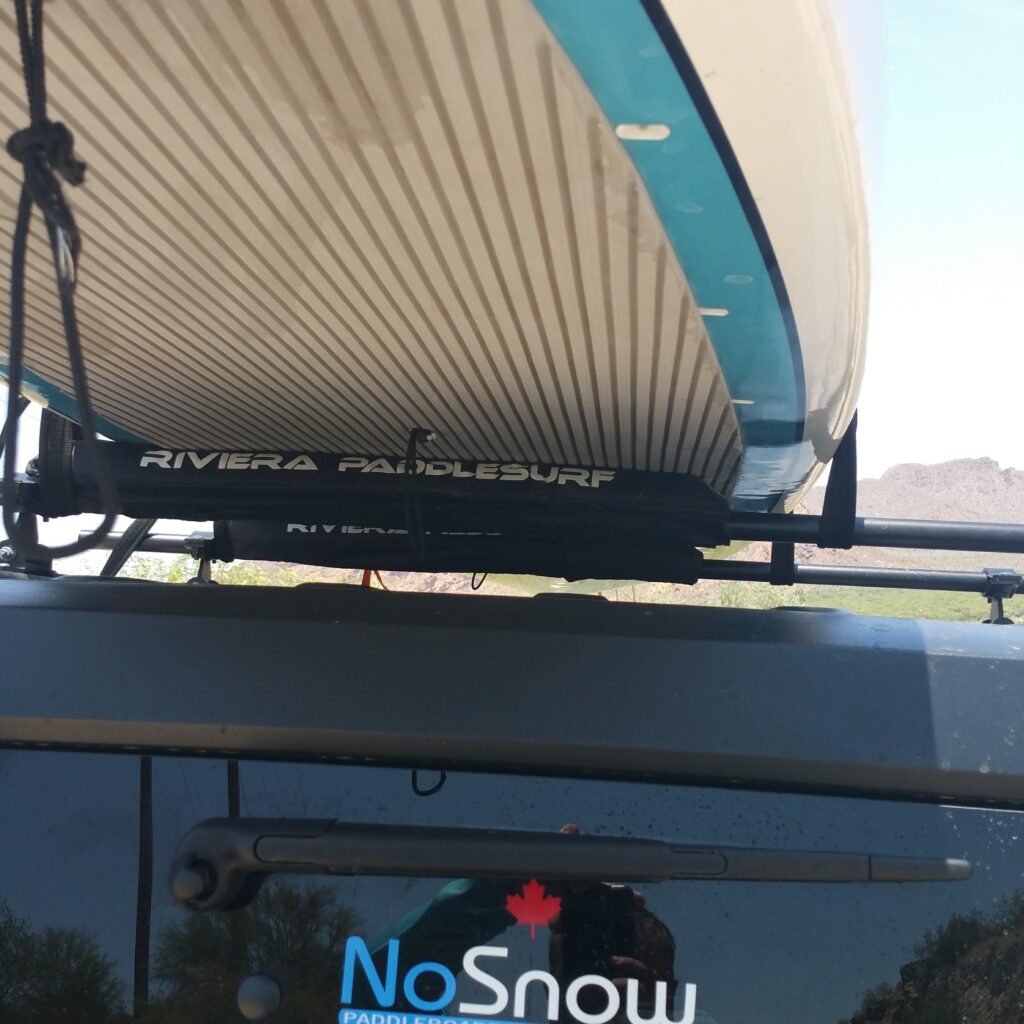
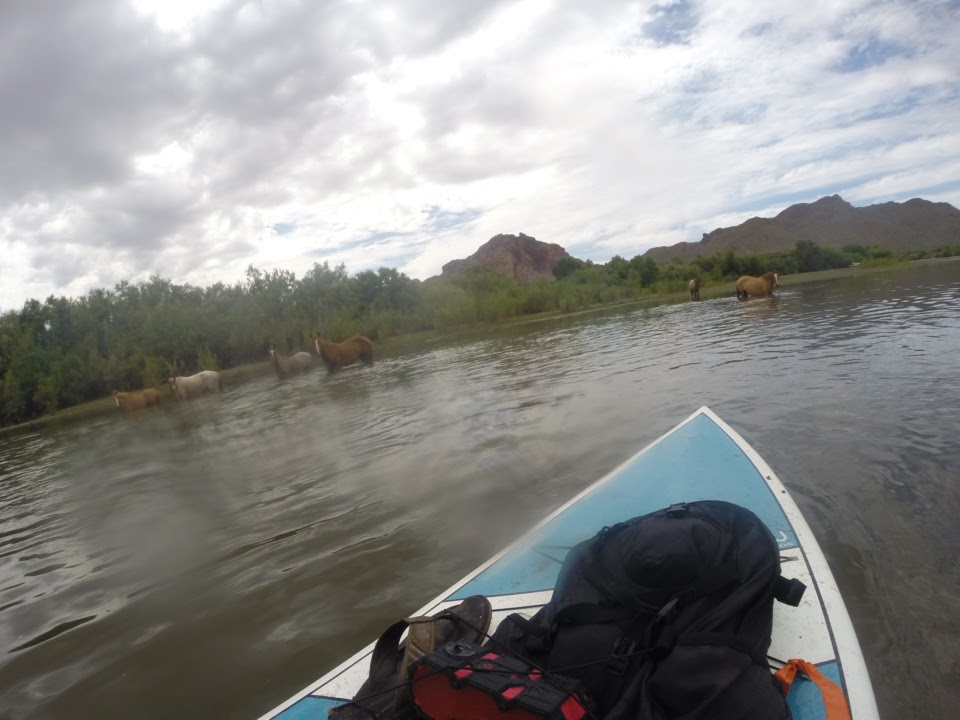
I preferred paddling the river because it involved exactly zero hassle. Toss the board on the Jeep, drive 20 minutes, and boom—adventure achieved.

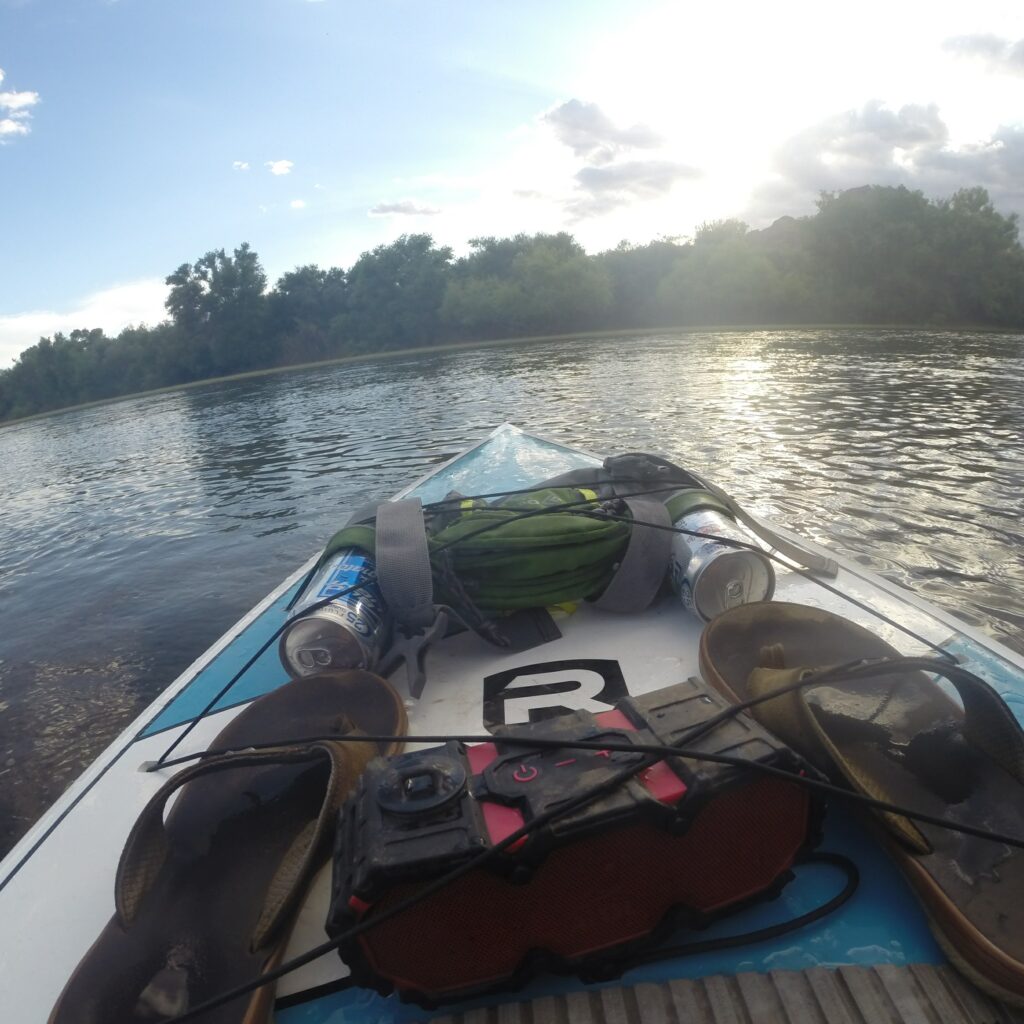
You’d get a solid workout grinding upstream into the current, then enjoy the universally beloved reward: a free ride home provided by gravity and basic physics.

And let’s be honest—it didn’t hurt that the “commute back” involved cracking a beer, relaxing, and pretending this was all very intentional while the scenery did the work.

Passing the families of wild horses quietly from the water is always surreal—half nature documentary, half “is this real life or did I drink that beer too early?”

Kept one paddleboard at my place in Rocky Point, Mexico, and an inflatable in storage—because nothing says commitment like owning multiple versions of the same abandoned hobby.

I also used to paddle in a quiet ocean cove in Mexico, until the tides reminded me they do not care about my confidence or balance. That phase ended quickly.

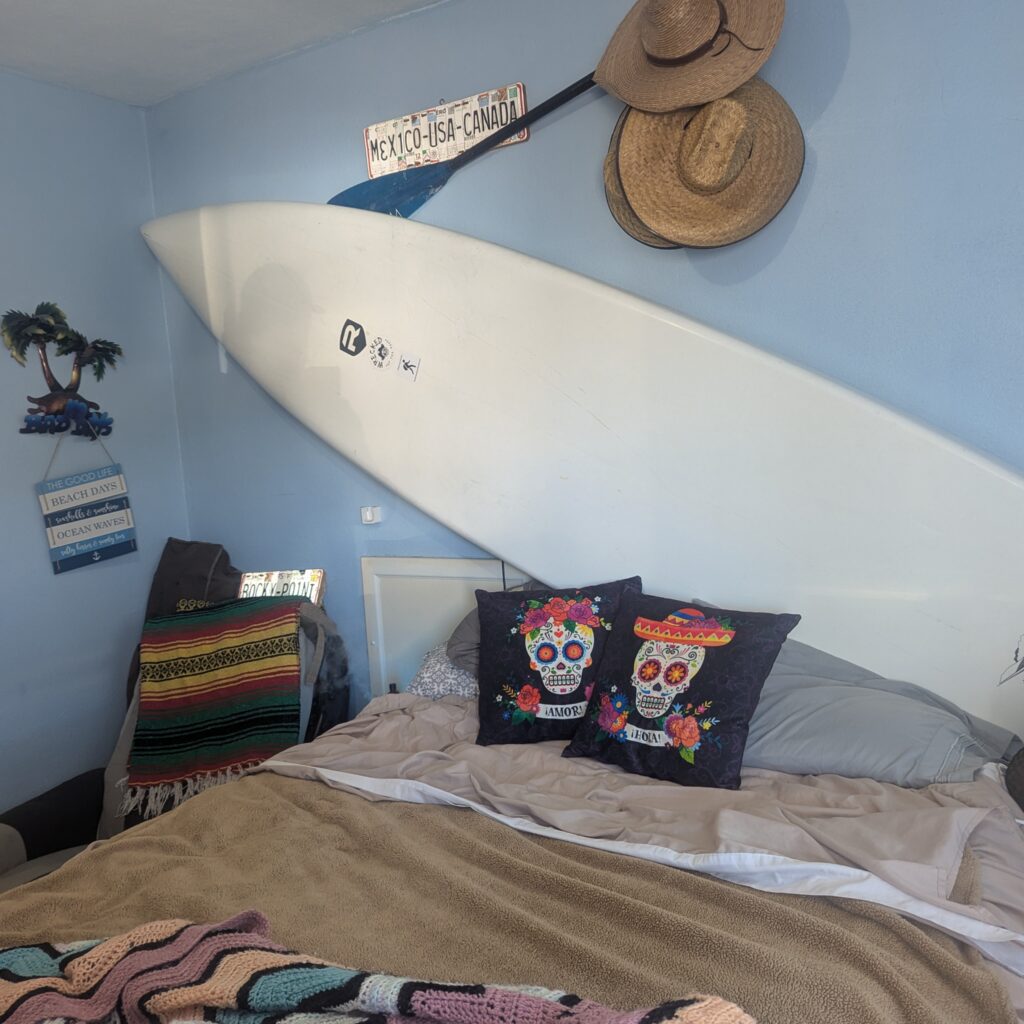
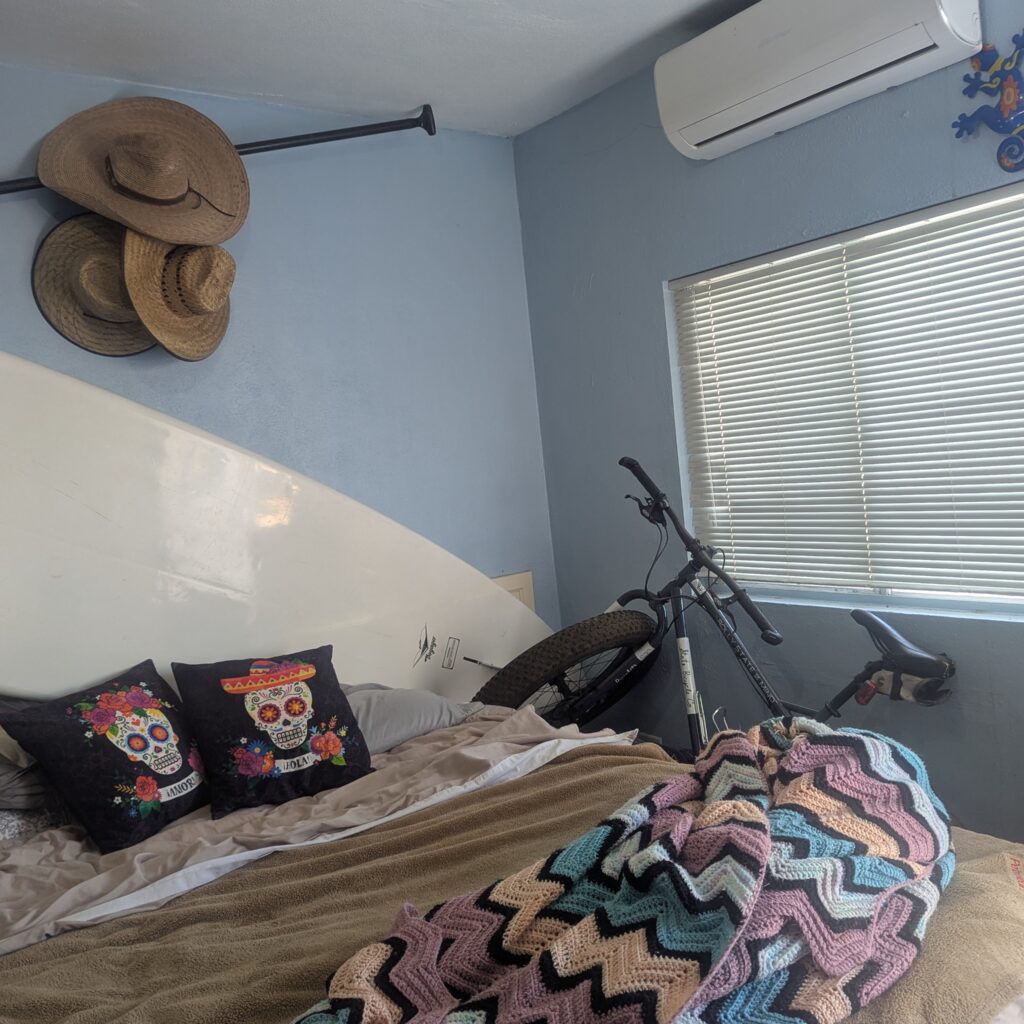
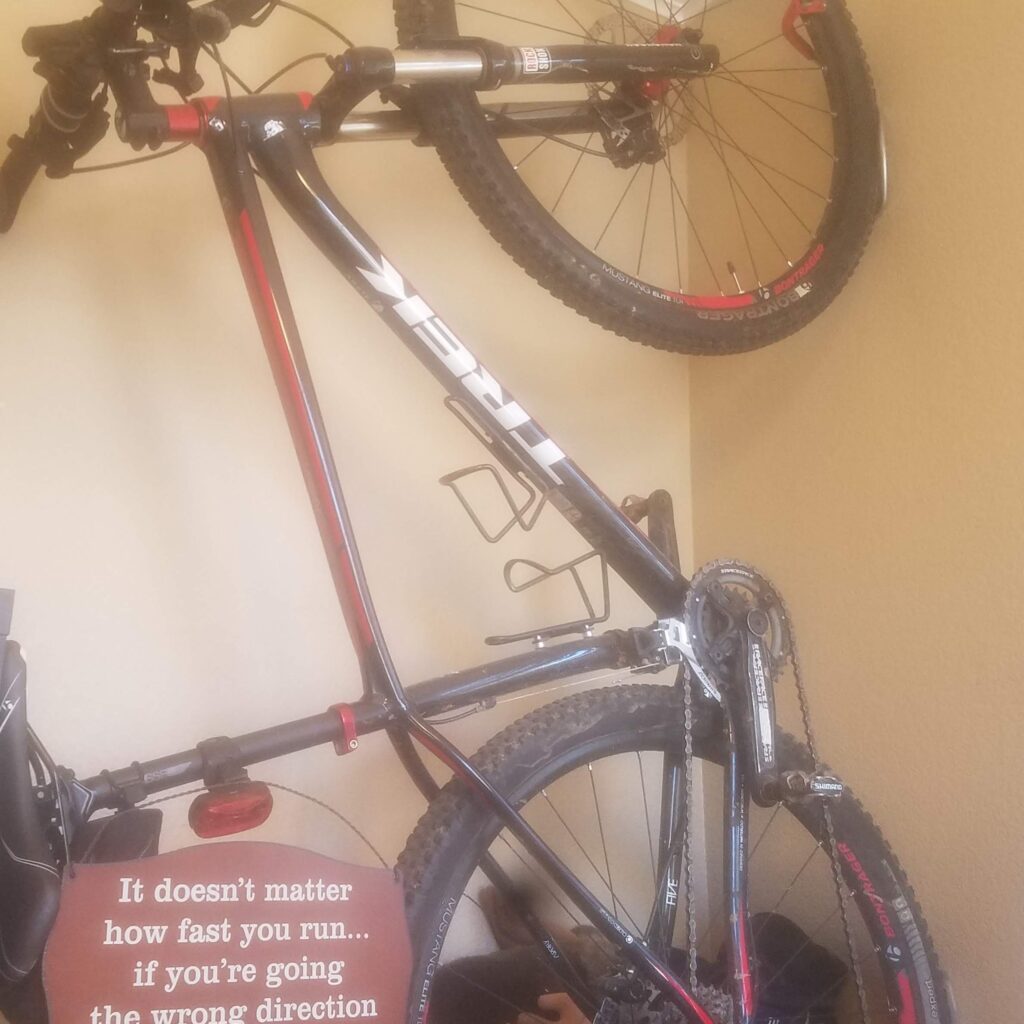
Over the years, the boards slowly evolved into tasteful wall art of days gone by, joining my golf clubs and bikes from other eras when I was sure this was my thing.

Looking back, the best part was the ~$2K “404 race board” I had mounted on my condo wall in Mesa. I couldn’t paddle it properly, but as dĂ©cor!?!

Flawless. Minimalist wannabe, very aspirational, trying to fool anyone who cared.  

Just like the boards and bikes on the wall, my bike became art in the desert too! LOL

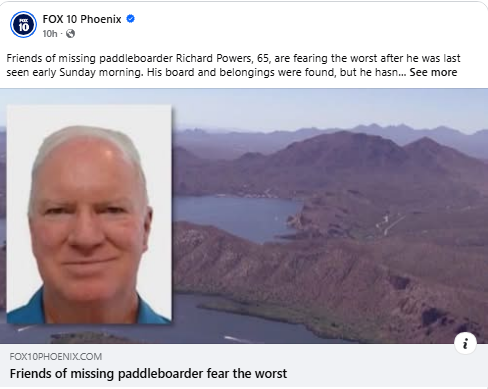
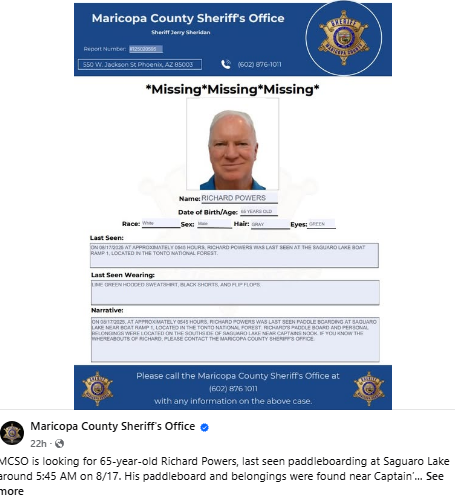
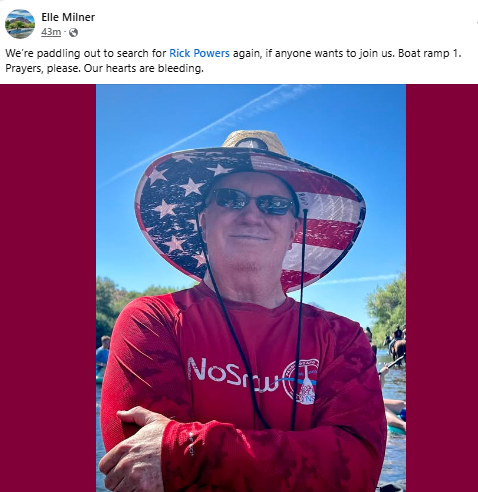
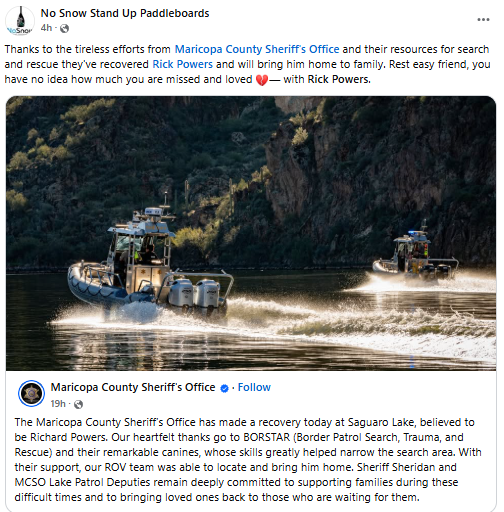
This blog was inspired by Rick Powers, his loved ones, and the AZ NoSnow paddle Family in Mesa, AZ.

It has been several years since I last saw Rick, but do not let his age fool you; he was an amazing paddler. He had hundreds of paddles and many races under his belt.  

He didn’t turn up after his early morning paddle on August 17, 2025, and found his gear, but there was no sign of Rick. They found him on the afternoon of August 20th. There was so much emotion during the search for him!

He had been all over the news (<– click here for links) with his incredible story that touched so many people.

I will always remember Rick lapping me on the lake and being so pissed off at him as he was ten plus years older!

You were an absolute legend to the “older guys” trying not to hang it up. Ultimately, you helped put me into paddle retirement where I belonged, knowing you were uncatchable. 

That will be a memory I will laugh about forever.Â đŸ™đŸ»

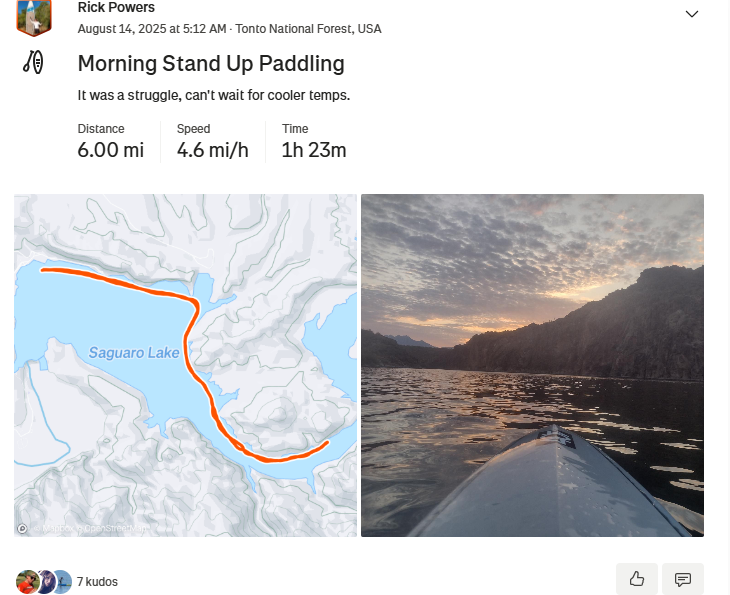
Here are Ricks’ Strava statistics (<- click the link to access stats). If you are interested in how being an older athlete can still be badass, consider that his last paddle would have been his 950th entry on Strava!

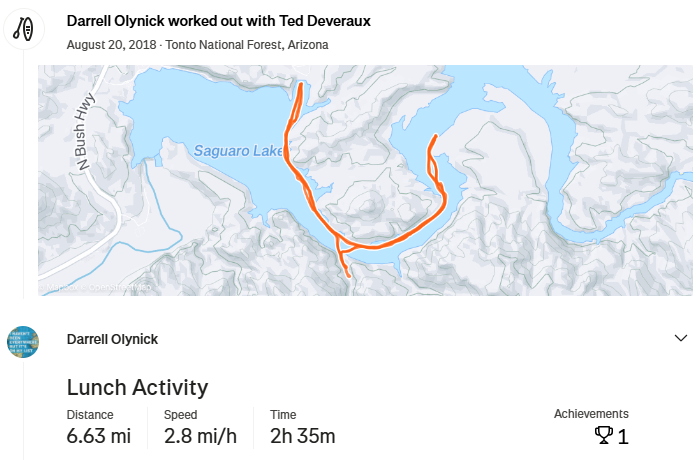
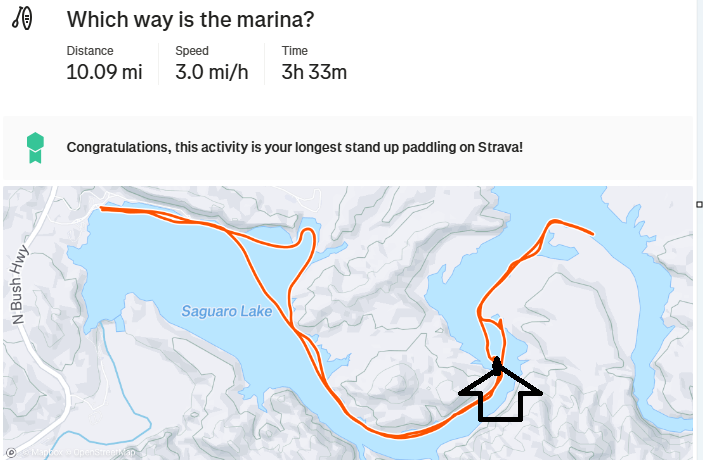
Below were our last recorded long paddles, with mine being exactly seven years ago, the day they found Rick. Ironically.  I was exhausted, I would never paddle alone again, and hung it up soon after.

Unlike Rick, I was just not good enough, and he belonged on the water! đŸ€™đŸ»

Paddle for your life was my thought that day, as I did not have much left in the tank the last couple of miles.

During my longest paddle on the same Saguaro Lake, I fell on my way home, which is marked âŹ†ïž on the map above. I got turned around and paddled further into the cove. I thought I was headed home, but was going the wrong direction, making my paddle home further.

I should never have paddled alone was my takeaway that day …

image

Sept.2025 Europass train travel!đŸ›€ïžđŸš…

I rebooked for September 2025 with a 7-day train travel pass, which works out to roughly USD $50 per travel day, plus any required reservation fees. For the distance covered and flexibility you get, it’s an incredible deal.

Until I visited Europe in mid-2024, I honestly had no idea how amazing—and how popular—train travel is there. It’s fast, comfortable, scenic, and stress-free. No security theater, no baggage roulette, no sprinting through airports.

These train trips weren’t just transportation—they were part of the experience. Watching cities turn into countryside, countryside into mountains, and borders quietly disappear from your seat changes how you think about moving through a continent.

Once you do Europe by train, it’s hard to imagine doing it any other way.

Here are the routes I took in September 2025 on my seven-day pass

Day 1:

Faro, Portugal to Porto, Portugal via Lisbon

Day 2:

Warsaw, Poland to Prague, Czeck

Day 3:

Prague, Czeck to Munich, Germany

Day 4:

Munich, Germany to Chur, Switzerland

Day 5:

Chur, Switzerland to Lucia, Switzerland

Lucia. Switzerland to Zurich, Switzerland

(Famous Bernia Express)

Day 6:

Zurich, Switzerland to Strasbourg.

Strasbourg, France – Paris, France

Day 7:

Paris, France – London, England 

These trips were taken over the month of September. I more than paid for the pass with these trips as Day 5 in Switzerland would have been $300+

Reservation fees were a bummer!  It cost me over and above pass to secure seats on some of these routes. I spent about $100 on top of the $350 pass.

Here are some **pictures and videos from train travel in Vietnam and across Europe during the spring of 2025.

I rode so many trains, for so long, that I eventually made a smart call and postponed the European portion of my train-heavy travel until September 2025. At a certain point, even the best journeys deserve a pause.

That’s one of the underrated lessons of slow travel: knowing when to keep moving—and when to save something great for later.

I also got to experience a high-speed train from Barcelona to Madrid, cruising along at 300 km/h on the return.

Smooth, fast, quiet—and wildly efficient. One minute you’re in the city, the next you’re watching the Spanish countryside blur past like a screensaver. It’s another perfect example of how, in Europe, the train isn’t just a backup to flying—it’s often the best option.

The slow train from Naples to Rome, Italy, was also a great experience as I was able to see a lot more of the Italian wine Countryside.

Screenshot_20240925-150032

All you can fly! September 2025!!✈

This pass worked for me because it matched how I like to travel now—not how I used to think I should travel. I wasn’t trying to optimize every dollar or squeeze in as many flights as possible. I wanted movement, flexibility, and the freedom to change plans without feeling locked in.

The standby nature of the pass turned out to be a feature, not a flaw. It kept things light. I booked late, went where there was space, and let availability decide the route. That removed the pressure and made each trip feel more like an experience than a checklist.

It also fit my schedule and temperament. I don’t mind odd flight times, backtracking, or staying put an extra day if that’s how things unfold. That kind of loose structure wouldn’t work for everyone—but for me, it made travel feel spontaneous again.

Most of all, it worked because I’ve learned that I enjoy the journey more than the plan. Whether it was hopping cities, riding trains, or sitting in an airport with nowhere urgent to be, the pass supported that mindset. No rush. No maximizing. Just moving through places when the timing felt right.

For the right kind of traveler, this pass makes exploring 52 countries both accessible and affordable.

I picked up the All You Can Fly pass from Wizz Air for €599 (£500), mostly because it promised something I’ve always liked—freedom without overspending. The catch was that flights run on a standby basis and can only be booked within 72 hours of departure, which sounds limiting until you lean into it.

Once I was registered, it turned travel into something lighter. Instead of planning months ahead, I’d check what was available, pack a bag, and go. It wasn’t about maximizing flights or hacking the system—it was about saying yes to movement, short trips, and places I probably wouldn’t have visited otherwise.

The all-you-can-fly pass gave me the freedom to say yes more often—quick trips, last-minute plans, and places I probably wouldn’t have visited otherwise.

I’ve come to appreciate that not everything in life needs to be permanent to be meaningful. 

Some things are meant to be used for a while, learned from, and then set aside. The gear, the hobbies, the passes—they all mark where I was at a given moment. This one gave me movement, freedom, and a sense of possibility when that’s exactly what I was looking for. And like the others, it did its job. That feels like a good ending.

20150730_185313

Living the Arizona life!đŸœïž

One thing I’ll always be thankful for is buying a condo in Arizona during the housing market crash in 2009. At the time, it felt like a practical, almost conservative decision. In hindsight, it quietly set the foundation for everything that came later.

That gratitude sits alongside a bit of nostalgia. I’d already sold some incredible homes in Edmonton, Alpharetta, Georgia, and Mooresville, North Carolina—places tied to specific chapters of my life. Each move closed one door and opened another, even if I didn’t fully understand it at the time.

What I couldn’t see then was how the Arizona place would eventually become more than just a home. It became an anchor—a base that allowed me to take risks and travel literally elsewhere. Stability in one place made freedom possible in others. 

Knowing I had something solid to return to gave me the confidence to travel more, stay longer, and say yes to opportunities that didn’t come with guarantees.

Looking back, that condo wasn’t just a smart investment that pays me to travel through Airbnb. It was also permission to move, to explore, and to build a life that didn’t have to stay in one place to feel grounded.

From an investment standpoint, the timing was absurdly good. In 2009, the Phoenix market was still in full capitulation mode—single-family homes with pools were selling under $100K, and condos could be picked up for under ~$30K. Most of these were cash deals, with banks more interested in clearing defaulted inventory than maximizing price. Recovery mattered more than valuation.

At the time, I was working in Georgia and already owned a home there, so this wasn’t about replacing a primary residence or chasing a lifestyle fantasy. It was about positioning. A low-cost asset in a market that had clearly overshot to the downside and would, eventually, revert. While in Las Vegas that year, I took a day to fly to Arizona and look at opportunities in person—because listings are useful, but markets are easier to read when you’re standing in them.

We toured roughly ten condo properties. Living across the country forced discipline, which worked in my favor. I only considered turnkey units—no renovations, no surprises, no emotional projects. My criteria were unapologetically practical: strong amenities (pool, gym, hot tub), walkability to groceries and restaurants, and a layout that would work equally well for short-term stays and seasonal renters.

Rental potential wasn’t optional—it was the point. The goal was a property that could generate income from snowbirds while remaining usable as a personal base when needed. That dual-purpose flexibility capped downside risk and improved the return profile without adding complexity.

When we toured Solana later that day, it separated itself immediately. The location worked. The amenities worked. The condition worked. Everything aligned. By the end of the visit, it was clear this wasn’t a lifestyle purchase pretending to be an investment—it was a clean, well-timed asset with multiple usage paths.

Which is exactly what you want when markets are panicking, and patience is underpriced.

From an investment perspective, it checked every box.

The Solana community had two pools, a hot tub, and a gym—exactly the kind of amenities that matter to both renters and owners. A Safeway directly across the street, a Walmart down the road, and multiple restaurants within walking distance made it even more attractive. Convenience sells, especially for long-term renters and short-term guests.

I left Arizona with clear instructions for the agent:
One-bedroom, ground-floor unit, green space patio view in Solana.

He nailed it!

All wrapped up in a $52,500 all-cash deal—a low-risk entry price with real usability, solid demand, and strong rental upside. At the time, it felt like a smart move. Looking back, it turned out to be a foundational one.

In the summer of 2014, I was laid off while living in Mooresville. It was one of those moments that forces clarity whether you’re ready for it or not.

Instead of scrambling to stay put, I treated it as a clean break. No panic. No patchwork fixes. Just an honest look at what I wanted next. It was time to leave the South and head west—and the difference was, I already had a landing spot waiting for me in Arizona.

What could’ve felt like a setback turned out to be a pivot. Sometimes losing the plan is exactly what makes room for the right move.

Arizona—and **Solana in particular—**turned out to be the perfect landing spot. It gave me a property that could generate rental income while still supporting the kind of life I actually wanted to live.

Year-round access to pools, hiking, biking, paddling, and camping meant the place worked whether I was home or on the road. From an investment standpoint, it made sense. From a lifestyle standpoint, it made even more sense.

It wasn’t just a smart buy—it was the rare overlap where numbers and quality of life lined up.

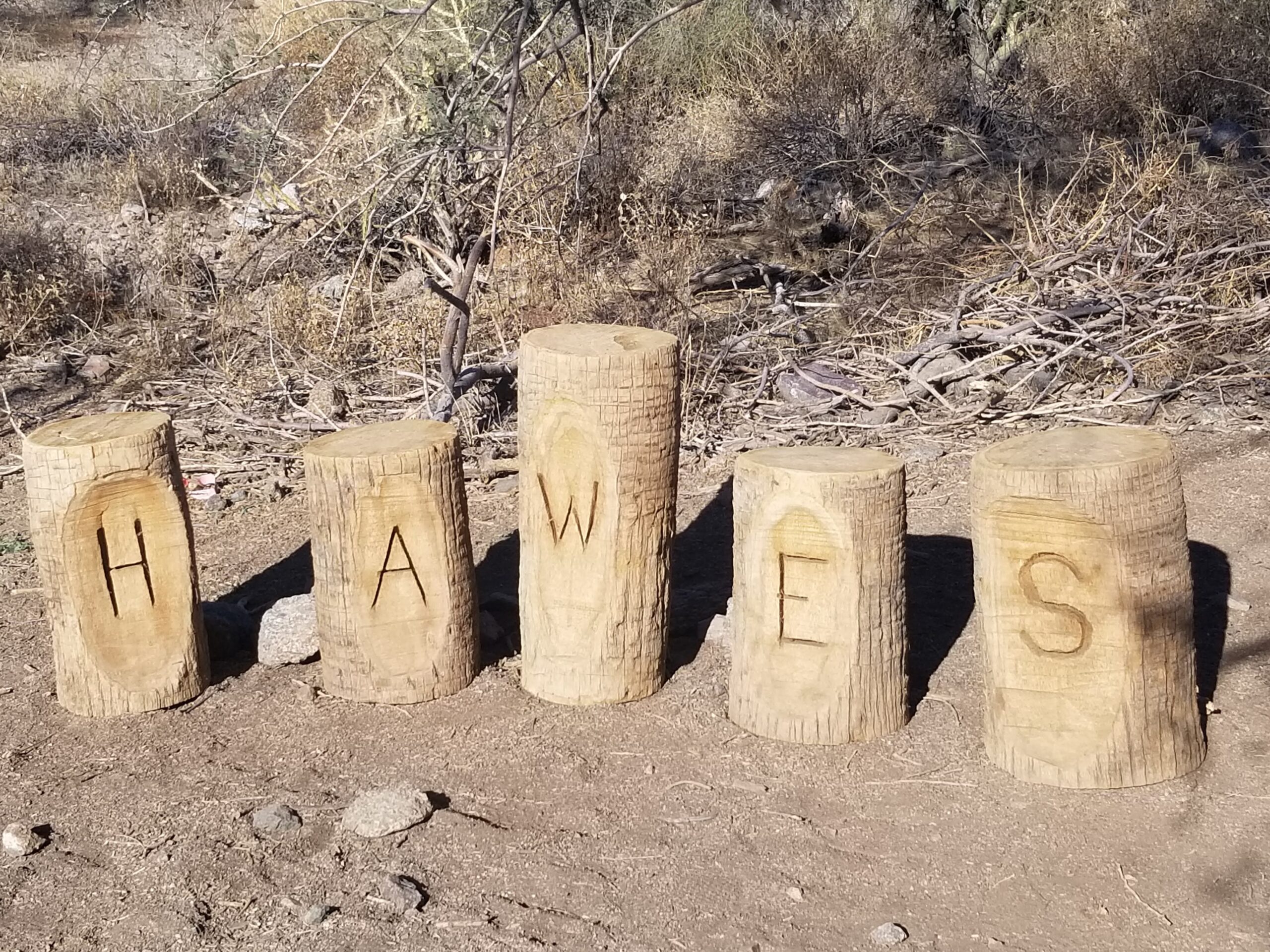
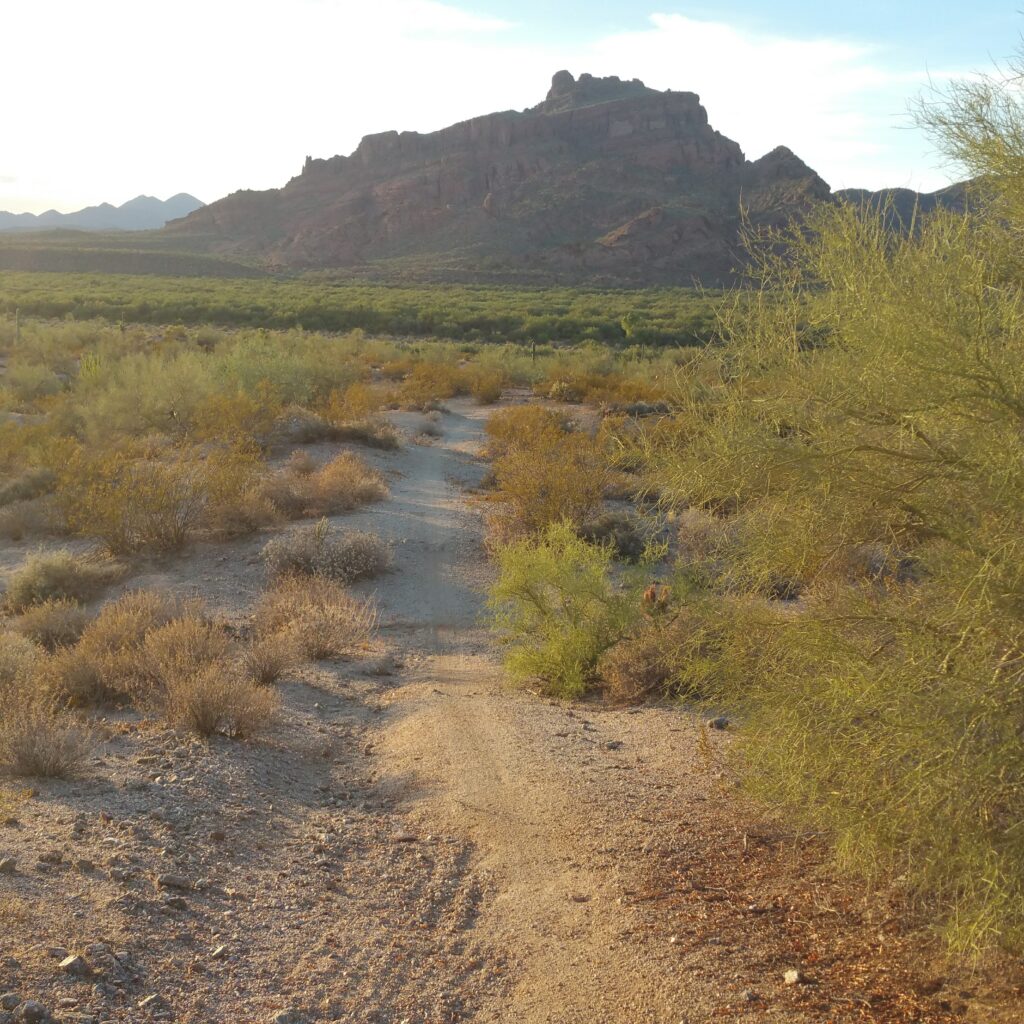
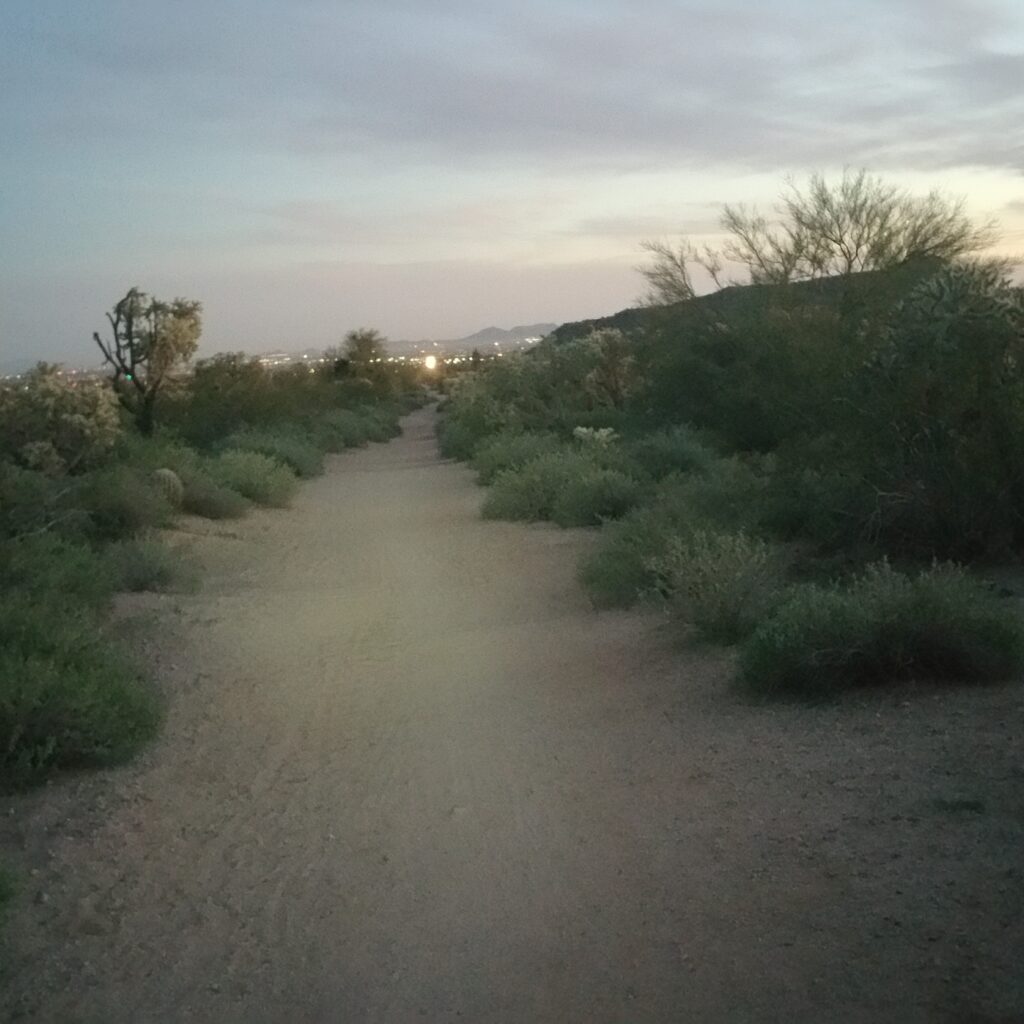
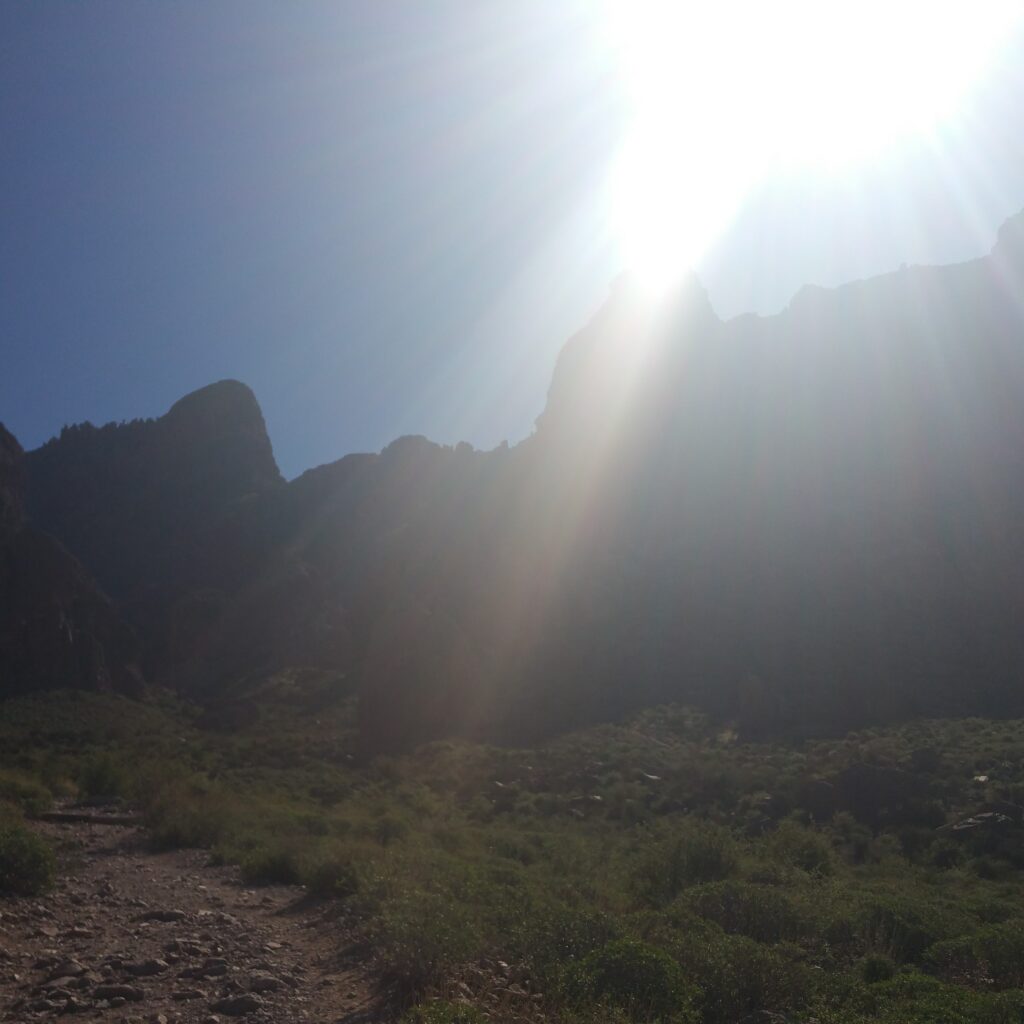
I’ve hiked the Hawes Trail System hundreds of times. Being just 15 minutes from home meant it was never something I had to plan around—it was simply there, ready whenever I needed it.

Over time, those trails became more than exercise. They turned into a reset button. A familiar place to think, to recalibrate, and to work things out one step at a time. No agenda, no pressure—just movement, space, and perspective.

Some places quietly heal you.
Those trails did exactly that.

I hope you enjoyed the pictures as much as I enjoy calling Arizona my part-time home, part-time Airbnb income generation—a place I return to when I’m not traveling.

20191118_075126

You only die once! Live life to the fullest!!

Creating NorthAmericanDarrell.com is my way of sharing both my work and my personal solo travels. I’ve collected stories over the years that I’ve always wanted to tell, and it doesn’t really matter whether you’re friends, family, or someone who stumbled across the site by accident.

Some posts might help you save money. Others might give you an edge when planning your own travels. And some are simply experiences I felt were worth passing along.

One of the things our mom used to tell us kids was, “Live life to the fullest.” She’d often follow it up with, “And if they don’t like it, they can kiss my ass.”

It drove my sister and me crazy at the time. But looking back—and hearing ourselves say it now.

We finally get it. She was right.

That sentiment sits at the heart of this site. Not as advice, not as a challenge—just as an honest reflection on choosing a life that feels intentional, curious, and fully lived.

Take what’s useful. Ignore what isn’t.
And live it your way.

NorthAmericanDarrell.com exists to share real-world travel experiences, practical insights, and stories collected along the way.

The goal isn’t perfection or permission—it’s curiosity, independence, and living life to the fullest on your own terms. Some ideas may save you money. Others may challenge how you think about travel, work, or timing.

This approach won’t be for everyone—and that’s fine. This site is about choosing the path anyway.

Please also check out my YouTube channel by clicking 

âžĄïžâžĄïžHEREâŹ…ïžâŹ…ïž

This site reflects how I try to live my life—curious, independent, and always moving while trying to save a nickel along the way.

Why NorthAmerican Darrell?

I call myself NorthAmerican Darrell because my life has never fit inside one border.

I was born in Edmonton, built much of my adult life in the United States, and now live in Mesa. I also rent a place in Rocky Point (Puerto Peñasco), Mexico, which has become another home base when my AZ condo is rented, or I’m not traveling.

Canada, the United States, and Mexico aren’t just places I’ve visited. They’re places I’ve lived, worked, invested, and returned to—sometimes by plan, sometimes by instinct. Calling myself NorthAmerican reflects that fluidity. It’s less about nationality and more about movement, curiosity, and being comfortable living across borders without labels.

NorthAmericanDarrell.com is simply a reflection of that life—one shaped by three countries, a lot of miles, and the belief that home doesn’t have to exist in only one place.

People love to give Canada, the United States, and Mexico a bad rap. I see them differently. Each has flaws—no question—but they’re also full of opportunity, good people, and incredible places if you’re willing to look past the noise and the headlines.

So yeah, I consider myself an absolute North American legend 😆
Not because I’ve mastered any one country—but because I’ve learned to appreciate all three.

cost

Geoarbitrage! Retire sooner!!

I am guessing both of these colums have increased since COVID but you get the idea!

Geoarbitrage refers to the strategy of relocating to a lower-cost area while maintaining the same income.

This allows individuals to stretch their dollars further. It involves taking advantage of differences in living costs between locations to maximize financial returns and purchasing power. This practice can significantly enhance personal finance management by reducing expenses and increasing savings.

I have used this concept throughout my life and now during my run at retirement!

I fell in love with the idea of making your money go farther!

Using my first experience with the concept

Geoarbitrage isn’t about chasing the cheapest place to live—it’s about aligning where you earn, where you spend, and where you invest.

In my case, moving from Canada to the United States created an immediate advantage. The currency exchange boosted my purchasing power back home by roughly 30%, while the role itself came with a higher salary and a relocation bonus.

The real leverage came from travel. Because I was on the road full-time and living off per diem, my personal expenses stayed low even as my income increased. That gap—higher earnings with reduced costs—is where geoarbitrage actually works.

Instead of inflating my lifestyle, I banked the difference and sent money back to Canada, where it went toward my first property purchase—paid in cash.

The takeaway is simple:
Geoarbitrage works best when you resist lifestyle creep, stay mobile, and think across borders instead of within them. The opportunity isn’t just where you live—it’s how you structure the entire system.

Another example, to a lesser extent. 

I’ve lived in Arizona for the last ten years, and one thing that still stands out is how inexpensive fresh produce can be—especially if you pay attention to seasonality.


A simple example: avocados.

Geoarbitrage isn’t just about big moves like changing countries or jobs—it shows up in everyday life.

Living in Arizona, where produce is grown nearby, and the seasonal supply is high, means things like avocados can be cheap, fresh, and abundant. In Canada, the same avocado is often imported, older, and easily costs $2 or more—unless you’re in a very specific region.

That difference adds up fast if it’s something you eat regularly. The same goes for beer, fuel, housing, and utilities. It’s not about deprivation—it’s about geography.

 Geoarbitrage works when you align your lifestyle with places that naturally support it, instead of fighting the math.

Small choices, repeated daily, are often more powerful than big financial hacks that will not expose you financially like a bad avocado in Canada.

An Everyday Example of Geoarbitrage

You probably drink coffee. I know I do—two cups every morning. You’ve also probably been to Starbucks more than once a year, or at least passed through places like Tim Hortons, Second Cup, or one of the countless pop-culture cafĂ©s that have become part of daily life.

Post-COVID, the math is pretty consistent:
A decent coffee runs $3–7 USD, and a breakfast pastry is another $3–4 USD. Totally normal. Totally accepted.

Now let’s change geography.

I had a favorite coffee shop in Lima, right next to my Airbnb in Miraflores—arguably the nicest area in the city. Every morning I’d go for a walk (easy to do year-round in Lima), stop in, and treat myself.

My order:

A fairly fancy mocha

A small breakfast treat

Often a fresh-pressed, organic juice

Total bill before tip (about 10% in Lima): under $5 USD.

(Try tipping 10% in America and getting out alive!)

For the same order at Starbucks or a similar cafĂ© in the United States or Canada, I’d estimate the total would be around $14 USD, give or take a few dollars. And that’s without the ocean view—plus you’re probably wearing a heavy jacket and warming up your car for 30 minutes beforehand.

The arbitrage didn’t stop there.

On two separate trips to Lima, I never did laundry or shaved. Weekly laundry service—with overnight turnaround, folded and ready for the drawer—cost less than $2 USD. I also found a local barber (as I do in most low-cost cities) who gave me a hot shave and a trim for under $4 USD per visit.

Those prices barely cover the cost of a laundry pod or a single shaving cartridge back home.

The Lesson

Geoarbitrage isn’t about sacrifice—it’s about context.
The same lifestyle can cost dramatically different amounts depending on where you place yourself. When everyday expenses drop, quality of life often goes up, not down.

That’s the power of geography.

Geoarbitrage Taken to the Extreme: Asia

If you really want to see geoarbitrage at work, Asia is where the concept goes from interesting to undeniable.

People with income in USD, Euros, or Pounds regularly take advantage of this by living full-time or part-time in places like Thailand, Vietnam, Philippines, Colombia, Peru, and across Eastern Europe and Central America. Many do it on Social Security, CPP, or seasonal income—and they live extremely well doing it.

Now imagine this.

You’re living in a brand-new, furnished studio apartment with air conditioning, a full kitchen, hot water, reliable internet, and often a balcony view for your morning coffee or evening nightcap. Downstairs? A resort-style pool that makes hot days a non-issue.

You wake up without an alarm. Walk ten minutes to a gym that feels more like a resort—free weights, machines, pool, sauna, steam room. Afterward, you grab a massive garden-fresh salad and a freshly squeezed juice made right in front of you. Not shipped across continents. Not $25+. Just food.

Lunch happens while you work—or don’t. You walk home, drop your laptop, then head out again for dinner at either a local spot or a North American-style restaurant. After that, you meet friends—expats or locals—for drinks at a bar within walking distance. A good beer? Often under a couple of dollars.

Then you go to sleep.
No alarm.
Rinse. Repeat.

You stop thinking about money—not because you’re rich, but because you can’t realistically overspend. As long as you’re not living like a drunken sailor (different blog post 😄), it’s almost impossible.

What Does This Actually Cost?

In places like Thailand, Vietnam, Peru, Colombia, and the Philippines, this lifestyle typically runs $1,000–$1,500 USD per month. Many people do it for $700–$800 by living slightly outside city centers and cooking more at home.

That number is often less than a monthly pension or Social Security check. Some people split the year—six months abroad, six months back home—and still come out ahead.

Vietnam: A Concrete Example

Vietnam is one of the clearest examples I’ve experienced.

$500/month on a 6–12 month lease (slow travel) gets you an apartment with a pool and full gym

My month-to-month rent was about $300 USD (more expensive than long-term)

Pho: ~$2

BĂĄnh mĂŹ: ~$0.85

North American-style meal (burger + fries): ~$5

Beer: ~$1

I could live comfortably under $1,000 USD per month.
Live very well at $1,500.
Live like a king at $2,000.

The Real Lesson

This isn’t about luxury.
It’s about leverage.

When your income comes from a strong currency and your expenses exist in a lower-cost environment, life opens up. Time, freedom, health, and choice replace budgeting apps and financial anxiety.

That’s geoarbitrage—taken to its logical extreme.

Here are some examples and an explanation of geoarbitrage from YouTube:

Here’s a great way to introduce YouTube examples of geoarbitrage for early retirement on your site — with context, value, and a smooth transition:


Geoarbitrage in Action: YouTube Examples That Inspire Early Retirement

If you want to see geoarbitrage in real life, there are a ton of great YouTube creators who explain how living abroad or in low-cost regions can accelerate retirement goals. Below are some channels and videos I recommend checking out — whether you’re curious about spending less, earning smart, or retiring early.

đŸ”č Recommended Geoarbitrage YouTube Examples

1. Nomad on a Budget
Focus: Living abroad cheaply while earning remotely or on savings.
What you’ll learn: realistic cost breakdowns in Asia, Central America, and Eastern Europe.

2. Retire Early Overseas
Focus: Retiring early in affordable countries.
What you’ll learn: how retirees use pensions, Social Security, or remote income for long-term low-cost living.

3. The Expat Money Show
Focus: finances for expats and digital nomads.
What you’ll learn: geoarbitrage basics, tax considerations, and investment strategies for location-independent living.

4. Cheap Living Abroad
Focus: detailed city guides and monthly budget videos.
What you’ll learn: exact prices for housing, food, transportation, and entertainment.


Why Watch These

Watching real videos from people doing this gives you:

Real cost comparisons between countries

Day-in-the-life insights (not just theory)

Budget breakdowns that reflect real choices

Inspiration for your own retirement or travel plans

Here are two of the many you’ll find with a simple search:

Screenshot_20200627-081346_Facebook

UPDATED! 50+ NAD promo videos!đŸ“œïž

Here are some of the videos I made to promote my website.

The pictures and videos? 

Those are all from my actual travels—which I still think is pretty frickin’ awesome, considering they came from flight deals, bad sleep, great food, and decisions that usually start with, “Another beer, why not?”

Just me, a camera, and wherever I happened to land.

Screenshot 2025-08-07 195641

Hitting the reset button, again …

Freedom is great
 but it turns out accountability pairs nicely with vegetables.

Traveling solo and being single is a great way to learn just how little supervision I actually need—and how badly I sometimes need it anyway.

Balanced meals become a suggestion, vegetables go missing in action, and there’s no one around to question why dinner is beer with a side of “I’ll fix this tomorrow.”


The upside is total freedom. The downside is realizing I am not, in fact, the responsible adult I thought I was, and carbs are my enemy!

The extra weight didn’t just sneak up on me—it kicked the door in, sat on my couch, and aged me ten years out of spite.
And the “just for men” look somehow makes it even worse—like I’m both the problem and the person who signed off on it.

I’ve been both versions of that guy more times than I can count. I buckle down, lose the weight, feel great
 then get comfortable and slowly put it back on—sometimes a little, sometimes impressively.

Every time, I confidently declare, “This time will be different.”

And look—I know the track record. I’m fully aware of the evidence.

But still
 THIS TIME WILL BE DIFFERENT.

THIS TIME WILL BE DIFFERENT! 😁

There’s a saying: “You can’t outwork a bad diet.”
For me, that couldn’t be more true.

I’ve walked, run, hiked, biked, paddleboarded

Paid for gym memberships most of my adult life when I wasn’t traveling

Bought treadmills, steppers, rowing machines, weights


I’ve also thrown away—or quietly watched expire—more supplements than I will ever admit to owning.

Thousands of dollars.
Endless effort.
All expertly undone by travel, convenience, beer, and the magical thinking that calories don’t count when you’re moving.

I didn’t lack discipline.
I lacked consistency
 and apparently vegetables.

And yet—here I am again, staring down the same cycle, saying it with full confidence and zero shame:

THIS TIME WILL BE DIFFERENT.

(History suggests otherwise.
Optimism insists otherwise.
We ride at dawn.)

In the summer of 2025, I finally put myself in a timeout and decided to combine everything I’d learned over the years—plus one major change.

I quit drinking and traveling.

Well
 I switched to non-alcoholic beer and still went to Mexico—but that version doesn’t sound nearly as dramatic, so we’re going with the first one.

Still, the intent was real. Fewer excuses. Fewer resets. More structure. Turns out removing just one bad habit makes all the other “this time will be different” promises slightly less fictional.

Progress, not perfection. Even if I had to negotiate the terms.

Check out the non-alcoholic beer blog by clicking HERE!

(I review and list all of the best NA beers; take a look if you would like to see them.)

There is zero doubt in my mind that this is a life changer for me! The IPAs are decent, half the calories and do not fuck me up! LOL
Good lesson and the punishment fit the crime!

Here was my daily schedule for almost three months:

Wake up at sunrise and blog and YouTube until 9 AM. ✅

One homemade latte to kind of break my fast. ✅

Stationary bike and row for one hour at home. ✅

Spend 2-3 hours at the gym/spa. ✅

Get home, make a protein shake, and take my supplements. ✅

Eat my only meal between 3 PM and 5 PM as part of intermittent fasting. ✅

Drink non-alcoholic beer in the evening and watch a ball game a few times a week. ✅

I did have a few couch days, but kept track of my gym progress diligently, which is key for me! ✅

(I followed the above to a “T” on gym days shown below)

I had fun telling the Mexico border agent it was no alchohol beer. I did not have to pay tariffs or import taxes. It worked!!
l8

London, England pubs!đŸ»đŸŸđŸŸđŸ˜Ž

Getting to London from home in Phoenix is shockingly inexpensive on Norse Atlantic Airways.

And cheap flights change everything.

They turn vague ideas into actual plans.
Plans into movement.
Movement into blog posts


and, inevitably, into mildly annoying social media updates you didn’t ask for—but are definitely going to see anyway.

I wrote a full blog post about Norse that you can read by clicking HERE, because yes—cheap transatlantic flights are real, and no, it’s not a scam (I checked).

To get to LA cheaply, I use Google Travel, which I also blogged about HERE, because step one of international travel is not overpaying just to leave your own country.

And once you land? A proper plate of fish and chips with a cold beer at a London pub is way cheaper than you’ve been led to believe—especially if your reference point is North America, where you apparently need a small loan to eat out.

I was able to visit London twice in 2024 and I’m headed back again in September 2025. I’d been to London a few times before that, and it’s always been a great experience—familiar, lively, and endlessly walkable.

That said, it felt a little different this time. Landing without Queen Elizabeth II around gave the city a subtle but noticeable shift. London was still London, but the sense of continuity she represented was quietly gone.

On my last visit, I was just passing through on a layover. I took the train from Gatwick Airport into the city and hopped off at London Bridge station. Even with limited time, stepping into central London felt like reconnecting with an old friend—familiar streets, constant motion, and that unmistakable energy that never really shuts off.

London changes, but it somehow stays the same. That’s part of what keeps pulling me back with the inexpensive flights.

You can catch the Gatwick Express from the luggage area after clearing customs. 🛃

It is a hassle-free way to get to the action and back to the airport. Tickets are available online or on the platform for about $24 USD one way.

Just like everything else in London, Uber is very expensive!

After I got off the tube, I walked over to Tower Bridge, which was neat to see again—one of those sights that never really gets old, no matter how many times you’ve been to London.

And yes, London Bridge is right there too. I checked. I can confirm it was not falling down, falling down
 despite what the song would have you believe 😄

These are a few shots I took of typical London pubs, which seem to exist on just about every corner. No matter the neighborhood, there’s always a local pub tucked into the streetscape—part gathering place, part landmark, part living room for the city.

One thing that always trips up visitors to London is traffic flowing in the opposite direction. It sounds obvious, but muscle memory is powerful. You’ll notice “LOOK RIGHT” painted at crosswalks for a reason—and I very nearly learned that lesson the hard way on my first visit.

London does its best to warn you. You just have to remember to listen
 before stepping off the curb.

I was only in London overnight, with an early morning flight out to Istanbul. With an early bus ride back to the airport, there wasn’t much point in pretending it was a proper stay.

So I did what seasoned travelers do—I grabbed a short nap at the airport, watched the place slowly wake up, and had a quiet morning beer before settling in for the long flight to Turkey.

Not glamorous.
Not rushed.
Just one of those in-between travel moments that somehow stick with you.

If you want, I can also share maps or pub-crawl routes (historic, classic London, best for beer, etc.) to pair with your travels! 

https://chatgpt.com/share/69477321-9558-800b-90da-9f39a9b228f9

IMG_20240402_080108 (1)

Uruguay – ferry, bus from Buenos Aires!

As part of my 2024 trip—which took me through Central America and into South America—I made a stop in Uruguay. Getting there was easy and inexpensive thanks to a short ferry ride from Buenos Aires across the Río de la Plata.

It was one of those classic travel decisions: cheap ferry, new country, zero downside. So
 why not?

That’s one of the underrated perks of slow travel—when borders are close, transport is affordable, and curiosity wins.

I did not know what to expect as I had not read much about Uruguay. It was just the fact that I was so close to getting to experience it, and I took advantage of dropping another pin on the map. 📍🌏

Montevideo has a great beach walk, very nice cobblestone downtown, and friendly people, but I do not need to go back.  There was nothing that stood out like most Countries other than my Airbnb. 

I have never experienced so much pride in the presentation of this place.  Every little nook and cranny had something awesome displayed and check out the view from the bedroom!

The couple who ran the Airbnb were architecture lawyers from Argentina, and their background showed in every detail. Their shared love of music and antiques turned the place into an absolute gem—not flashy, just deeply thoughtful.

The lobby alone set the tone. A full wall of antiques, each piece clearly chosen with care, paired with calming music that made you slow down the moment you walked in. It didn’t feel like a rental—it felt like someone’s personal sanctuary that they happened to share.

It was one of those stays where the space itself becomes part of the travel experience. Honestly, that Airbnb left more of an impression on me than the city itself—and that says a lot.

There were hundreds and hundreds of trinkets throughout the property—every room, every corner, every shelf had something interesting to notice. During the day, jazz music played softly in the lobby, setting a calm, timeless mood. In my room, there was even a record player with a small collection of old jazz records. Sitting there, listening to vinyl and staring at the bookcase, felt almost meditative.

The Airbnb itself was about $25 a night, perfectly located between the main street and the ocean in Montevideo. You really couldn’t ask for a better setup.

It was hands down the best Airbnb experience I’ve ever had. Not because it was luxurious, but because it was thoughtful. Every detail felt intentional, personal, and cared for—and I’m genuinely glad I got to experience it. Some places stick with you because of what you see outside. This one stayed with me because of what was inside.

After spending the previous week in Argentina, the food scene in Montevideo was a bit of a shock—in the wrong direction.

Coming off Argentina’s absolute paradise of steaks, flavor, and value, these two meals were both underwhelming and overpriced. Not terrible in a dramatic sense, just disappointing enough that you immediately stop ordering food with any enthusiasm.

To be fair, I didn’t go to Montevideo for the cuisine—and after Argentina, that became very clear. Sometimes travel is about incredible meals. Other times, it’s about the place, the stay, and the experience around it.

I played it safe both times and ordered the house special, mostly because I honestly didn’t know what else to order.

On the left: two hot dogs buried under what felt like five pounds of cheese. Just
 not good. At all.
On the right: a meat plate that ran about $50, and when I cut into it, it was practically raw.

After a week of steak perfection in Argentina, this was a rough landing. I wasn’t expecting miracles, but I also wasn’t expecting hot dogs drowned in cheese or an expensive plate of meat that never met a grill properly.

It honestly may have just been bad luck both times. That said, after paying $50 for food that was raw and borderline inedible, I was beyond annoyed. I ended up calling my credit card company—and they refunded the charge without hesitation. It was the first time in my life I’d ever done that, which tells you how bad it was.

Thankfully, Montevideo redeemed itself in other ways. The city itself is relaxed and walkable, the coastline is beautiful, and that Airbnb more than made up for the food disappointment.

Between the thoughtful design, the music, the ocean proximity, and the price point, it was an incredible stay—especially considering how inexpensive it was. Sometimes travel works out that way: the meals miss, but the place, the vibe, and where you rest your head absolutely deliver.

A Brief History of Uruguay

Uruguay’s history is shaped by its position between two giants—Argentina and Brazil—and by centuries of struggle over who would control it.

Indigenous Roots

Before Europeans arrived, the region was inhabited primarily by the CharrĂșa people. They were semi-nomadic hunters and resisted colonization fiercely. Tragically, most of the CharrĂșa population was wiped out during the 19th century, making Uruguay one of the few South American countries with a very small remaining Indigenous population today.

Spanish vs. Portuguese Tug-of-War

Unlike much of South America, Uruguay wasn’t immediately colonized. Spain and Portugal both wanted it, largely because of its strategic location along the Río de la Plata.

  • Colonia del Sacramento was founded by the Portuguese in 1680

  • Spain countered by establishing Montevideo in 1726

For over a century, control of the region shifted back and forth between the two empires.

Independence & Artigas

Uruguay’s path to independence was complicated. The country’s national hero, JosĂ© Gervasio Artigas, led resistance movements in the early 1800s, advocating federalism and local autonomy.

After periods of occupation by both Argentina and Brazil, Uruguay finally became an independent nation in 1828, largely as a buffer state to prevent conflict between its neighbors.

20th Century: Stability & Reform

In the early 1900s, Uruguay earned a reputation as one of the most progressive countries in the world:

Early adoption of free public education

Separation of church and state

Strong labor protections and social welfare programs

This era gave Uruguay the nickname “the Switzerland of South America.”

Dictatorship & Recovery

Like many Latin American countries, Uruguay experienced a military dictatorship from 1973 to 1985. Democracy was restored peacefully, and since then, Uruguay has been one of the most stable, democratic, and transparent nations in the region.

Modern Uruguay

Today, Uruguay is known for:

Strong democratic institutions

High quality of life

Liberal policies (early legalization of same-sex marriage and cannabis)

A calm, understated culture compared to its neighbors

It’s not flashy. It’s not chaotic. And for many people, that’s exactly the appeal.

IMG_20240406_142756

Buenos Aires, Argentina! âšœđŸŸïžđŸ€€đŸ„©

When I was laid off in February 2024, the very first thing I did was start planning a trip through Central America and South America. I’d been there before, but seeing South America again felt different this time—less rushed, more intentional, and exactly what I needed.

The journey started in Phoenix and unfolded like this:

Phoenix → Los Angeles 🚌

Los Angeles → Guatemala → Costa Rica → Peru ✈✈✈✈

Lima → Chile → Argentina → Uruguay → Guatemala → Los Angeles → Phoenix ✈✈✈✈✈✈✈

Along the way, I visited multiple cities in each country, took my time, and let the trip evolve as it went. Every stop had its own rhythm and personality.

That said, one place stood out enough that it deserved its own post: Buenos Aires.

There’s something about Buenos Aires—the food, the architecture, the pace of life—that makes it linger in your head long after you leave. So instead of trying to cover everything at once, I wanted to slow it down and give that city the space it deserves.

Buenos Aires, Argentina—It was absolutely unforgettable!


I took the bus to Los Angeles, then used my Volaris all-you-can-fly pass to work my way through Guatemala, San José, and on to Lima.

The pass costs about $200 per year and runs on availability. In real life, I’ve rarely had issues—if you’re flexible with timing and routing, there are almost always seats open.

It’s a perfect example of how cheap flights can unlock big trips. With a little patience, that single pass turns Los Angeles into a gateway to Central and South America.

Once you’ve paid the $200, the prices get kind of ridiculous. I could fly from Los Angeles to Guatemala for about $80. The same plane continues on to San JosĂ© for another $30. I’d done both routes before, so I knew I could push as far south as Lima and then switch airlines.

From there, SKY Airline took me from Lima to Santiago, and then on to Buenos Aires—which was fantastic.

I hopped a ferry over to Uruguay for a few days, then back to Argentina, back to Lima, and finally used my Volaris pass to get the rest of the way home. The result: a surprisingly long, surprisingly affordable trip.

Now—let’s focus on Buenos Aires (BA), since the intro mirrors my Santiago, Chile post.

This was my $20-a-night studio in a high-rise near downtown Buenos Aires. The accommodations were cheap, the food was even cheaper, and the value was off the charts.

To get oriented, I jumped on the double-decker bus and knocked out all the tourist traps in one go—easy, efficient, and worth every peso.

When people think of legendary sports figures from Argentina, two names usually come to mind almost immediately:

Diego Maradona
and

Jorge.

Yes—Jorge.

More formally known as Lionel Messi, whose full name is Jorge Lionel Messi. In Argentina, he’s earned the rare privilege of first-name-only status—right alongside Maradona.

Maradona represents the raw, rebellious, almost mythological side of Argentine football. Chaos, genius, controversy, and magic all wrapped into one flawed human.
Messi represents precision, consistency, and quiet brilliance. A machine built for beauty. Different eras, different personalities—but both are stitched deep into the country’s identity.

You don’t need to follow football closely to feel it here.

Murals.
Jerseys.
Taxi conversations.
Corner cafés with TVs permanently tuned to replays.

These men aren’t just athletes in Argentina—they’re cultural landmarks.

Maradona’s legacy is shouted.
Messi is spoken of with reverence.

For context, Maradona earned 91 international caps, scored 34 goals, and played in four FIFA World Cups. His crowning moment came in 1986, when he captained Argentina to victory in Mexico—delivering both the infamous “Hand of God” goal and the “Goal of the Century” against England in the same match.

Messi’s story is different—longer, quieter, more surgical—but no less historic. His arc completed itself when he finally lifted the World Cup in 2022, cementing what many already believed.

Both were revolutionary in their own ways.

But as you walk the streets of Argentina, past walls covered in paint and memory, it’s easy to tell who the original folk hero was.

One name lives in legend.
The other lives in legacy.

Maradona

and Jorge

I also visited Boca Juniors, the club that Diego Maradona helped turn into a legend.

Their home stadium, La Bombonera, is considered one of the most famous—and intimidating—stadiums in the world.

Even empty, it has a pulse.

The impossibly steep stands, the tight neighborhood pressing in around it, and the history baked into the concrete make it feel less like a stadium and more like a shrine. It doesn’t whisper; it hums.

You don’t need a match day to understand why Boca—and Maradona—mean so much here.
You just have to stand still and listen and watch the fans interact.

I toured the neighborhood and the La Boca football museum!

Club AtlĂ©tico Boca Juniors is a professional sports club based in La Boca, one of the most iconic—and unapologetically colorful—areas of Buenos Aires. The club is best known for its men’s football team, which, since earning promotion in 1913, has never left the Argentine Primera DivisiĂłn.

Boca Juniors is the most successful club in Argentina, with 74 official titles, including:

35 Primera DivisiĂłn championships

17 domestic cup titles

Plus an honorary title awarded by the Argentine Football Association for Boca’s influential 1925 European tour, which helped put Argentine football on the global map.

Simply put, Boca Juniors isn’t just a club—it’s an institution.

Argentina is also famous for its steak and meat—very much in the same league as Brazil. And after touring La Bombonera, I had one of the best meals of my life.

I told the cook I wanted to try all the meats. He understood the assignment.

Sausage links.
Multiple cuts of steak.
A plate that arrived full
 and disappeared even faster.

It was gone before I even thought to take a picture—which, honestly, might be the highest compliment of all. đŸ„©

I ate steak almost every evening in Buenos Aires, and the portions were massive. A proper steak dinner would run about $12 USD, and more often than not, I’d be eating the leftovers for breakfast the next morning.

What really stood out was how the steaks were served. They weren’t just slabs of meat dropped on a plate—they were layered with extras like eggs, tomatoes, and other simple additions that somehow made the meal even better. No fancy sauces, no nonsense. Just quality beef, cooked properly, and paired in a way that made every plate feel both affordable and unforgettable.

I know I took pictures of just about every meal, but somehow I can’t find them as of this post—which honestly might be a blessing. Some things are better remembered than documented.

Below are a few representative shots, along with an article that dives into why Argentine steak is often considered the best in the world. It comes down to the cattle, the grass, the simplicity, and the culture around cooking meat. After eating my way through Buenos Aires, I get it.

Some cities impress you.
Others feed you so well that they ruin steaks everywhere else.

Argentina is also known as a true mecca for meat lovers, and many people argue it produces the best steak in the world. After eating my way through the country, it’s hard to disagree.

From grass-fed cattle to unique cuts of beef and time-honored cooking methods, Argentine steak is a craft—from start to finish.

You can’t talk about Argentine steak without talking about the cows.

While Argentina is home to several cattle breeds, the best beef comes from cows that graze freely on the legendary Las Pampas.

So what exactly are Las Pampas?

They span roughly 750,000 square kilometers of vast, mostly flat grasslands, famous for a temperate climate that produces exceptionally nutritious grass. Cows here spend their lives roaming and grazing naturally, rather than being grain-fed in confined spaces. The result is beef that’s leaner, more flavorful, and widely considered healthier than many alternatives.

Then there’s the cooking.

Argentina’s signature Asado technique is simple, deliberate, and deeply respectful of the meat. No heavy marinades. No distractions. Just fire, salt, time, and experience. The goal is always the same: let the quality of the beef speak for itself.

From pasture to plate, Argentine steak isn’t just food—it’s culture.

If you want to go deeper into why Argentina is considered the global capital of steak, you can read the full article HERE, which breaks down the land, the cattle, the cuts, and the traditions that make Argentine beef so unforgettable.

After experiencing it firsthand, I get the hype.

Argentina doesn’t just serve steak—
it sets the standard. đŸ„©đŸ‡ŠđŸ‡·

IMG_20240327_150237

Santiago, Chili – there was no chill here!

When I was laid off in February 2024, the very first thing I did was start planning a trip through Central America and South America. It felt like the right response—movement, perspective, and a chance to reconnect with places that had stuck with me before. Seeing South America again was just as incredible as I remembered.

The trip started in Phoenix and unfolded like this:

  • Phoenix → Los Angeles 🚌

  • Los Angeles → Guatemala → Costa Rica → Peru ✈✈✈

  • Lima → Chile → Argentina → Uruguay → Guatemala → Los Angeles → Phoenix ✈✈✈✈✈✈

I visited several cities in each country along the way, letting the trip evolve naturally instead of rushing through it. Every stop had its own rhythm, but one city stood out enough that it deserved its own post:

Santiago.

Set against the Andes, Santiago surprised me—in good ways and a few unexpected ones. So rather than trying to cover everything at once, I wanted to slow it down and give the city its own space.

Santiago, Chile—that story comes next.

I took the bus to Los Angeles, then used my Volaris all-you-can-fly pass to work my way south:
Los Angeles → Guatemala → Costa Rica → Lima.

The Volaris pass costs about $200 per year and is based on availability. In reality, I rarely have any issues using it—there are usually seats open if you’re flexible.

Once you’ve invested the $200, the pricing becomes almost ridiculous. I could fly from Los Angeles to Guatemala for about $80, and that same plane continued on to San JosĂ© for another $30. I’d already done both of those routes before, so I knew Volaris could reliably get me as far south as Lima.

From there, I switched airlines.

I used SKY Airline to fly from Lima to Santiago, and then on to Buenos Aires—which was an excellent leg of the trip.

After Buenos Aires, I took a ferry over to Uruguay for a few days, then headed back to Argentina and returned to Lima. From there, my Volaris pass kicked back in and carried me the rest of the way home.

By mixing an all-you-can-fly pass with low-cost regional airlines, I was able to move through Central and South America efficiently—and incredibly cheaply. It’s a perfect example of how flexible routing and inexpensive flights can turn a big trip into a very affordable one.

$57,950 Chilean Peso = $61.02 US Dollar

Santiago is a massive city, and one of the things that stood out to me immediately was the level of visible poverty. In some ways, it reminded me of my first experiences in Brazil—that sharp contrast between modern city life and deep, systemic hardship existing side by side.

I took a day trip to ConcĂłn, a popular resort town known for its dunes, beaches, boardwalk, and nightlife. The destination itself was polished and relaxed, but the bus ride there told a different story.

We passed through several small towns along the way. Kids were playing soccer in open spaces surrounded by trash—laughing, running, fully present in the moment. It was striking and uncomfortable at the same time.

I’d seen this before in Brazil, and seeing it again was a reminder of how widespread poverty can be across parts of South America. Informal housing climbing hillsides, communities built wherever space allows, and families making the best of what they have—it’s impossible not to notice when you’re moving through the region by ground instead of flying over it.

Travel like this has a way of pulling you out of abstractions. The inequality isn’t theoretical—it’s right outside the bus window. And while places like Santiago and Concón have their beauty and energy, those moments in between are often what stay with you the longest.

The biggest highlight of my time in Santiago was visiting Metropolitan Park of San CristĂłbal Hill. Getting up high above the city completely changed my perspective and made it crystal clear just how massive Santiago really is.

From the top of San Cristóbal Hill, the city stretches endlessly in every direction, with the Andes looming in the background and neighborhoods blending into one another as far as the eye can see. It’s one of those viewpoints where everything clicks—the scale, the density, and the complexity of the city all at once.

Pictures never fully capture it, but they come close. I’ve included a few photos (and a video) here, and I hope they do it justice. Standing up there, looking out over Santiago, was one of those quiet travel moments where you just stop and take it all in.

After a fun ride up, we finally reached the top—and somehow, the view was even better than what we’d seen on the way up. Standing there above Santiago, with the city spread out in every direction, really put its scale into perspective.

It was one of those moments where you stop taking pictures, stop moving, and just take it in.

At the top of Cerro San Cristóbal, there’s a beautiful little church that feels quiet and understated compared to what comes next. Just beyond it stands the massive Virgen de la Inmaculada Concepción, watching over the entire city from above.

Seeing it immediately reminded me of Christ the Redeemer in Rio de Janeiro. Different scale and style, but the same feeling—these monuments aren’t just landmarks, they’re symbols. You feel their presence long before you understand their significance.

Standing up there, with Santiago spread out below, it was one of those moments where travel connects places in your memory. Chile and Brazil, different cultures and landscapes, but tied together by perspective, altitude, and awe.

Every time I visit a church somewhere in the world, there’s that familiar ritual—lighting a candle for someone you want to pray for, and leaving a small donation. It’s simple, quiet, and grounding, no matter where you are.

My mom used to do this all the time, later in her life. Every church visit meant a candle lit, a pause, and a moment of intention.

And I know—without a doubt—that a lot of those candles were a prayer for me. đŸ™đŸ»

Check out my YouTube channel for 1,500+ travel videos from around the world, focused on geoarbitrage, slow travel, and living well without overspending. Real cities, real costs, real movement—nothing rushed, nothing staged.

NorthAmericanDarrell – YouTube

Smash that subscribe button like it’s the last beer in the fridge on a Saturday night.

Screenshot_20250705-170142

No-alchohol beer – He likes it!đŸ„ł

Disclaimer: This is NOT the final answer, but it has become a clear option for IPA consumption for me!  IPAs are my favorite and can have up to 8% alcohol, which can put me in the shitter, quickly!

One of my favorite things to do when traveling is trying the local beer. There are microbreweries in every city, so I can try them during my visits and have done so over the years.  Honestly, I never really considered NA beer until trying them and realizing how good they are and better yet, how they don’t make me feel.  

I get the same feeling of drinking a beer while watching the game, with no hangovers or questionable decisions.  Talk about a win-win-win!

I have tried quite a few NA IPAs, and I will share my thoughts in this post in hopes that you give them a chance.  One of the first IPAs on my market that I remember is Lagunitas.  

These have put me under the table more times than I would like to admit, and I quit drinking them years ago.

It wasn’t hard to dig up an old Lagunitas picture, I did ding all, including my liver (LOL). The Lagunitas India Pale Ale (6.2% alc): 190 calories per 12 fl oz đŸ€Ș

The next picture was the first time I tried a similar NA version, and what an amazing surprise.  Here is the description from their website, and you can find more information by clicking here:

“With the rising need for more near-beer, and with Hazys taking over beer fridges, our clever brewers did the math and put the two and two together and gave you .05% and 60 calories. Enter Hazy IPNA, a flavorfully juicy non-alc option that’s packed with passionfruit flavor. It’s bright and hoppy like our IPNA, only this time we went crazy hazy and tropically hoppy. It’s everything you want in a refreshingly satisfying IPA
It has all of the juicy flavor, all of the haze, and none of the compromise.”

 I have tried other brands and find myself at Total Wine package store looking for new onesGoogle and here is a “Top 10” and “Top 12” I found to during my research to try to keep this momentum.

The next on my list of favorites is Guinness NA.  I have also had a few of the original, including tasting them right from the Brewery in Dublin, Ireland, where I acquired the unique taste.  This NA tastes almost the same, and it was a staple for me during the Edmonton Oilers’ run during the hockey playoffs in 2025.

The secret to keeping this trend going is finding different flavors in the fridge to avoid a beer run. 

My first serious attempt was spending ~$80, which is basically the same price as regular beer. 😐

The winners in this order were Guinness, which I already mentioned, Partake IPA, Sober Carpenter IPA, Athletic IPA, and then the far right Athletic, which was ok with a lime but watered down version of beer.  It did taste great with Clamato, which was a win to keep around.

This is when I knew I was onto something awesome!  I then started researching the best IPAs and found Go Brewing, and they delivered right to my front door for FREE.  Below is $96 in NA beer with 20% off promo, which worked out to under $2 a beer. They had the best rating on IPAs, but unfortunately, they were not as good as Lagunitas, but glad I ordered them as I now have a legitimate favorite.

I have had some people congratulate me on switching to NA beer, while others ask, “What’s the Point?”.

Well, after taking a break from real beer, here is how it helped me so far:

1. I have been to the gym/spa almost every day for the last two months.

(Steam, sauna, cold plunge, hot tub on repeat for 2-3 hours)

2. I set up my cardio at home and work out every morning before the gym.

3. I have not had a hangover for the last two months.

(I haven’t been back to Mexico since, but I have already packed a NA cooler). 😐

4. The best of all, I feel fantastic, and people are starting to notice my weight loss.

Admittedly, I have always been a fad person my whole life, and this may be no different.

I have lost/gained many times over the years, which is something that does not stick long term.  It has to be a lifestyle change, and a routine takes a lot longer than two months to show 100% commitment. The first thing I mentioned in this blog is that it is not a replacement but an alternative that has been working for me.  

Another good reason is to let you know that I am headed to Mexico soon and Oktoberfest in two months, which will be a good test of this fad.  A German friend told me that they do sell NA beer in Munich and there is a NA tequila that I will take to Mexico in my cooler of hope, but I will have real beer there in moderation.

 Other than Margaritas and the odd Bloody Mary/Caesar, I do not drink alcohol, but you can see that there are NA options, including Ritual and Free Spirits brands.  Ritual is the number 1 seller of “Mocktail” replacements, as they use it in bars, from my understanding. Here is a YouTube video I found, and making a mocktail margarita:

If this is something that has piqued your interest, I found another company that creates fancy Mocktails.  Some are even premade as testers and their website can be found here:

I will update my blog after Mexico and Oktoberfest, as I often do with my blogs.

Here are the NA beers I have tried with links, and I will also continue to update.

Athletic Brewing 

Lagunitas Hazy IPA

Sober Carpenter

Guinness 0.0

Go Brewing

Partake Brewing

Sierra Nevada Brewing

Bero 

Penn’s best (Less than half price compared to others – $3.99 six pack – most others $10+)

Heinieken 0.0 

Tecate 0.0 Mexican cerveza

What is your favorite NA feel-good beer so I can add it to my list?

H19

Hawaii – miss you, see you soon!! đŸ€™đŸ»

I have been fortunate enough to go to Hawaii several times and lived there for four months at the end of 2022 into 2023. I was at the end of my rope with my job and took my show on the road incognito.

I have visited almost every island except Kauai and Molokai.

Each Island had its vibe for me.  Expensive, touristy, inexpensive, better food, and of course, fishing.  I do not need to go back to Maui or Lanai, as there was not much there for me.  Maui is super expensive, and Lanai is a dot on the map that is extinct since they took the Dole factory and moved it to Oahu near the North Shore.

My choices come down to two: Oahu, as it is the least expensive, and the local transportation, and Kona for the fishing and friends.  These are the two I spent the most time on, including my incongnito work trips.

Let’s start with my favorite, hands down, Kona!  I was lucky enough to meet first mate Sue in my first week there, who introduced me to her fishing crew, and I never looked back.  They were some of the most fun traveling days of my life to date out on that boat catching my dream fish, a 338 Marlin!  The weight changes with each story, as it was such an EPIC day, and the official weight was 334 lbs, and we smoked it at Captain Tom’s.  

It tasted like fishy, spicy jerky, and it was unforgettable, as you can see from my smile while reeling it in that day.

This is an absolute dream crew (makes me dream of going deep-sea fishing again)!

I was also able to find great, inexpensive food and happy hours.  There was the big hotel on Ali Drive where I would crush local IPAs and Kona ahi tuna nachos by the pool overlooking the ocean.  The Kona Brewery, where I could try all of their beers on tap and take a growler home. O’la Seltzer Brewery, where they made the best seltzers, including Lemongrass, which was my favorite drink while eating Ahi tuna.  Willie’s Chicken serves the best chicken tenders (my favorite), and Da Shark Shack is a local dive bar where they’d show Oilers games for me and serve my favorite fish, Ono.  

I would take the free trolley around town, which would drop me off at all my favorites.

Other than fishing and friends, here are just some of my favorites mentioned that keep me coming back to Kona.

No mistakes can be made visiting any of the Hawaiian Islands except saving a few bucks here and there. It all comes down to choice.  I know people who love Maui, too.  The road to Hana is stunning, but it was one and done for me, especially after Lahaina burned down and the politics and conspiracy theories that followed.

The historic town of Lahaina, the former capital of the Kingdom of Hawaii, was damaged beyond recognition in the weeklong series of fires. A community plagued by a housing crisis and power struggles with the tourism industry was among the issues tested in the aftermath of the wildfire.  Oddly enough, Oprah’s and the properties were untouched by the fires while they begged for donations to rebuild the Island. 🙄

Honolulu, Oahu, fits me best for many reasons.  I have an Airbnb that I have stayed at several times for $35 a night or $1000 a month.  I am able to catch the bus to Waikiki or the North Shore for $2 and find all of the GEMs.

My favorite ways to kill a day are to pack my hammock, beach chair, and beers, and take the bus to Waikiki or the North shore.  I would wing it from there, hitting my favorites: Foodland poke from the deli, Yard house happy hour, and stopping in at the ABC store on the way to the beach with my hammock.  

Cost-wise, this plan cannot be beat as a solo traveler, and I plan to keep it in my routine.

I would not be able to keep returning to paradise without cutting a few corners along the way.  

Let me know if you need help saving a buck or two!!

default

Solo travel – don’t knock it, until you try it!

rarely had great experiences traveling with other people—and yes, I fully understand that I’m the common denominator here. I’ve done the math.

That said, I genuinely don’t know how some people manage to travel together at all. Maybe they’re just comfortable arguing as a lifestyle choice. I’ve seen it. I still see it. Loudly. In public. Over nothing.

I was told more than once that I needed to change, adapt, or compromise
 otherwise I’d end up traveling alone forever.

Well
 look at me now.
It’s working out just fine.

Meanwhile, you’re still arguing about:

whose turn it was to plan

where to park

And why that restaurant you absolutely had to try is suddenly a disaster

đŸ«Ą Godspeed.

Some of my worst vacations were spent with other people.
Some of the best times of my life have been solo.

Watching grown adults bicker nonstop doesn’t look relaxing to me. I’ve been there. I’ve lived it. I’ve watched it unfold too many times to pretend it’s “part of the experience.”

Getting yelled at like a puppy in public while supposedly on vacation?

Yeah
 HELL NO.

Solo travel isn’t for everyone.
But neither is forced compromise pretending to be a “great trip.”

Pick your chaos wisely.

So many people can’t even go out to dinner by themselves—let alone visit another country solo.

I honestly think solo travel (and yes, solo dining) is a skill. And like any skill, it has to be learned. This didn’t come naturally to me either.

It came from years of traveling for work. If you didn’t force yourself out of the hotel or apartment, you’d just stare at the same four walls every night. That gets depressing real fast. So I started going out alone—restaurants, cafĂ©s, even the movies.

Turns out, it’s kind of amazing.

No negotiating where to eat.
No waiting on someone who “isn’t hungry but might order something.”
No small talk when you just want to enjoy the moment.

And let’s be honest


Not having to share popcorn is elite behavior.
Everyone wants the last handful. I’m just brave enough to admit it. 😁

Solo travel isn’t lonely—it’s efficient.
Solo dining isn’t sad—it’s peaceful.

Once you learn the skill, it’s hard to give it up.


I recently came across an article on Hostelworld that inspired me to write more about my solo travel and hostel experiences. Their content does a great job digging into why hostels are such a natural fit for people traveling alone.

As of this blog, I’ve stayed in hostels in:

Thailand

Philippines

Vietnam

Cambodia

London

Austria

Bulgaria

Greece

Hungary

United Arab Emirates

United States

And my favorite Hawaiian island, Kona, multiple times

(I know I’m forgetting a few—so I’ll keep updating the list as I remember them.)

Hostelworld’s articles go much deeper into the why behind solo travel and hostel culture. If this topic resonates with you, their blog is well worth a read:

Solo Traveller Hostel Blog – Hostelworld Travel Blog

At the end of the day, being comfortable on your own isn’t lonely—it’s freedom. And once you get good at it, the world opens up in ways group travel never quite allows.

I’m just going to borrow a bunch of their fancy data and stack it up against my own travels—because honestly, it lines up way better than I expected.

First of all
 how great is it that Japan ranks as the #1 solo-travel country?
I already booked a full month in Japan for February 2026, followed immediately by another month in South Korea. Complete coincidence, obviously. Totally not validating every life choice I’ve made. 😄

While I was bouncing around Southeast Asia, I had no idea how popular Japan was for solo travelers. Then I fell down the YouTube rabbit hole (as one does), and now I’m fully committed. The planning alone has me fired up—and that’s before I even land.

And here’s the kicker


I’ve already been to 10 of the 16 countries on their solo-travel bucket list. I’ll knock out four more on my next two trips, which leaves just New Zealand and Iceland sitting at the top of the list—according to the “experts,” anyway. 😎

Not bad for someone who was once told they’d end up traveling alone forever.

Turns out, that wasn’t a warning.
It was a recommendation.

Let’s look at some of the stats on solo travelers from the Hostel World blog. These numbers help show just how big—and how legit—solo travel has become.

Whether you’re curious about who’s doing it, where they go, or why they love it, the data lines up with my own experience out on the road.

Below are the key takeaways from the blog, followed by how my travels stack up against those trends:

I know what you’ve probably been thinking since you started reading this—and trust me, I’ve been told the same thing more than once:

Aren’t you a bit old to be staying in hostels?

Maybe đŸ«Ą
But you’d be surprised by some of the experiences I’ve had.

Hostels aren’t just for 20-year-olds on gap years anymore. They’re full of solo travelers, digital nomads, long-term wanderers, and people who simply value connection over room service. Some nights it’s quiet, some nights it’s social, and some nights you end up in conversations you never would’ve had behind a hotel door.

Age matters a lot less when everyone’s there for the same reason: to see the world without overcomplicating it.

I 100% agree—the last thing I want is to make anyone uncomfortable during their travels. Because of that, I’ve developed a few personal rules when it comes to booking hostels.

First, I’ll always book a studio or private room if one is available. Having my own space matters to me now, especially after years of being on the road.

Second, I’ll only book a dorm room if a private option isn’t available or the price difference is completely out of line. In some countries, a single bunk bed can run $50+ per night—that’s $1,550+ per month—so you can imagine what studios or hotels cost in those same places.

I’ve also realized I’m far from alone in this approach. Especially in Europe, it’s common to see older travelers and even couples staying in hostels. Sometimes it’s a bunk, sometimes a private room, and occasionally a one-bedroom if the property offers it. The idea that hostels are only for twenty-somethings on gap years just doesn’t hold up anymore.

Another lingering stigma around hostels—and travel in general—is safety and comfort. In reality, modern hostels have come a long way: lockers, key-card access, privacy curtains, solid Wi-Fi, and thoughtful layouts are more common than not.

Like everything in travel, it comes down to choosing what works for you. Hostels aren’t about suffering through discomfort—they’re about flexibility, affordability, and meeting people on your own terms.

I’ve only had one truly bad hostel experience, and it happened in Orange County, California. It was bad enough that I left—and yes, I was refunded. That experience was enough for me to decide I’ll never stay in a hostel in California again. Lesson learned.

That said, let’s be real—how many people can honestly say they’ve also had a brutal stay at an expensive hotel? It happens. Price doesn’t guarantee a great experience, just like budget travel doesn’t guarantee a bad one.

If you’re a solo traveler, I genuinely hope some of this helps you feel comfortable trying it at least once. Start smart. Choose what fits you. Adjust as you go.

And if you need advice or have questions, I’d love to hear from you through the homepage contact.

Make it unforgettable—and affordable. đŸ€™đŸ»

There are a lot of reasons people choose to travel solo, but these are the top three that line up with mine:

Freedom of Choice

Every decision is yours—when to wake up, where to eat, how long to stay, and when to move on. No compromises, no negotiations, no group chats arguing about dinner plans. If something feels right, you go. If it doesn’t, you pivot.

Peace Over Compromise

Solo travel eliminates unnecessary friction. No bickering over directions, budgets, or schedules. No managing other people’s moods. What you gain instead is calm, clarity, and the ability to actually enjoy where you are without tension tagging along.

Growth Through Discomfort

Traveling alone forces you to engage—with places, people, and yourself. You learn how to solve problems, sit with silence, and be comfortable on your own. That confidence carries back into everyday life in ways most people don’t expect.

Solo travel isn’t about being antisocial or avoiding people—it’s about choosing intentional experiences over forced ones. It’s not for everyone, but for the right person, it changes everything.

Affordability + Built-In Community

Hostel travel makes everything more affordable—and it’s one of the easiest ways to meet like-minded people along the way.

You’ll save significantly on accommodations, and food and drinks are often cheaper too—especially if there’s a shared kitchen or an on-site bar with hostel pricing. Even better, you’re surrounded by other budget-savvy travelers who are constantly exchanging real-time intel: what’s worth seeing, what’s overrated, how to get around cheaply, and where not to get ripped off.

Many hostels also offer discounted excursions, walking tours, and group activities that are both cheaper and more social than booking solo.

It’s not just about saving money—it’s about instantly plugging into a travel brain trust the moment you check in.

If you want, I can now:

write #2 and #3 to match your philosophy

make this funnier or punchier

or tailor it specifically to older solo travelers

You too can become a cheap travel nerd and travel the world solo!

stickboss

My YouTube – get your shit together!đŸ«”đŸ»

As I continue charging headfirst at the impossible—trying to build momentum on my channel—I’m starting to see some growth.

Trying to stay relevant as a boomer on YouTube is
 ambitious.
Honestly, it’s probably easier to win the lottery. With worse odds.

I went into this “hobby” knowing that 99.99% of these channels fail, which weirdly makes everything easier. When success is unlikely, the pressure to make money completely disappears.

And yet—here we are.

I’m finally seeing growth in views.
Not subscribers.
Not monetization.
Views.

Monetization is still a distant fantasy, but as of 06/28/2025, the numbers are moving in the right direction—and I’m still stepping up to the plate.

Helmet on.
Bat in hand.

Here are the latest numbers!

đŸ«Ą

The below updated edit is from 07/07/25!

Ten-day statistics:

Added 214 videos (20% increase)

11 subscribers (8% increase)

Added 40,238 views (34% increase)

Five weeks later, 08/13/2025 …

I hit 200K+ views! đŸ«”đŸ»đŸ˜Ž

I’m getting some genuinely positive feedback—and a lot of thumbs-up—which tells me people are actually taking the time to say, “Yeah, I enjoyed that.”

I know, it might sound a little childish, but knowing someone is watching does help me keep putting in the time.
I am, after all, a human being.
Mostly.

The ironic part? Friends and family don’t watch at all.

Instead, the views are coming from like-minded strangers from all over the world, which somehow feels even better.

Another unexpected realization has been which videos people actually watch.

The video below has been viewed over 20,000 times, in more than 50 countries, and is still being watched a week after posting.

Turns out, the internet has a mind of its own—and apparently, it found this one interesting.

It’s almost embarrassing how simple it was.

I was just buying a coconut in Vietnam—and somehow that turned into new subscribers and a flood of
đŸ‘đŸ»đŸ‘đŸŒđŸ‘đŸ‘đŸŸđŸ‘đŸż

No edits.
No hot take.
No algorithm whispering.

Just
 coconut.

What’s even more interesting is seeing who watched it.
YouTube Analytics doesn’t just tell you how many people watched—it shows you where they’re from, and the audience spread genuinely surprised me.

Apparently, a guy buying a coconut in Vietnam is internationally relatable content.

I currently have 1,300+ videos on my channel—which sounds impressive until you remember how the internet works.

I’m heading to Europe in September 2025, then Japan and Korea in February 2026. After that, I’ll reevaluate this entire shit show and decide whether this is a content strategy
 or a cry for help.

Until then, the numbers don’t lie—no matter how confusing they are.

Here are my Top 10 most-watched videos on the channel as of the blog.

So until further notice, I’ll continue being annoying AF—posting on Facebook, Instagram, and sliding into PMs like a man fully committed to this experiment. I’ll keep filming, posting, and seeing what sticks, because apparently a coconut in Vietnam can outperform ~1,599 other videos. 

Worst case? I tried. Best case? The algorithm blinks first.

Come on—hit follow.
You’ve already read this far, you’re clearly invested, and I’ve got 1,600+ videos proving I will not stop.
Follow now or I will continue being annoying AF across every platform until morale improves.

www.NorthAmericanDarrell.com 

#NorthAmericanDarrell

www.Youtube.com/@NorthAmericanDarrell

âŹ†ïžâŹ‡ïžClickity CLICKâŹ‡ïžâŹ†ïž

www.YouTube.com/@NorthAmericanDarrell

air1

If tomorrow never comes …

I saw a post today from Claudia, who was my Airbnb host the first time I visited Puerto Vallarta over five years ago, and I couldn’t help myself—I had to write about it.

Thank you for the powerful message, Claudia. And here’s to you traveling exactly the way we talked about all those years ago. 🙌

I have this little schtick I like to play: “Live life to the fullest.”
I’ve said it so much that I actually tattooed it on my left calf.

Ironically, it was also my mom’s most annoying saying when we were kids. I’d roll my eyes and say, “Yes, Mom.” I didn’t really get it—until I unexpectedly lost her on July 1st, 2019. Looking back now, she couldn’t have been more right.

To be fair, she wasn’t all motivation and sunshine. Later in life, she had no problem telling people to kiss her ass, so there was balance. 😄

Every time I hear about someone dying—no matter their age—that phrase comes back to me. I’ve had too many family members whose lives were cut short in one way or another, so it always hits close to home.

That’s what pushed me to write today. Stories like these are reminders—not in a dramatic way, but in a quiet, unavoidable one—that tomorrow isn’t guaranteed. And that makes today matter a whole lot more.

So yeah

Live life to the fullest.
Roll your eyes if you want.
I did too.

Until I didn’t.

I have this little schtick that I try to play, “Live life to the fullest!”  So much so, I even got it tattooed on my left calf!

It was my mom’s most annoying saying to all of us kids.  I would roll my eyes and say Yes, Mom.  I never realized it until I unexpectedly lost her on July 1st, 2019; she couldn’t be more right.  She would also tell a lot of people to “Kiss her ass” later in life, so she was not all motivation.  LOL

Every time I hear of someone dying, I always think of this saying, no matter the age. I have had so many family members’ lives cut short one way or another, so it does hit home for me.  

These stories from the horrific Air India plane crash made me blog today:

Air India plane crash

For some, it was just another breaking news headline.
For me, it was a stark reminder of how fragile—and unpredictable—life really is.

Four lives. Four stories. Four lessons that reshaped how I think about time, purpose, and grace.

First:
A family who waited years to fulfill their dream of emigrating to the UK. Life kept getting in the way—responsibilities, delays, decisions. When they finally boarded the plane, they believed the hard part was over. They never reached their destination.

It reminded me how often we postpone our lives for “someday.”
If we keep waiting, someday can quietly become never.

Second:
A woman who was supposed to be on that flight—but arrived late. She begged to board and was denied. Angry. Frustrated. Defeated. Only later did she realize that the delay may have saved her life.

We don’t always get what we want because we don’t see what lies ahead.
Sometimes a door closing is protection.

Third:
A man who survived. The plane broke apart, and he happened to be in the section that didn’t catch fire. He walked away from something no one expected anyone to survive.

It didn’t feel like luck. It felt like timing.
“There is a time for everything, and a season for every activity under the heavens.”
It simply wasn’t his time.

Fourth:
Those who didn’t make it. People with dreams. Families. Unfinished stories.
Someone kissed them goodbye that morning, unaware it would be the last time.

Their lives remind us of a truth we often avoid: time is not guaranteed. We are not promised old age. We are not promised later. What we have is now—a breath, a moment, an opportunity.

So while you still have today:
Don’t wait for the perfect moment.
Live now.

Because life doesn’t always come with warnings.
And sometimes
 next time never comes.

Whatever “live life to the fullest” means to you — just fucking do it.

Sometimes tomorrow never comes.
Sometimes planning tomorrow assumes you even get one.

Stop waiting for permission.
Stop waiting for perfect timing.
Stop waiting for approval.

Just let it happen your way.

Because life doesn’t ask when you’re ready.

Whatever “live life to the fullest” means to you — just fucking do it.

Not someday.
Not when it’s convenient.
Not when everything lines up perfectly.

Sometimes tomorrow never comes.
Sometimes planning tomorrow assumes you even get one more day.

Stop waiting for permission.
Stop waiting for perfect timing.
Stop waiting for approval—from your boss, your family, society, or the version of yourself that’s “more ready.”

There is no finish line where life suddenly begins.
There is only now.

Make the trip.

Do it scared.
Do it imperfectly.
Do it your way.

Because life doesn’t ask when you’re ready.
And the only real failure is never showing up at all

Don’t forget to post about it to keep your haters updated!

IMG-20250507-WA0005

AZ: PT home, PT Airbnb & FT awesome!

This is the large, heated pool and hot tub right at the front of the property. There’s also a smaller pool in the back, and my condo sits perfectly between the two—which is honestly the ideal setup. Maximum pool access, minimal effort.

This is the view the moment you walk in the front door.
Pools. Palm trees. Adult beverages.

That instant “I’m definitely not at work anymore” feeling never gets old.

And if you want to work from paradise, I’ve got that covered, too.

The setup includes a proper sit/stand desk and an ergonomic chair, so it’s an actual work-from-home space—not a balanced laptop on the couch pretending this is a fine situation. It’s comfortable, functional, and easy to settle into.

Now imagine the water-cooler conversations when people ask how work is going
 and you casually mention sunshine, pools, and palm trees.

Yeah—those stories tend to make friends, family, and coworkers just a little jealous. 😎

Less than a 30-minute drive puts you at the Salt River in the Tonto National Forest, where you’ll find one of Arizona’s coolest—and most unexpected—surprises: wild horses roaming freely along the river.

You can kayak, paddleboard, float, or just hang out by the water, and there’s a very real chance they’ll wander right past you like it’s no big deal. No fences. No zoos. Just horses doing horse things with desert cliffs in the background.

It’s one of those only-in-Arizona moments that sounds fake until you see it for yourself—and even then, it never really gets old.

Less than a couple of hours’ drive from Mesa puts you in Sedona—a place that almost doesn’t feel real the first time you see it.

The red rock formations are absolutely captivating. Whether you’re hiking, driving through town, or just pulling over to stare at the scenery, Sedona has a way of slowing everything down. The light changes constantly, the views never repeat, and it somehow feels both grounding and otherworldly at the same time.

It’s one of those places that makes you grateful you didn’t stay home—and a perfect reminder of how much variety Arizona packs into a short drive.

Book on Airbnb—or reach out directly for Friends & Family pricing—and come experience Arizona for yourself.

Beautiful landscapes, endless adventure, warm weather, and wide-open space are all waiting. Arizona is ready when you are. đŸŒ”âœš

Photo tour – Listing editor – Airbnb

Wide-open space, warm weather, endless adventure—Arizona is ready when you are. đŸŒ”âœš

My nephew and his GF visited from Canada and had an amazing adventure during their visit in the Spring of 2025!

Click below to book your stay or send me a PM from the contacts on the homepage with any questions.

Photo tour – Listing editor – Airbnb

There is nothing like the top off a Jeep and driving through the AZ mountains with the tunes cranked.

Arizona can fix this situation—at least temporarily—if you’re lucky enough to stay at my Airbnb. 

Side effects may include:

 Constant happiness

Hiking locally or a road trip to Sedona

Paddling the Salt River with the wild horses

Cold pool drinks by the pools

Planning another trip here before you leave.

Photo tour – Listing editor – Airbnb

IMG_20220524_083049_1

Credit card points game – #winning!

I’ve been back and forth to Hawaii several times over the last few years, mostly by stacking credit card points and being flexible with travel dates.

At one point, I even worked remotely there for four months, which was every bit as amazing as it sounds. Same workday
 wildly different backdrop.

A few of those trips were on Hawaiian Airlines, where I signed up for their credit card bonus on the plane (yes, that’s a thing). The offer was 70,000 points, with a $100 annual fee that was waived the first year. Between that bonus and flying back and forth—and hopping around the islands—I ended up with 100,000+ points without much effort.

That’s really the theme here:
nothing extreme, nothing fancy—just pay attention to opportunities, stay flexible, and let the math work in your favor.

Hawaii doesn’t have to be a once-in-a-lifetime trip. With points, timing, and remote work, it can just be
 life for a while. đŸŒŽâœˆïž

I’ve already burned some of the points over the last couple of years, but I still had 103,000 points sitting there—just waiting to be used.

So I put them to work and booked my February 2026 trip to Japan and South Korea.

And let me tell you
 This booking is an absolute GEM.

This is exactly why I’m obsessive about points and flexibility. Credit card bonuses, strategic flights, and a little patience turned into a massive trip that would’ve cost a small fortune out of pocket.

Sunshine in Hawaii âžĄïžÂ , neon nights in Tokyo âžĄïžÂ , street food in Seoul
All powered by points.

That’s the game.

You read that correctly


30,000 points.
Five bucks.
Plus tax.

That’s not a typo. That’s a credit-card-points mic drop. âœˆïžđŸ”„

#NorthAmericanDarrell

This is where points nerd magic really paid off.

I was also able to transfer the remaining 7,500 miles from Hawaiian Airlines to Alaska Airlines to cover my flight from **Phoenix

So if you’re keeping score at home


👉 Phoenix → Tokyo, Japan:
$11.20 total.

That’s not a typo.
That’s points, patience, and playing the long game.

This is why I preach flexibility, credit-card strategy, and thinking a few trips ahead. You don’t need luxury spending or manufactured nonsense—just consistency and timing.

Sometimes the best travel wins aren’t about where you’re going

They’re about how little it costs to get there.

AirfareAirlineGIF

Norse Airlines – Inexpensive, but worth it!

Pro Tip: Check Multiple Airports:

When you’re searching for flights, don’t just check your local airport:

Search multiple departure airports that Norse services:

(LAX, NYC, etc.)

Search multiple arrival airports that Norse services:

(London, Paris, Rome)

Search arrival for flexibility

Try flying into one city and out of another

I’ve saved hundreds doing arrive-one-place, depart-another trips — like flying into London and flying home from Rome.

It might cost $50 to get to another airport for departure, but you might also save hundreds.


Travel math doesn’t have to be mysterious.
It just requires flexibility, curiosity, and a willingness to look past the first search result.
That’s how deals become stories
 and how aisle seats become lifestyles. âœˆïžđŸ“

Make sure you go to their website and sign up for their Tuesday takeoff mailer!  This one starts with $129 to London to grab your attention.

They are always sending out teasers that may not fit your schedule, but you never know! I booked my return flight from Los Angeles to London for only $402 return! đŸ‘đŸ»

 Flying into one airport and departing from another airport would be more adventurous and possibly cheaper, too.  Fly into Athens and leave from Paris, using Los Angeles as an example.  I have blogged/bragged about the deals I have taken advantage of in the past using Norse Airlines:

These are the two one-way flights that I have already taken, which included a carry-on bag and a personal item:

LAX-LGW $109 

(Los Angeles to London Gatwick)     

FCO-LAX 216 Euro/USD 

(Rome to Los Angeles)

If you’re interested, sign up for their weekly email. They send out a rundown of their best deals every week—you can do that by clicking HERE.

I love watching those prices drop!

YT3

My YouTube @NorthAmericanDarrell

I’ve technically had a YouTube account since 2011, but for most of that time I was just a viewer—no content, no audience, no plan.

When I started this blog in January 2025, my YouTube channel had one subscriber and one lonely video with zero views. That’s it. Nothing glamorous.

Once I started blogging, I decided to finally upload all the videos I’d been hoarding on old phones, hard drives, and cloud folders over the years—along with new clips from my travels. No strategy, no algorithm obsession
 just hitting publish.

Slowly—but consistently—it started to grow.

As of 12/24/25:

1,675+ videos

~208 subscribers

150+ blog posts (and growing daily)

~242,000 total views, which honestly blows my mind

Building the YouTube channel has been just as fun as working on the blog. I embed videos directly into posts so readers can see places the way I experienced them, not just read about them. I’ve also organized the videos by country, so they’re easy to browse if you’re planning a trip or just wandering.

If you feel like it, I’d love the support—give me a follow or a thumbs up here:

Darrell – YouTube

No pressure. No expectations. Just sharing the journey.

Here is a cheat sheet to get a glimpse of my YouTube channel:

Click to subscribe to @NorthAmericanDarrell’s YouTube channel

Click to view a list of all the 850+ videos on the channel

Click to view a list of all the short videos on the channel

Click to view the fast-growing posts on the channel.
Click to view the playlist of all the videos broken down by Country.

Click to view the featured videos on @NorthAmericanDarrell YouTube channel

Please take the time to become a subscriber and ring that bell to see if I can grow my channel even more.

Darrell – YouTube    <— clickity click

https://www.youtube.com/@northamericandarrell <— clickity click

goog1

Finding flight deals! It’s too damn easy!!✈

I’m always hunting for a deal—and honestly, finding a cheap flight gives me an irrational amount of joy.

I’m always hunting for flight deals—and honestly, I still get a rush every time I find a good one. It never gets old.

The first place I always start is Google Flights. It’s the fastest way to see which airlines are running sales and which routes are suddenly cheap. It also gives you a big-picture view instead of locking you into one airline too early.

The first thing you’ll want to do is set your home airport and country. That part matters more than most people realize. I’ll often switch countries or check prices from different locations because many sites use cookies and regional pricing. Sometimes the same flight is noticeably cheaper just by changing where you’re “searching from.”

You can enter exact departure and return dates, but I usually leave them blank at first. I want to see what’s cheap before I decide when or where to go. Let the prices guide the plan, not the other way around.

Right now, I’m scanning flights for Europe and Southeast Asia, and starting with an open search gives me a much better sense of where the real deals are hiding before I narrow anything down.

That flexibility is where the magic—and the savings—usually happen.

My go-to search method

I usually leave the dates blank at first.

This gives me a high-level snapshot of the best prices available right now, which helps set expectations before I commit to anything. It’s especially useful when you’re flexible or just fishing for ideas.

When I was looking at Europe and Southeast Asia, this approach instantly showed me:

The cheapest round-trip prices

\Which cities were on sale

Which airlines were driving those deals

If a price catches my eye, I click into the city, and Google Flights shows:

The exact dates

The airline

How long is that price likely to last

From there, I either:

Book immediately, or

Take note of the price and keep checking until it drops closer to my ideal dates.

I will typically charge the flight to my PayPal credit card.  That way, I can pay it off at the end of the month or make minimum payments and place it in the budget down the road.  

If you’ve made it this far and are actually paying attention, you’ll notice a pattern: Asia prices were lower last year. That’s exactly why I keep checking and tracking them. Deals come and go—but trends matter.

Flights from Los Angeles to London are almost always a steal. It’s one of the most consistently cheap long-haul routes out there. One-ways are often under $200, and round-trips regularly hover around $500 on Norse Atlantic Airways.
I even spotted a $402 round-trip deal today, which is absolutely worth watching.

The tradeoff with cheap one-way tickets is simple:
You’re gambling on the return price.

Sometimes it works beautifully.
Sometimes it doesn’t.

That’s the cost of flexibility—but it’s also the upside. A one-way ticket gives you the option to:

Stay longer

Change countries

Or fly home from an entirely different city

That’s how one trip quietly turns into a bigger adventure.

In the end, it always comes down to:

Timing

Patience

And knowing when “good enough” is actually a great deal

I also have a bit of an ace-in-the-hole—a friend who can get me home on a buddy pass if things go sideways. Not mad about it.

Last time, she even snagged me an emergency exit bulkhead seat with extra legroom and free drinks. Honestly, that felt like winning the airline lottery without losing half in a divorce.

Moral of the story:
Always have a Plan B.
And if Plan B includes legroom and booze
 even better. đŸ»âœˆïž

A legend in my mind is the best way to describe it. 

I think differently from most people!

I was born in Edmonton, Alberta, Canada, and raised in the early eighties when life was simple. We rode our bikes, played outside, and didn’t have the internet and cell phones like kids today.

Canada was the only thing I knew until my first vacation to Southern California, Las Vegas, and Mexico in my early teens. My first memory of travel was falling asleep under the Christmas tree with the paper airline ticket after reading it 100s of times. 

Yes, they used to have paper carbon copies of your actual legs of an airplane return trip, wild! 

Just like now, I would tell anyone who cared about my travels (most didn’t and still don’t) that I was going to California, Acapulco, and Mexico (some things never change, LOL)!  We drove all around Southern California into Las Vegas and then flew to Acapulco with those initial memories engraved in my mind forever. 

Unimaginable at the time, I would later live in Southern California, Las Vegas, and now spend part of my time in Rocky Point, Mexico, and Mesa, Arizona, when I am not traveling.  Looking back, I had a plan, and no matter what happened along the way, I would selfishly follow it, even if I didn’t know it at the time of my decisions. 

The makings of a solo traveler!

After graduating from high school in Edmonton and trying a few things, my first break happened. I wanted to work with satellites for some unknown reason, so I enrolled in Telecommunications at the Northern Alberta Institute of Technology (NAIT) in Edmonton. It would take me three years to complete my two-year Telecommunications associate’s diploma. I was not the most dedicated student, to say the least, plus my favorite bar was just across the field, Ezzies.

The week before graduating from NAIT in December 1995, I would interview with Canada’s largest Company, Northern Telecom. Looking back, it was a miracle as I was in the bottom half of my class. I aced the interview, and it was the biggest break in my life! I was going to make $13.80 an hour from the part-time $5.50 I was making in 1995; life was good!!

I needed to relocate to Calgary, AB, and started on January 4th, 1996. Within a couple of years, I was traveling back and forth to our Richardson, TX head office, which is a suburb in Northern Dallas. It seemed that I was going there every month, making contacts while falling in love with the American dream. I would board a plane in freezing Calgary, and three hours later, I was wearing shorts! How awesome was that!!

After traveling back and forth, I met someone who was a flight attendant, which again was another sign of things to come.

Eventually, I was offered a job in Richardson, TX, given a work visa, and was traveling full-time. 

I bring this up as looking back, she was a major part of my decision to move to the United States. Work would have me crisscrossing the United States and eventually internationally. My girlfriend would follow me and also fly me anywhere I wanted, whenever I wanted. 

Holy shit, my dreams were happening! After a few crazy years, it never worked out, but I still thank her to this day when I ask for free flights, LOL. Thankfully, she has a great life raising twin boys along the way!

Little did I know, but these events would severely warp my crazy traveling mind into what it is today. A travel junky who cannot stay put and is always looking for a deal. I was turning into North American Darrell!

My next break was getting a job at PayPal after 18 years at my first job out of college. The job fell in line with my strong beliefs in managing money, so I could eventually travel. It was a great company, a shitty call center job, but it showed some additional money management skills learning through others.

I would get yelled at via email, chat, or on the phone by people being broke-ass douchebag, not being able to manage their money. I could have also easily moved up and might still be employed, but I just didn’t have the piss and vinegar needed. I had health insurance and investments in place, and I was burning time for the Freedom50 traveling dream.

Fast forward, and I was laid off for the second time by a greedy corporation. 

Northern Telecom after 18 years in 2014, and now PayPal, 7 years in 2024, 25+ years of service gone after both started cleaning house.  Here I was in 2024, unemployed, 52, single AF.  I was somewhat financially stable and able to travel whenever and wherever I wanted, again. I started looking back on previous decisions in life.

Almost everyone had a kid, and grandkids, worked 9-5, took their one-week all-inclusive vacation, and spent the summers at the lake. They were living the life we were taught to live by generations. You’re supposed to get married, have 2.5 kids, live in a house with a white picket fence, pay a mortgage, be in debt, retire, and then die.  That is just how it works out for the majority of people, and there is nothing wrong with it, but again, I am just different.

Statistically, if you’re a man, you die when you’re 73, if I am lucky to make it that far. 

That gives some people 5-10 years of retirement, depending on their health, after working their whole life. I watched it happen over and over in my Telecom career while losing so many family members at a young age as well.

Should I have kept my houses in Edmonton, Atlanta, and Charlotte, where I had some stability? 

My first 2,400-square-foot Edmonton house that I designed and built did not have a mortgage. I was able to pay cash from my work travels. I would have been set with no mortgage, surrounded by my friends and family, living like a normal person. I didn’t even use one of the three bathrooms before I sold it, FFS! 

Who in their right mind would move on from that situation? đŸ™‹đŸ»â€â™‚ïž

I could have also settled in other amazing cities that I worked in long-term (Calgary, Dallas, Southern California …)

What about all the other shorter stops along the way (Las Vegas, Austin, San Antonio, Mexico City, Acapulco, and even Brazil)? I had corporate condos for months at a time, met some women and friends, and had a good job opportunity to possibly settle down.  There were also so many amazing situations in their way, and I still think about all of them from time to time. I am slowly convincing myself that as we get older, life is a mirage, and we see it the way we want.

Instead, I settled into my small, turnkey, mortgage-free condo that I Airbnb in AZ in 2015 for the long run.

I have always wanted to blog about my travel years of work and personal travel. This is the second attempt, so here we go, again!  I hope to share my idea of inexpensive travel through slow travel and geoarbitrage blogs.

Slow travel is a deliberate, unhurried approach to exploring destinations, emphasizing meaningful experiences and cultural immersion. Think of it as living like a local on vacation, where your dollar goes a lot further, geoarbitrage.

Welcome to NorthAmericanDarrell.com LFG!

hock2

Rocky Point, Mexico 🌼Taco Tuesday🌼

Celebrated Taco Tuesday the only responsible way—fish tacos to start, hard-shell chicken tacos to finish, and absolutely zero regard for sequencing, nutrition, or personal dignity.

If this is wrong, I don’t want to be right.

Taco Tuesday went off the rails with beers, the Oilers are winning, and I’m dangerously close to texting people I shouldn’t.

Pray for me. 🙏

Suddenly, I’m pacing, yelling at the TV, talking to tacos like they understand hockey

LFG tacos and burritos.

LFG, whatever this version of adulthood is..

Wing Wednesday hits are different when you are at the beach on that glorious Humpday!

The Edmonton Oilers knock out Vegas and are headed to the Western Conference final!

A City that never sleeps? 

Goodnight Vegas!!

plane2

Wizz Airlines – all you can fly update …

In September 2024, I bought a one-year all-you-can-fly pass with Wizz Air for about $499 USD/EUR (they were basically at par at the time).

It was absolutely a leap of faith, considering you have to actually get to Europe before the pass is worth anything. But I made it work—three separate trips to Europe in twelve months, all on Norse Airlines, paying anywhere from $109 to $250 one-way out of Los Angeles.

That alone made the pass viable.

I ended up booking 24 flights on the Wizz pass—roughly $23 per flight—and cancelled four of them as plans changed, which is kind of the whole point of traveling this way.

I didn’t renew the pass for 2026. I’m taking a year off. Not because it wasn’t worth it—but because I squeezed the hell out of it.

High risk? Maybe.
Great value? Absolutely.
Would I do it again? Ask me after I get bored.

The part I enjoy most about the pass is the pure spontaneity. I log in, look at availability, and suddenly I’ve got 52 countries staring back at me like, “Pick one.”

There’s a three-day booking window, which means I could be leaving the same day or within the next few days. No overthinking. No long-term planning paralysis. Just momentum.

I paired the pass with a Eurail train pass on my third trip, making it even more convenient to decide between flying or taking the train.  

I found myself canceling flights and taking the train as I blogged about HERE.

Here is a list of the Countries available for booking:

mex1

Visiting Mi casita in Rocky Point Mexico!

I took the shuttle from Phoenix for $55, and it dropped me off down the street from my casa, which is perfect. It takes me about four hours to drive door-to-door from my condo in Mesa. The shuttle leaves from West Phoenix and takes about the same time.  The USA van takes you to the border, and you walk across, and the Mexican van is waiting. It works out perfectly!
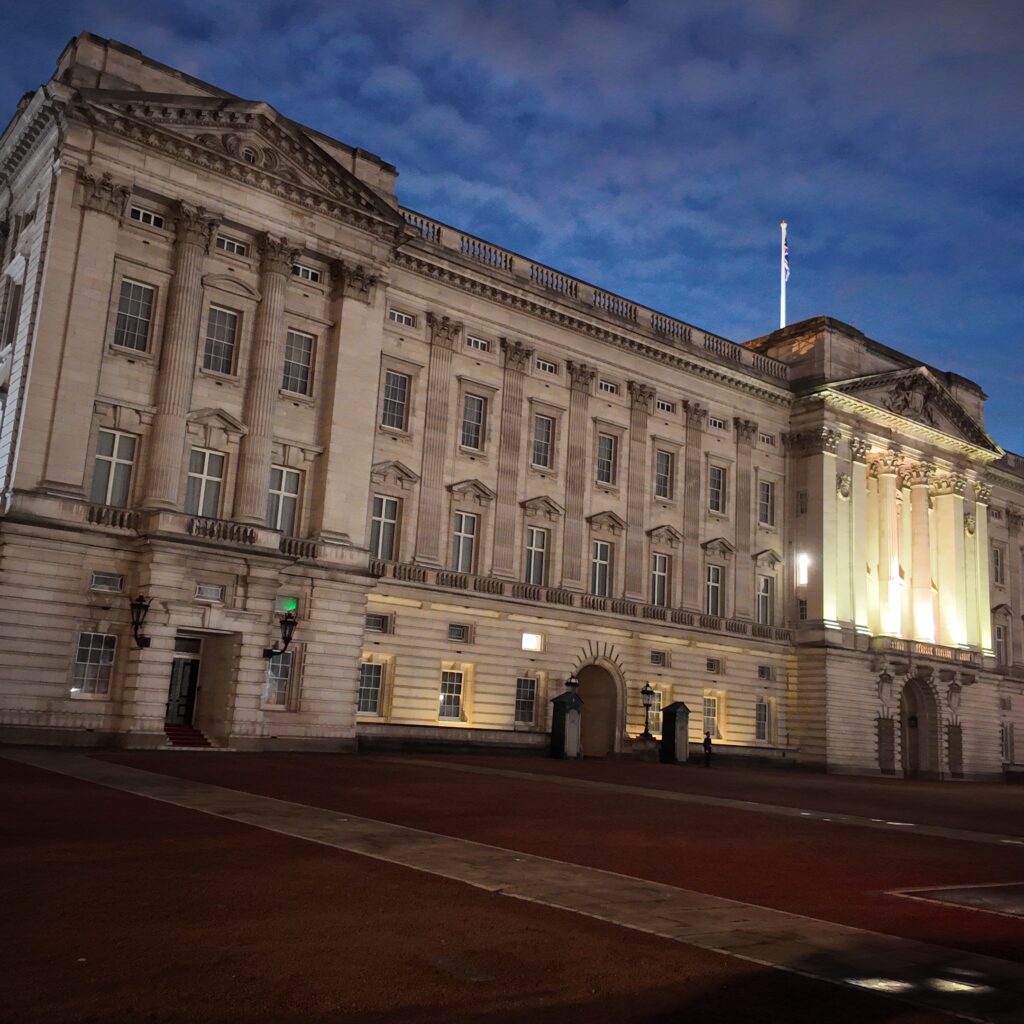
I keep my truck here as it is only $175 a year to insure and inexpensive to maintain. It is a 2003 F-150 I bought off the showroom floor, so I don’t want to let it go. Any major issues will be the end in the United States. My mechanic here is a tenth of the price, so it is a good place to try to keep it on the road. I only drive it around town, which should keep it going for a long time.

When I arrived, my landlord greeted me with a high five. It always feels so good to open that door, as it feels like home. 

I have everything I need here to live a simple life. Comfy bed, beer fridge, grill, office, and a 55″ TV all for $150 a month. 

I have zero issues keeping it empty most of the year. It is here when my AZ Airbnb is rented or when I want to just get away. 

I always have a couple of first stops to see local faces and grab some of my favorites when I come to town.

I had my favorite chicken enchiladas with green sauce (pollo enchiladas verde.

Yes - I demolished it all in one sitting!

Lower prices, oceanfront beers, playoff hockey, and everyone always has a great time!

2-for-1 wings! 👌

The most famous restaurant in Rocky Point is Pollo Lucas (Lucas Chicken).  It is a short ten-minute walk from my pad, and it is amazing.

You can order 1/4, 1/2, 3/4, or the whole chicken and eat it or take it to go.

Each order comes with onions and lettuce, with the awesome homemade salsa and tortillas.

I get the 1/4 chicken for 65 pesos, which is $2.50 for the best lunch ever! The half chicken is $120 Pesos, which can feed two people easily for $6 USD.  The whole chicken can feed larger families for about $12 with all the fixings!

Friday nights are surf and turn night at my local watering hole down the street.

The price cannot be beat, as that was $15 USD with a draft beer and hockey.

$150 a month rent easily explains why I have been renting here for over 7 years! Awesome setup!!

default

Naples, Italy – Pompeii Museum

Look for the cost, accommodation, and how to get there cheap at the bottom of this blog!

I am the first to admit that I knew very little about the history of Greece and Italy until my visit in the spring of 2025. Due to rain, I did not make it to the actual city, so this post will be dedicated to the Pompeii Museum in Naples, Italy.

From Wikipedia, the free encyclopedia. This article is about the ancient city of Pompeii. For the Classical Roman leader, see Pompey. For the Roman family, see Pompeia gens. For the Pacific Island, see Pohnpei.

Largely preserved under the ash, Pompeii offers a unique snapshot of Roman life, frozen at the moment it was buried, as well as insight into ancient urban planning. It was a wealthy town of 10,000 to 20,000 residents at the time it was destroyed. It hosted many fine public buildings and luxurious private houses with lavish decorations, furnishings, and artworks, which were the main attractions for early excavators; subsequent excavations have found hundreds of private homes and businesses reflecting various architectural styles and social classes, as well as numerous public buildings. Organic remains, including wooden objects and human bodies, were interred in the ash; their eventual decay allowed archaeologists to create molds of figures in their final moments of life. The numerous graffiti carved on outside walls and inside rooms provide a wealth of examples of the largely lost Vulgar Latin spoken colloquially at the time, contrasting with the formal language of classical writers.

Following its destruction, Pompeii remained largely undisturbed until its rediscovery in the late 16th century. Major excavations did not begin until the mid-18th century, which marked the emergence of modern archeology; initial efforts to unearth the city were haphazard or marred by looting, resulting in many items or sites being damaged or destroyed. By 1960, most of Pompeii had been uncovered but left in decay; further major excavations were banned or limited to targeted, prioritized areas. Since 2018, these efforts have led to discoveries in some previously unexplored areas of the city.

Pompeii is a UNESCO World Heritage Site, owing to its status as “the only archaeological site in the world that provides a complete picture of an ancient Roman city. 

It is among the most popular tourist attractions in Italy, with approximately 2.5 million visitors annually.

Pompeii was destroyed by the eruption of Mount Vesuvius on August 24, 79 CE. The volcanic debris covered the city, burying it beneath a blanket of ash and pumice.

Following its destruction, Pompeii remained largely undisturbed until its rediscovery in the late 16th century. Major excavations did not begin until the mid-18th century, which marked the emergence of modern archeology;[5] initial efforts to unearth the city were haphazard or marred by looting, resulting in many items or sites being damaged or destroyed.[6] By 1960, most of Pompeii had been uncovered but left in decay;[7] further major excavations were banned or limited to targeted, prioritized areas. 

Since 2018, these efforts have led to discoveries in some previously unexplored areas of the city.

Less than ten years ago, which is what made this museum so fascinating to me. Here is the entrance:

I must have taken over a hundred pictures and videos, as everywhere you looked was incredible. 

Here are some favorite pictures, a nd you can find all of the pictures here:

One of the most incredible things about Pompeii is that they are still discovering new things as they continue to roll back time, excavating the site.  

The ruins at Pompeii were first discovered late in the 16th century by the architect Domenico Fontana. Herculaneum was discovered in 1709, and systematic excavation began there in 1738. Work did not begin at Pompeii until 1748, and in 176,3 an inscription (“Rei publicae Pompeianorum”) was found that identified the site as Pompeii. The work at these towns in the mid-18th century marked the start of the modern science of archaeology.

Here is a recent article I found that explains they are still discovering ruins:

Archaeologists make a breakthrough as life-size sculptures are discovered in a Pompeii tomb

Archaeologists make a breakthrough as life-size sculptures are discovered in a Pompeii tomb

Visitors to the site of Pompeii, the ancient Roman town buried (and so preserved for thousands of years) by the eruption of Mount Vesuvius in 79 AD, don’t often think to look beyond the city walls. And it’s easy to understand why: there’s plenty on offer within this monumentally well-preserved town, from jewel-like wall paintings of myths and legends like Helen of Troy, to the majestic amphitheatre and sumptuously stuccoed baths.

But step outside the gates for a moment, and you’re in a very different – yet no less important – world.

For the ancient Romans, the roads and paths leading into and out of cities were crucial: not just for getting places, but as a very real kind of “memory lane”. Tombs lined these ancient byways – some simply bearing inscriptions to the memories of loved ones lost, others, more grand, accommodating space for friends and family to feast in remembrance of the dead.

Some of the tombs even address the passerby directly, as if their occupant could speak again, and pass on what they’ve learned. Take one Pompeian example, set up by the freedman Publius Vesonius Phileros, which opens with ineffable politeness: “Stranger, wait a while if it’s no trouble, and learn what not to do.”

Going into Pompeii, and leaving it, was about being reminded of ways of living and ways of dying – as well as an invitation to tip your hat to those who trod the path before you, and to learn from their example.

Click the link to read the entire article.

During my travels, I try to balance the cheap, thrifty and going for it while trying to remain on budget. It normally makes me feel like I missed out when leaving a new City/Country.

Rain or Shine, I will visit Pompeii as I missed out. I will share some sweet dance moves too! đŸ•ș

How to get to Italy, cheaply: I recommend flying Norse Airlines from Los Angeles to Rome for $220. You can get to Los Angeles cheaply from anywhere in Canada and the United States using Google Travel. Consider staying in LA a day or two, doubling up your vacation, and saving a ton of money.  It is a quick ~$13 train ride from Rome to Naples. Keep in mind that the high-speed train can be very expensive, so check out the milk run to see the countryside.

Where I stayed: Hopestel Secret Garden. It was a great hostel in a historic building in the city center.  I paid $28 euros / USD 30 a night, which is spectacular for Naples City center.  There are also studio rooms that can be rented for about $12,5, which is also a steal in the area.

The best local beer and meal: PIZZA!  It was a no-brainer since Napoli is where pizza was invented. I tried several different variations and washed it down with a local Ichnusa unfiltered brewski, which hit the spot every time.

Would I return? 100% YES! I missed the most important historical area due to rain, Pompeii.

plane3

Three months looking out windows!

I left Arizona on January 12th and didn’t return until April 7th, 2025, heading first to Vietnam and then bouncing across the globe. In order, I visited:

Vietnam → Cambodia → Thailand → London (twice) → Singapore → Greece → Turkey → Egypt → Italy → Spain

Eight of those ten countries were brand-new pins on my map, which made the whole thing feel even more unreal. 📍🌍

I spent the first three months slowly moving through Vietnam, Cambodia, and Thailand. After that, I flipped the switch and went full chaos mode with my all-you-can-fly pass—whizzing (Wizz Air style) through London, Singapore, Greece, Turkey, Egypt, Italy, and Spain.

Here’s the actual chain of planes, trains, ferries, and buses that somehow all worked:

✈ Phoenix → Los Angeles
✈ Los Angeles → Singapore
✈ Singapore → Saigon (HCMC)

🚆 Saigon → Nha Trang
🚆 Nha Trang → Huáșż
🚆 Huáșż → Da Nang
🚆 Da Nang → Hoi An
🚆 Da Nang → Saigon
🚱 Saigon → PhĂș Quốc
🚱 PhĂș Quốc → Saigon

🚌 Saigon → Phnom Penh
🚌 Phnom Penh → Siem Reap
🚌 Siem Reap → Angkor Wat

🚌 Angkor Wat → Bangkok
🚱 Bangkok → Koh Tao
🚱 Koh Tao → Koh Phangan
🚱 Koh Phangan → Koh Samui

🚱🚌 Koh Samui → Bangkok
✈ Bangkok → Singapore
✈ Singapore → Athens

✈ Athens → Istanbul
🚱 Istanbul → Princess Islands (day trip)
✈ Istanbul → London
✈ London → Sharm El Sheikh, Egypt
✈ Sharm El Sheikh → London
✈ London → Naples
🚆 Naples → Rome

✈ Rome → Madrid
🚆 Madrid → Barcelona
🚆 Barcelona → Madrid
✈ Madrid → Rome
✈ Rome → Los Angeles
✈ LAX → Phoenix

(That doesn’t even include all the local buses, metros, tuk-tuks, and 25+ ride share ((Grab/Uber/Bolt/InDrive)) rides along the way.)

Three months in Southeast Asia.
Then a rapid-fire lap through Europe, the Middle East, and North Africa.

It sounds insane written out like this—and honestly, it kind of was.

But that’s part of the fun.
And after traveling like this for three straight months


Sometimes all you can do is drop a blog and watch miserable people be jealous. 😄

This was, by far, the longest—and most expensive—trip of my life.

I blew through my budget. And once that happened, I made the call to keep going anyway, because I was already there. I ended up canceling my Eurail pass and coming home three weeks early to stop the financial bleeding.

At the time, I didn’t think I’d ever use my all-you-can-fly pass again, so I went into “see everything now” mode and stacked as many countries as I could. I still missed a few, which means there’s a pretty good chance I’ll give it one more run someday—especially since I’m not renewing the pass.

And here’s the truth:

I have zero regrets about spending money on travel.
Not at the end of this trip.
Not at the end of any trip.

What I do have is better awareness.

Travel is worth it.
The memories are worth it.
The experiences are worth it.

I just need to be smarter next time in Europe and use train travel—pace it better, plan a little tighter, and learn from the mistakes without losing the magic.

That’s not regret.
That’s learning and sharing.

pope

Rome, Italy – Second visit to Vatican City!

I spent the last day of my recent travels in Rome, a place I’d already explored before. I’d checked off most of the major tourist traps on earlier visits, but it still felt essential to revisit the Colosseum and Vatican City—some places deserve more than one look.

Ironically, I chose a Sunday, which meant the Vatican Museums and the Sistine Chapel were closed. Not ideal—or so I thought at the time.

Unbeknownst to me, I was about to get a much bigger—and completely unexpected—treat that day.

Below is a video I took earlier in the week, showing St. Peter’s Basilica from the outside, walking inside, and soaking in the atmosphere. Even without the museums open, this place never disappoints.

It was simply a good feeling knowing I was there on a day when Pope Francis was well enough to make a public appearance. With Holy Week approaching, it felt like an important moment—likely a quiet test of strength and endurance ahead of what is normally an incredibly demanding time.

Sadly, I later learned that he had to cut his speech short due to shortness of breath—and that this appearance would turn out to be his final public speaking engagement before his passing. Knowing that now adds a weight to the experience that I didn’t fully understand in the moment.

As I walked through Vatican City, the atmosphere felt different—solemn, but meaningful. A massive crowd was lined up to enter St. Peter’s Basilica, far larger than anything I’d seen earlier in the week.

It was one of those rare travel moments where you realize you weren’t just visiting a historic place—you were quietly present for a small but significant piece of history.

How to get to Italy (cheap)

If you’re coming from North America, I highly recommend flying Norse Atlantic Airways from Los Angeles to Rome for around $220 USD.

Getting to Los Angeles is easy and inexpensive from almost anywhere in Canada or the U.S. if you use Google Travel. Even better—consider staying in LA for a day or two. You essentially double your vacation while still saving a ton of money overall.


Where I stayed

I stayed at Freedom Traveler, which offered a single bed for €40 a night. Hotels in Rome can easily run $150+, so this was a no-brainer.

If dorms aren’t your thing, they also have private studio-style rooms for under $100, which is excellent value if you just want a quiet place to sleep. I stayed here twice—once before and once after my trip to Barcelona—and the staff were fantastic, always helping me get the best room available.


Best local meal & drink

Pizza. Obviously. 🍕

Rome is packed with corner spots selling freshly made pizza, and walking past them without stopping should honestly be illegal. While wine dominates in Italy (vino everywhere), I kept laughing because I’d walk into places with 10 taps, and every single one was wine. Beer lovers, adjust expectations accordingly.

My favorite pizza spot was just around the corner from Vatican City. I grabbed three slices (yes, all at once—you can see them stacked in the photo), and it was hands-down the best pizza I had in Italy.


Would I return?

To Rome specifically? Probably not.

Once I spent a full day at Vatican City and the Colosseum, I was ready to move on. I’d originally planned to stay a full week, but instead booked a last-minute trip to Barcelona to break things up.

That said, Italy absolutely deserves more time—just maybe not all in Rome. Cities like Venice, Sicily, Milan, Capri, and the Amalfi Coast are all worth visiting. One important lesson learned the hard way: book train tickets early. Last-minute fares were over $200, sometimes 5× the normal price, which is no different than flights.
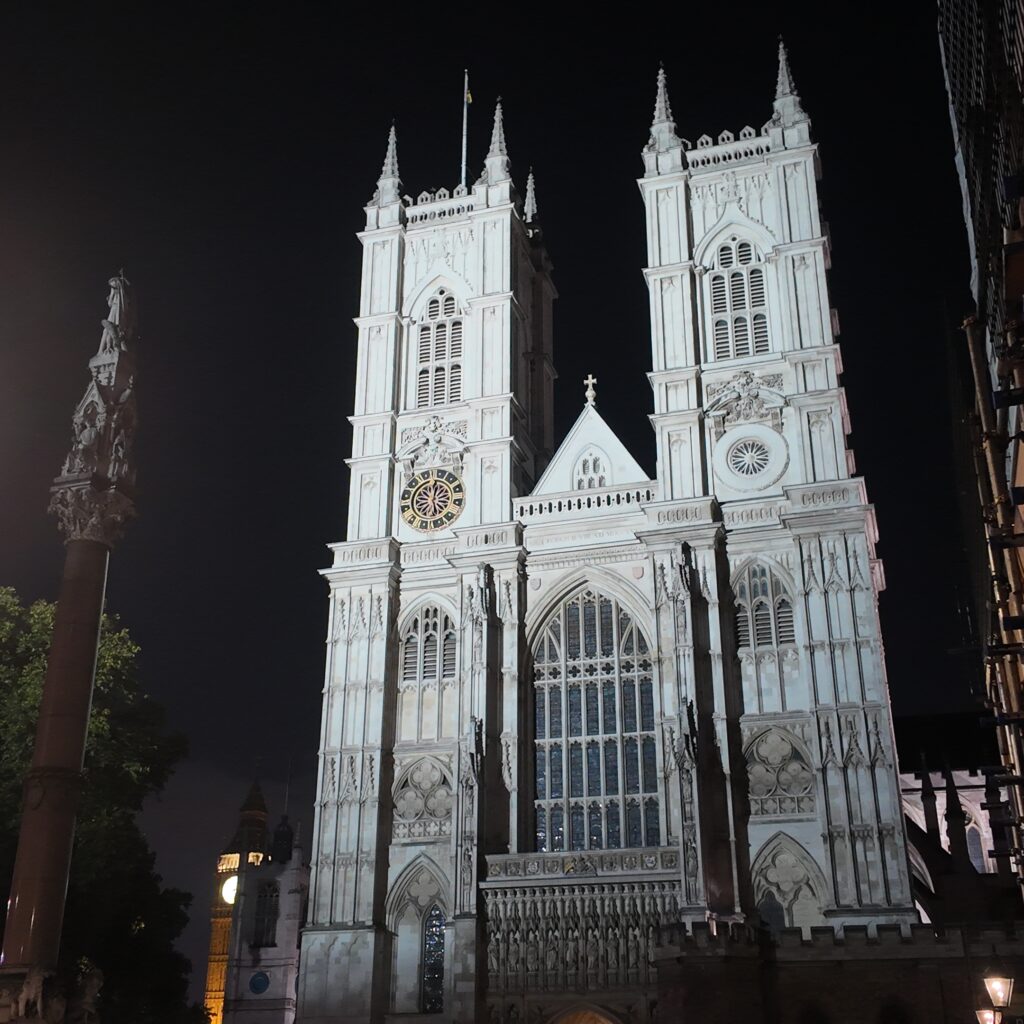
If you plan to stay within one country, trains are amazing—but procrastination is expensive.

spain

Real Madrid & Barcelona FC stadiums!

The first week of April 2025 was my last week on this adventure. I left on January 12th, and it was time to return home to Arizona. My Airbnb tenants were checking out, and I had a home to go back to, finally.

The plan was to hang around Italy since my flight left from Rome on April 7th. 

My first day, I toured the Colosseum, and the second day was the Vatican. I did not want to spend five more days in Rome, and the train to Venice was over $200 return.

I checked out my Wizz Pass to see if there was availability to depart and return within a 72-hour window. My choices were Gdansk, Poland, or Madrid, Spain. I honestly did consider Poland before I found the Madrid flight.  

Ultimately, I chose Madrid so I could also visit Barcelona with a quick train ride.

There is no better feeling than booking a last-minute flight for $10 on an all-you-can-fly pass!

One minute, I am in Italy and the next day flying to Spain, watching football locals in a Madrid pub!  It sure beats working for a living!!

I also like to think that I am responsible when traveling, but not this time. Once I arrived in Madrid, I was very hungry, so I went to find food. I thought there was food in the Irish pub, but only beer. 

I was going to find a hostel after the game as I stayed for the whole game, plus, whoopsie! 

GOOOOAAAALLLLLL!!! âšœđŸ„…

After the game, slight panic started as it was after midnight, dark, rainy, and in a City I had never been to in my life.  How is that for an adrenaline rush!  I reset and looked for food and nailed it!

I have honestly never had Tapa’s before, as it reminds me of the foos-fos that go for Dim Sum or Sushi.  Well, holy shit – I am foo fucking foo for this Tapa’s gig!!  Check this out!

Pushing 2 AM, still no hostel, but new friends!  We pigged out on so many items!

Since it was past midnight and check-in time, I set out on foot, in the rain and half in the bag, looking for a place to sleep.

** I have a string chain around my neck with two charms, a cross and a foot for adventure.  I was rubbing the cross this time, and it always works out!  ***

After knocking on door after door, I came to find out that the entire City center was sold out. 

Well SHIT!!  This is where I do my best thinking, WTF now dumbass?  Why not head to the train station, catch a high-speed train to Barcelona for $40?  Perfect recovery plan!!

I was able to get a couple of hours’ sleep on the train, even though it was going 300K/H.  I woke up in Barcelona (huge bucket list,) and I was able to find a great hostel in the city center for $30 a night.  After touring the city for a couple of days, I was off to find the biggest attraction, the Barcelona FC iconic Stadium, on my last day.

Ironically, the football stadium was closed for renovations.  I visited the amazing team store and do not think I have seen anything else like it in the world. It was massive:

I cannot wait to reference this memory when the new ultra-modern stadium opens. I can say, I sat in this pub pre-gaming months/years earlier, preparing for the grand opening. LOL

I had better luck when I got back to Madrid.  I was able to take the metro with fans to a Real Madrid game and experience gameday.  I was flying back to Rome that night, so I could not go to the game, but this was amazing enough without paying hundreds of dollars for tickets.

It was a match between Barcelona FC and Valencia, and here is a little pre-game action:

After waiting an hour walking around as fans entered the stadium, I needed to leave.  I was one of the few who headed the other direction on the metro as more fans arrived for the game.

It looks like I missed a great game which an exciting ending with the visiting team winning!

default

Spain – Madrid and Barcelona!

Spain and Portugal have always sat high on my European bucket list—mostly because they’re supposed to be two of the cheapest countries in Western Europe.
And yeah
 cheap is relative. Because from what I saw, they weren’t dramatically cheaper overall—just different flavors of expensive.

Still, when a deal shows up, you don’t argue with it.

I grabbed a last-minute return flight to Madrid using my all-you-can-fly pass on Wizz Air. No overthinking. No spreadsheets. Just click.

The schedule was aggressive:

Land in Madrid late Wednesday night

Fly back to Rome on Saturday night

Then turn around and fly home to Phoenix Monday morning

Was it enough time?
Absolutely not.

Was it still worth it?
Also yes.

That’s kind of the tradeoff when you chase cheap flights and flexibility—you don’t always get enough time, but you get access. A taste. A reason to come back. And sometimes that’s all a city owes you on the first visit.

Madrid wasn’t done with me.
I just ran out of runway.

As I blogged about in my Spain football blog, 

I managed to squeeze in both Madrid and Barcelona—along with their legendary football stadiums—by bouncing back and forth on Spain’s high-speed rail.

The train itself was unreal. I’ve taken the Channel Tunnel between London and Paris, but somehow this felt even faster. Smooth, quiet, no drama—and at times we were pushing nearly 300 km/h.

Blink and you’re in another city.
No airport security.
No wasted hours.
Just sit down, watch the countryside blur, and suddenly you’re somewhere else entirely.

Being able to visit Santiago BernabĂ©u Stadium and Camp Nou on the same short trip felt borderline unfair—in the best way.

Spain’s rail system alone is reason enough to come back and do it properly next time.

Fast trains, football temples, and not enough time—
a recurring theme of this trip.

One of the best parts was having real competition on the route. There were multiple high-speed rail companies to choose from—Renfe, iryo, and Ouigo—which kept prices refreshingly reasonable.

I paid $40 to go from Madrid to Barcelona, and $63 to head back on a Saturday night. For speeds pushing 300 km/h, that’s borderline absurd value.

Barcelona itself was instantly likable—especially the city center. Narrow, cobblestoned streets, tight corners, and that old-world layout that forces you to slow down and wander. It felt lived-in, textured, and human-scale in a way that makes getting lost part of the experience.

Fast trains, fair prices, and streets meant for wandering—
Spain quietly does this part very well.

I spent two days in Barcelona, which barely scratched the surface. If there’s one obvious advantage Barcelona has, it’s the location—you get the best of both worlds: a major city and the sea.

Being right on the Mediterranean Sea changes the whole feel of the place. I took a bus tour that covered roughly 30 miles of coastline, and even in the off-season it was impressive. Beaches, waterfront neighborhoods, long promenades—it just keeps going.
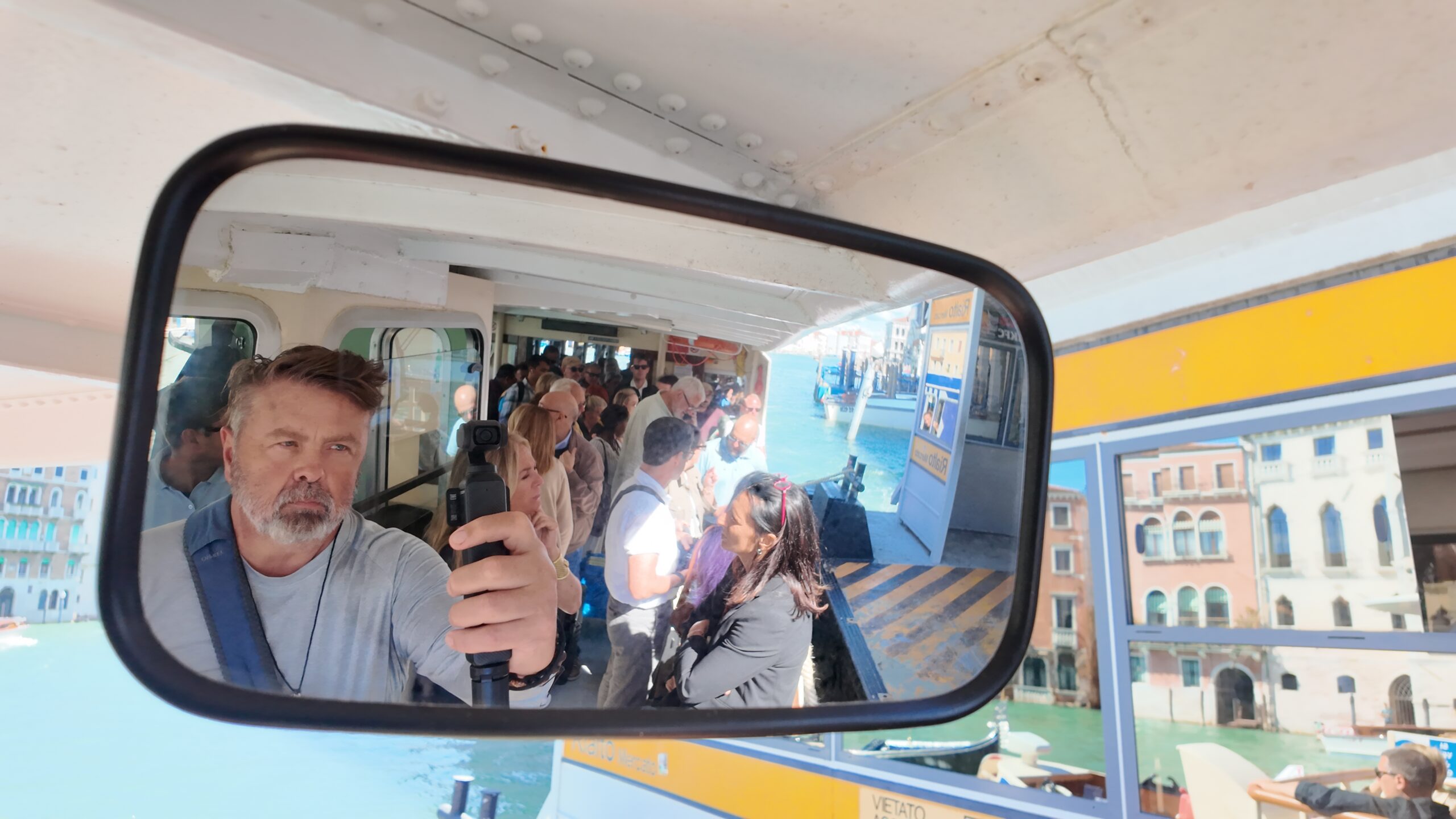
I couldn’t help but imagine how unreal it must be in the summertime, when the city fully leans into that coastal lifestyle. Barcelona feels like a place where you could slow down, stay longer, and let the city and the sea split your attention evenly.
Two days wasn’t enough.
But it was enough to know I’ll be back.

I spent most of the day just riding the metro around the city.

I only spent a few hours in Madrid before bolting to Barcelona, so I made sure I came back to Spain for a proper wrap-up.

I arrived back in Madrid on 04/04/25, checked into an excellent hostel, and booked just one night. One of the underrated perks of hostel life is flexibility—you can store your bags, grab a towel, and even shower later in the day. That worked perfectly since my flight didn’t leave Madrid until 9:00 PM on 04/05/25.

With limited time, I kept the list tight. There were only a few things I needed to see:

Santiago Bernabéu Stadium

Royal Palace of Madrid

Puerta de Alcalá (Madrid’s Arc de Triomphe)

No rushing.
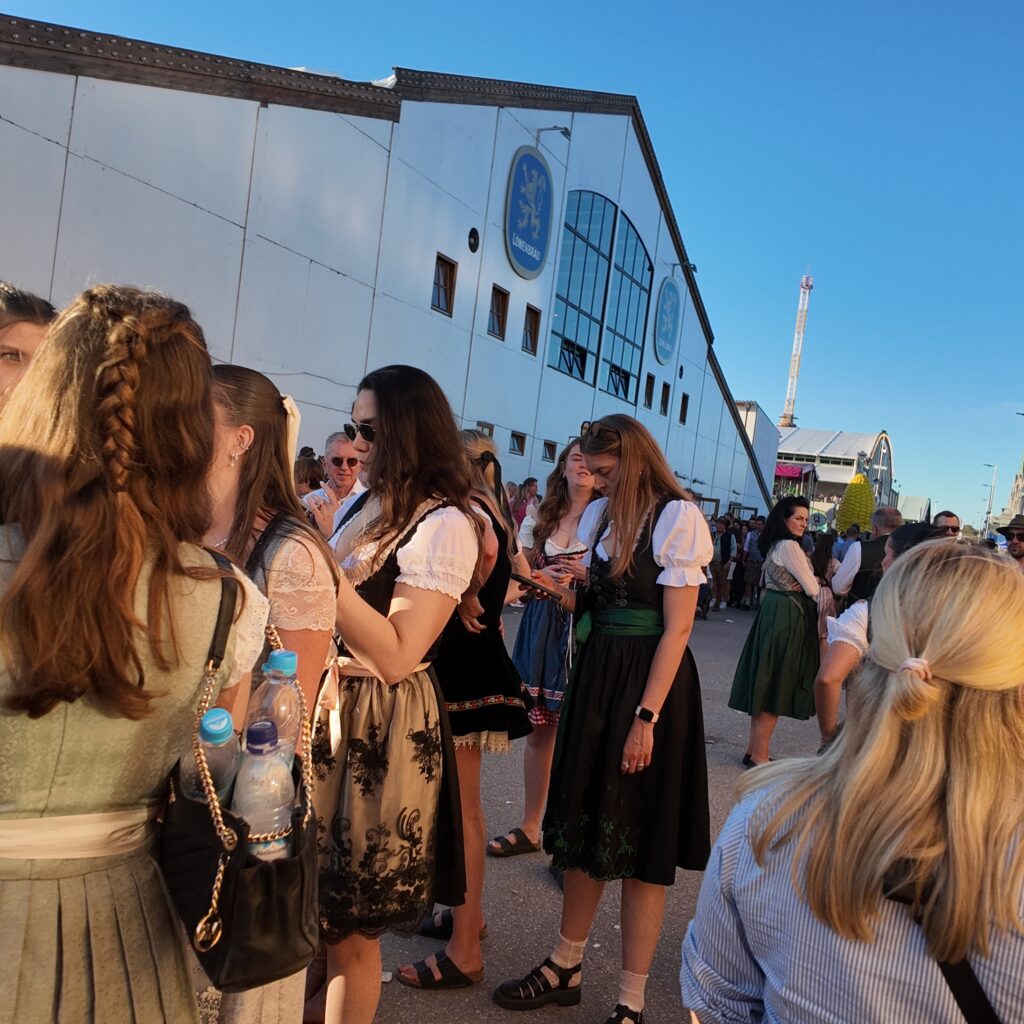
No overplanning.
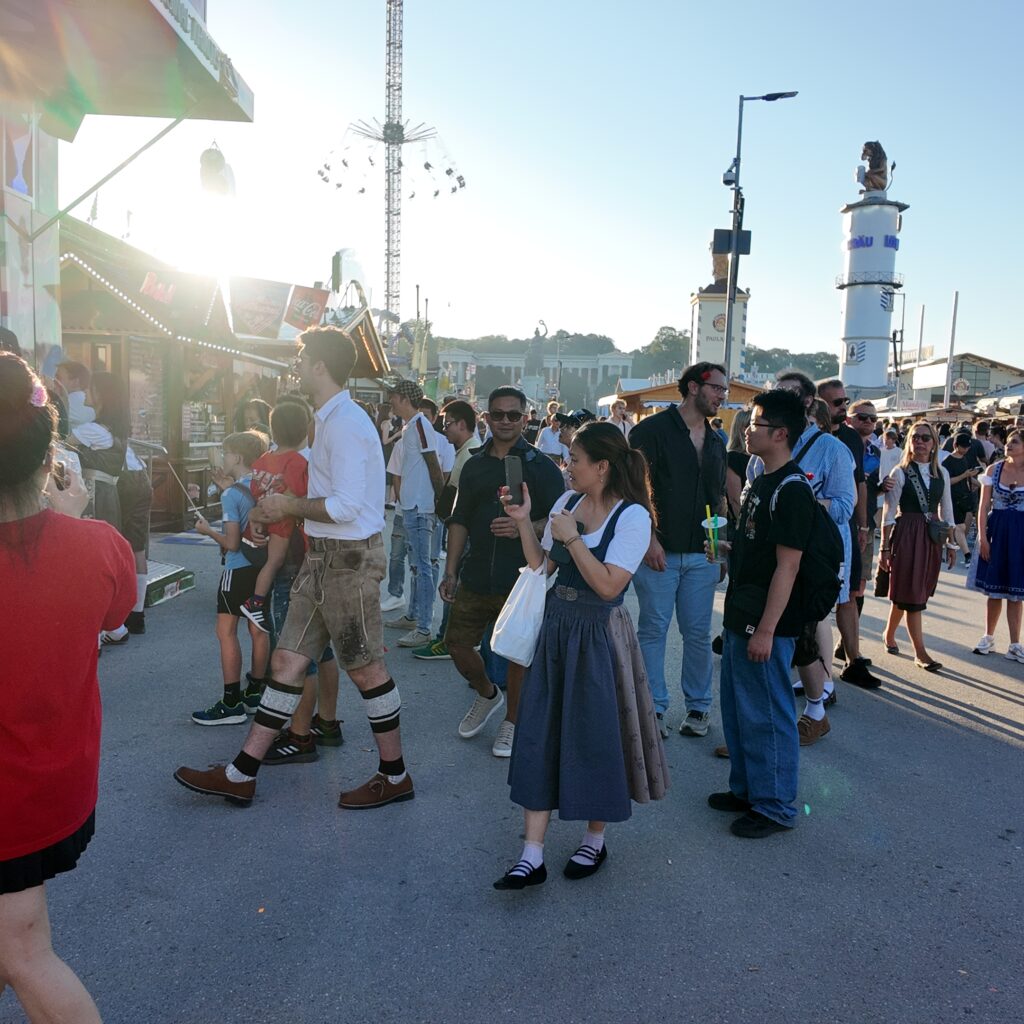
Just enough time to close the Spain chapter properly—exactly the way it deserved.

Real Madrid — pre-game vibes!

I caught the buzz outside Santiago Bernabéu Stadium as fans poured in and the energy started to build. Scarves out, chants warming up, that unmistakable match-day electricity in the air.

Unfortunately, I had to catch a flight back to Rome later that day, so I couldn’t stay for the match itself.

Still—soaking in the atmosphere was more than enough to remind me why football culture in Madrid hits differently.

FB_IMG_1436933494145

Naples and Rome – pizza everywhere!🍕

âŹ†ïžHigh School gym classâŹ†ïž


My first stop was Naples—or Napoli, as the locals correctly call it—the original, unapologetic version reminded me of High School gym class.

Fast-paced, intense, a little rough around the edges, and absolutely unforgettable history.

Home of the Pizza! 

The history of pizza began in antiquity, as various ancient cultures produced flatbreads with several toppings. Pizza today is an Italian dish with a flat dough-based base and toppings, with significant Italian roots in history.

A precursor of pizza was probably the focaccia, a flatbread known to the Romans as panis focacius, to which toppings were then added. Modern pizza evolved from similar flatbread dishes in Naples, Italy, between the 16th and mid-18th centuries.

The word pizza was first documented in 997 CE in Gaeta[4] and successively in different parts of central and southern Italy. Furthermore, the Etymological Dictionary of the Italian Language explains the word pizza as coming from dialectal pinza, ‘clamp’, as in modern Italian pinze, ‘pliers, pincers, tongs, forceps’. Their origin is from Latin pincere, ‘to pound, stamp’.

I had pizza every day that I was in Italy and even had a couple two a day!!

The below was one of my favorites near Vatican City. The Chef will make pizzas on massive sheets and then place them in the window for display.  Once you decide on a flavor or three, in my case, on this day, in the top left.  They take a pair of scissors, cut to your desired size and weight it for the amount. 


Below is fried pizza—basically a calzone that made better life choices and went into the fryer instead of the oven.

The second photo is my first meal after landing in Naples.
Stromboli is my favorite, so this one felt less like a meal and more like a reunion.

The rest?
Just random pizza stops along the way.
No plan.
No regrets for eating and not even being hungry!

Yummy!! 🍕😄

I definitely ate my share of pizza throughout Italy, especially Naples.

Every now and then I’d think, “Maybe I should order something else
”
And then immediately decide—
nope.

When you’re in the birthplace of pizza, branching out feels less like curiosity and more like betrayal.

You tell ’em, Boss!

DJI_20250402152318_0005_D

Rome – The Vatican & St Peter’s Basilica

When in Rome – visiting the Vatican and St. Peter’s Basilica was not an option! I needed to throw a few Hail Mary’s so not a better place to make some peace. We had a good talk, and we are good! 👌 The Vatican grounds were a short 15-minute metro ride from my hostel and easy to access.  It was amazing to think that I could hop on a metro train and be there in under 20 minutes.

I blogged about my second time visiting, but here are more details, pictures, and videos.

The train ride from my hostel to Vatican City was under 20 minutes:

Once you exit the Vatican station, there is a short walk to St Peter’s Square.

The Pope has been very sick and made his last appearance the week I was in Rome before passing away.

Pope Francis (born Jorge Mario Bergoglio, 17 December 1936 – 21 April 2025) was head of the Catholic Church and sovereign of the Vatican City State from 13 March 2013 until he death in 2025. He was the first Jesuit pope, the first Latin American, and the first born or raised outside Europe since the 8th-century Syrian pope Gregory III.

Born in Buenos Aires, Argentina, to a family of Italian origin, Bergoglio was inspired to join the Jesuits in 1958 after recovering from a severe illness. He was ordained a Catholic priest in 1969, and from 1973 to 1979, he was the Jesuit provincial superior in Argentina. He became the archbishop of Buenos Aires in 1998 and was created a cardinal in 2001 by Pope John Paul II. Following the resignation of Pope Benedict XVI, the 2013 papal conclave elected Bergoglio as pope on 13 March. He chose Francis as his papal name in honor of Saint Francis of Assisi.

Throughout his papacy, Francis was noted for his humility, emphasis on God’s mercy, international visibility, commitment to interreligious dialogue, and concern for the poor, migrants, and refugees. Francis believed the Catholic Church should demonstrate more inclusivity to LGBTQ people, and stated that although blessings of same-sex unions are not permitted, individuals in same-sex relationships can be blessed as long as the blessing is not given in a liturgical context.[2] Francis made women full members of dicasteries in the Roman Curia.[3][4] Francis convened the Synod on Synodality, which was described as the culmination of his papacy and the most important event in the Catholic Church since the Second Vatican Council.[4][5][6] Francis was known for having a less formal approach to the papacy than his predecessors by, for instance, choosing to reside in the Domus Sanctae Marthae guesthouse rather than in the papal apartments of the Apostolic Palace used by previous popes. In addition, due to both his Jesuit and Ignatian aesthetic, he was known for favoring simpler vestments devoid of ornamentation, including refusing the traditional papal mozzetta cape upon his election, choosing silver instead of gold for his piscatory ring, and keeping the same pectoral cross he had as cardinal.

Here are some additional pictures of my two days spent in Vatican City.

RIP Pope Francis (born Jorge Mario Bergoglio, 17 December 1936 – 21 April 2025)

DJI_20250403135623_0070_D

Italy train travel! Fast and faster!!

I am at the point in my travels where I was supposed to be using a Europass to travel Europe by train.  

I bailed on that plan a month ago after taking a 20-hour train trip up and down the Vietnam coast.  I realize that taking a train across Europe would be a lot nicer than Vietnam but sitting in coach would be the same back breaking experience.

Here was the plan, and I still feel good about my decision as it is time to go home:

I did get a chance to take a train from Naples to Rome, which was pretty awesome and had me second-guessing. The ten-day Europass was an amazing deal, but taking the train once scratched that itch for $13 USD.
It was not the highspeed train as that was $60 and would have been an hour a half instead of four hours.

Since I enjoyed my first train experience in Europe, I followed it up with another train trip later that week! 

This time, I took the smoking fast-speed train between Madrid and Barcelona, Spain.

The train almost hit 300KM/H (292KM hour was the highest I noticed as I fell in and out of sleep for the three-hour trip.)  Imagine a flight doing ~500KM/H is about an hour and a half, and the train doing ~300KM/H is about three hours.

Amazing!

I had taken the “Chunnel” from London to Paris in the past, but this was a great reminder of how fast train travel can be compared to flying. The line at the train station was a lot longer than most airports, as they do not have the same setup, which can delay travel.

Lucky for me, I am a dumbass and went to the wrong departure station.  Once I realized it, I took a 15-minute taxi to the correct station and cut to the front of the line with my sob or SOB story, so it took less than five minutes as opposed to over an hour. 

It was stressful, but it worked out perfectly as I did not sleep.  I landed in Madrid and took the subway to the City Center and there was a football game on, so I jumped into the fun without finding a hostel.
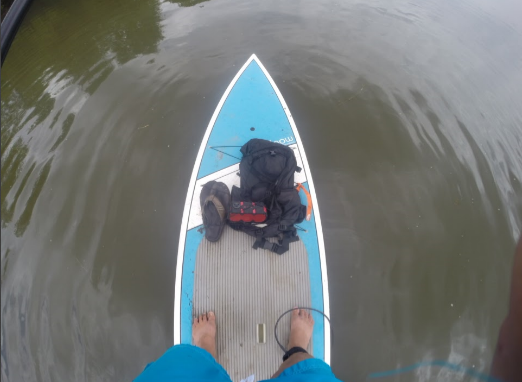
After the game, I grabbed some tapas and beer and quickly found out that the prices were $150 euros that night.  After a bit of panic, walking in the rain and soul searching my shitty situation, I headed to the wrong train station. It all worked out amazingly as always!  

Check out all those tapas and awesome local beer!

The closest I have ever experienced Tapas is when a Ukrainian whips up a meal with whatever is in the fridge, and it turns out to be a five-star meal.  Same idea, a little bit of everything and refilling your plate.

What an amazing sequence of events, which is why I love to travel so much!  

col2

Italy! The Colosseum experience!!

Below is the Colessem location about Rome and Italy in general.

The top can be zoomed in and out if you are curious!

I am not a big history guy, but Athens, Greece, and now Rome, Italy, had me caught up in the experience!

From Wikipedia, the free encyclopedia, for all of us, as it was so overwhelming:

The Colosseum ultimately derives from the Ancient Greek word “kolossos,” meaning a large statue or giant. It is an elliptical amphitheatre in the centre of Rome, Italy, just east of the Roman Forum. 

It is the largest ancient amphitheatre ever built, and is still the largest standing amphitheatre in the world, despite its age. Construction began under the Emperor Vespasian (r. 69–79 AD) and was completed in AD 80 under his successor and heir, Titus. 

Further modifications were made during the reign of Domitian (r. 81–96). The three emperors who were patrons of the work are known as the Flavian dynasty, and the amphitheatre was named the Flavian Amphitheatre (Latin: Amphitheatrum Flavium; Italian: Anfiteatro Flavio by later classicists and archaeologists for its association with their family name (Flavius).

The Colosseum is built of travertine limestone, tuff (volcanic rock), and brick-faced concrete. It could hold an estimated 50,000 to 80,000 spectators at various points in its history,[4][5] having an average audience of some 65,000; it was used for gladiatorial contests and public spectacles including animal hunts, executions, re-enactments of famous battles, dramas based on Roman mythology, and briefly mock sea battles.

The building ceased to be used for entertainment in the early medieval era. It was later reused for such purposes as housing, workshops, quarters for a religious order, a fortress, a quarry, and a Christian shrine.

Although substantially ruined by earthquakes and stone robbers taking spolia, the Colosseum is still a renowned symbol of Imperial Rome and was listed as one of the New 7 Wonders of the World. It is one of Rome’s most popular tourist attractions and has links to the Catholic Church, as each Good Friday, the Pope leads a torchlit “Way of the Cross” procession that starts in the area around the Colosseum. The Colosseum is depicted on the Italian version of the 5 euro cent coin.

It was about a 30-minute walk from my hostel to the Colosseum and the ancient ruins area.

I rarely pay to enter tourist traps, but this was another one that I could not miss out on. Here are some pictures and videos of the Colosseum inside and out.  It was so amazing to see, and unsure if these will help portray it properly

The area around the Colosseum, including the ruins, is an incredible experience.